After a few months of wear, our socks, ankle socks and wool socks sometimes start to pill, for a couple of reasons:
On our cotton socks and ankle socks, you may notice small pills where there’s friction, especially around the Achilles tendon. That’s because we’ve added a stronger polyamide yarn in these areas to hold off holes. The trade-off is that it hangs on to pills that would have come away more easily from 100% cotton fabric. In short, these little pills are an aesthetic sacrifice on the altar of durability.
You’ll also see pilling where our wool socks rub, because the tiny wool fibres tangle together and form pills. The good news: once you’ve de-pilled your wool socks, you’ll have got rid of most of those loose little fibres, so new pills will form more and more slowly. We go into this in more detail in this article.
If the pills don’t bother you (and at Loom, that’s pretty much our view), you can also just let them live their little pill lives: nobody will see them but you, and they don’t weaken your socks.
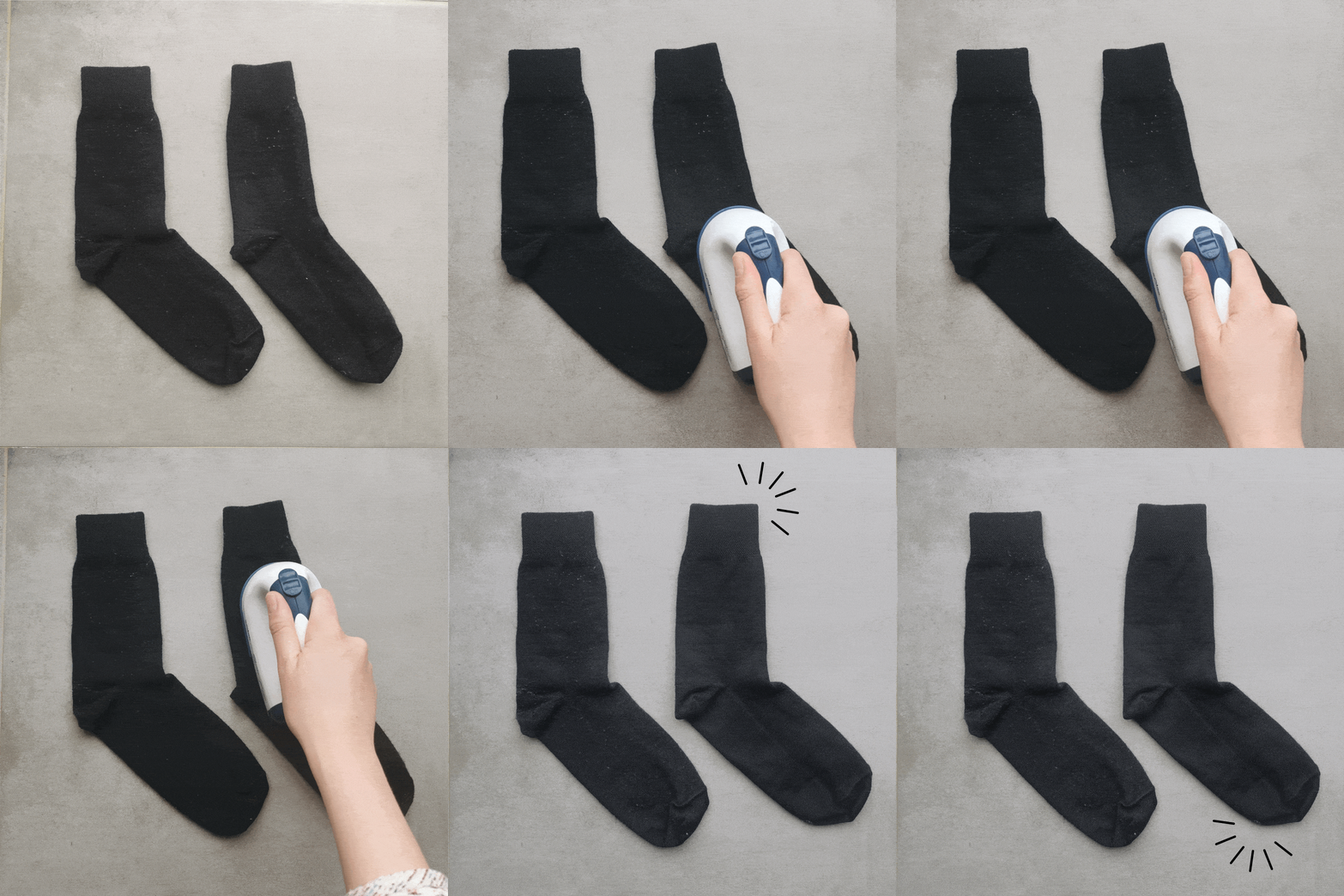
If they do bother you, you can easily remove them with an electric fabric shaver, like this one for €29 (sadly, it’s only sold on Amazon, which breaks our hearts a little) or this one, available from Darty (a French electronics retailer), where its price varies between €24 and €50 depending on the time of year. It won’t damage your socks and takes less than two minutes:
You know us by now: we never pass up the chance to show you a satisfying before-and-after:
Be careful not to press the shaver too hard against the fabric, especially on textured knits. The top of our socks, for example, is knitted in a “honeycomb” stitch, and its loops can get caught in the shaver if you press too hard. The blade could then cut through a strand of wool and make a hole.
Who am I to give you advice on caring for your clothes? My name is Claire and I’m in charge of production follow-up at Loom. Basically, I try to keep things from selling out on our site (OK, it’s not perfect yet, but I’m working on it) and I make sure, at every stage of manufacturing, that our clothes meet our quality standards. On top of that, I’m passionate about anything that helps clothes last longer: care, repairs and good old grandma’s tricks. I love giving clothes a little extra soul: reworking them, mending them, giving them another chance when nobody else wants them. On these pages, I’ll try to pass on anything I know that might come in handy. One last thing: I’ve genuinely tried every tip you’ll find on this site and checked for myself that it works (in other words, it isn’t just copied and pasted from the internet). If you have new ones to suggest, feel free to leave a comment below this article.
Back in 2016, Loom was just getting started and we wanted to create the shirt that wouldn’t have the problems of other shirts. And what people were telling us was that the number one reason they throw away a white shirt is stains. The solution seemed obvious. We had to make…
Click here to see how much fun we were having back then.
August 2017. BonneGueule, France’s go-to menswear website, publishes an article comparing shirts from different brands. Including our stain-proof shirt. And their verdict hurts:
Ouch.
Oof.
Ow.
Sniff.
Boo-hoo!
In short, our shirt really wasn’t great. And on top of that, we had made claims that were completely false.
Maybe you’re tempted to give us the benefit of the doubt, and you’re thinking BonneGueule got it wrong, or was particularly harsh with us? That’s very kind of you, but we had to face the facts: every one of their criticisms was justified.
Part 2: Back to the drawing board
A new manufacturer
The first thing we did was write to our shirt manufacturer: what do you mean, our buttons aren’t mother-of-pearl? What do you mean, our seams don’t have 7 stitches per centimetre?
That’s when we realised these “failings” were partly our own fault: we hadn’t been clear enough in our written requests.
So we changed the way we work with our factories: from then on, we would send a very specific document spelling out every detail of the garments we produce, a “tech pack”, as it’s called in the trade. And of course we changed this shirt’s page on our site, removing every unjustified promise.
An example of the document that tells our factories exactly what our clothes should look like. It’s called a “tech pack”.
But we also realised we weren’t the only ones at fault: a few weeks later, that same manufacturer delivered a batch of shirts with measurement errors all over the place. We then found out that production had been subcontracted to another factory, one we didn’t know.
Trust was broken, so we decided to stop working with them and go looking for a new partner. Several people we trust pointed us to Supercorte.
How do you know whether a factory does good work?
By looking at its client list: Supercorte mostly works with high-end, even luxury, brands.
By talking to them: this time, we felt we were speaking the same language when it came to quality.
By looking at what they produce: every prototype they made for us was flawless.
By looking at their prices: the shirts cost us a little more than before. Which makes sense: quality has a price.
Quality control
For a long time, we only checked the prototypes, not the garments coming out of our big production runs. Yet when you care about how long clothes last, sticking to the size chart, for instance, matters as much as the strength of a fabric: if a shirt is 2 cm too narrow at the shoulders, it’s unwearable. So we put a whole series of things in place to minimise the risk of “non-conformity”: tests, measurement checks… and hiring someone dedicated to exactly this.
No longer a public health hazard
Of all the hard-to-read criticisms in the article, the most worrying was the one about the fabric:
All of this suggests that this “stain-proof” fabric contained some pretty nasty chemical additives. To be fair, the fabric did comply with REACH, the EU chemicals regulation that any product made or sold in the European Union has to meet (a rule not everyone follows, Shein in particular, as this documentary showed).
And yet this fabric looks clean, doesn’t it?
But to be absolutely sure a fabric is harmless, we should have asked for the “OEKO-TEX” standard, which we now require for every one of our fabrics.
Digging into the subject, we realised that it’s best to avoid any treatment meant to give fabrics “superpowers”: they are often based on rather unpleasant chemical compounds, such as “PFCs”, which can contaminate the environment for centuries and whose effects on human health are still uncertain (the infamous endocrine disruptors…).
So we decided to stop producing this stain-proof shirt. And then we banned every treatment of this kind: “easy-iron” finishes on our shirts, “anti-odour” properties on our socks, “quick-dry” finishes on our swim shorts fabric… Is it worth risking your health to save three minutes of ironing?
Textile know-how
This BonneGueule article, along with feedback from our customers, shattered one of our beliefs: to make quality clothes, you cannot put blind trust in factories.
Factory workers do very hard and very valuable work, but they are far from knowing everything. In particular, unlike brands, they don’t necessarily know how clothes age. At Loom, we always ask our customers what they think of our clothes one year after buying them. So we know every potential weak point, and we often know better than the factories what to watch out for. On a t-shirt, for example, experience has taught us to pay very close attention to loss of shape. And if it’s a dark colour, we know we need to watch colour fastness, because sun and sweat can fade it.
In short, if we really want to improve the quality of our clothes, we have to understand the science behind garment quality: the technical expertise has to be on our side too.
And that’s what we work on every day now: reading studies and books, talking to the technical directors of factories and the quality managers of other brands, running our own tests…
We even have a thread on our internal messaging app where we write down EVERYTHING we learn.
Today, every time we learn something about garment quality, we try to cross-check our sources and not just cherry-pick the figures or facts that suit us. So much so that it has become one of our communication principles:
Point no. 7 of our editorial bible.
With this new way of working, we went back over everything we took for granted about shirts, point by point (“is it true that this detail makes it stronger?”). And that led us to make quite a few changes.
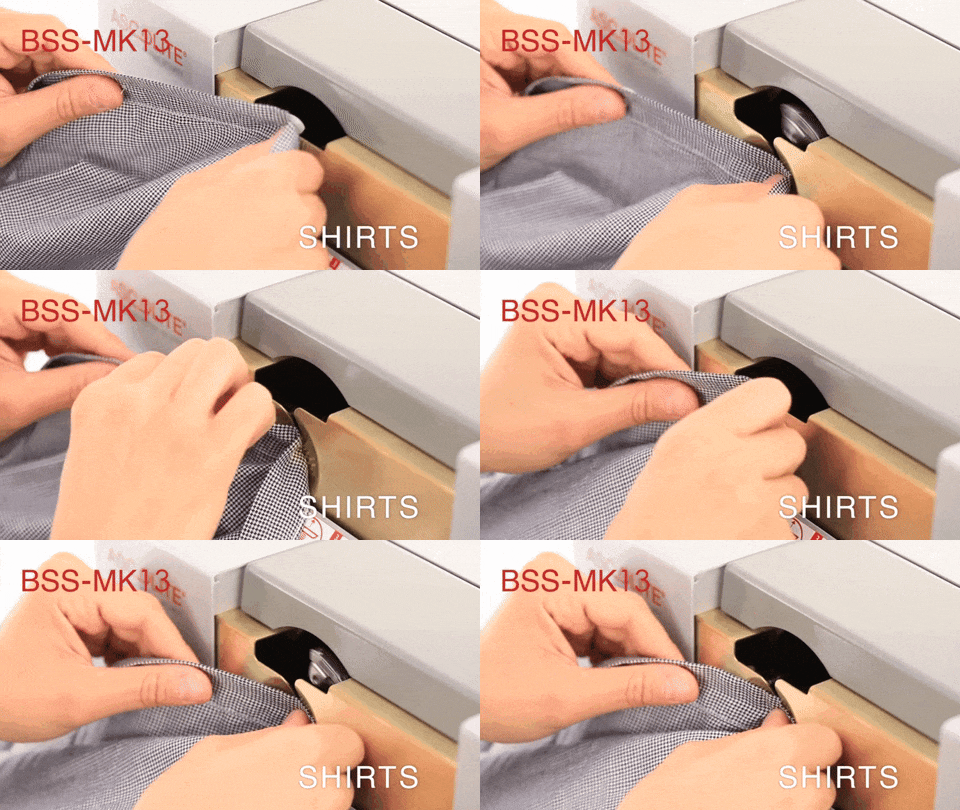
First, we decided not to use mother-of-pearl buttons: it’s true that the material is beautiful (which is why you find it on high-end shirts), but we found that these buttons can break in the washing machine. So we went for thick resin buttons that stand up better to washing. And we always reinforce how they are attached, using an Ascolite machine that wraps an extra heat-sealed thread around the shank of the button (see the machine in action here).
Next, we looked at side gussets (known in French as “hirondelles”, or swallows), those little triangles of fabric where the front and back of the shirt meet, which are supposed to make it stronger. We took a fast-fashion shirt with no gussets and pulled on each side as hard as we could: nothing gave. Another purely decorative detail rather than a real reinforcement, so we decided to drop them.
One swallow doesn’t make a summer. Or a sturdy shirt.
Finally, we gave up French seams and 7 stitches per cm: at one time these may well have improved durability, but today the most commonly used sewing threads (“polycotton”) are particularly strong, which makes this kind of detail superfluous. That doesn’t mean shirts with these seams are bad, just that they are an aesthetic choice, not a matter of strength.
Part 3: Redemption
At first, as you can imagine, reading that BonneGueule article knocked us back a bit.
But the article also did us good (that’s our masochistic side): it was one of the wake-up calls we needed to radically change the way we develop clothes. Stop working with unreliable factories, check the quality of our production runs more closely, question what everyone takes for granted, build up our textile knowledge… and finally, stop “over-promising”.
Because it’s normal not to manage to make flawless products. What we want to avoid is claiming that they are. And at the time, the superlatives we used for our products were pretentious… and false.
Oops, I did it again. I played with your heart, got lost in the game.
In fact, we were suffering from what the French blog Bon Pote calls “jaitoutcomprisme”, the I’ve-got-it-all-figured-out syndrome: when you first get interested in a field (garment quality, in our case), you often fall victim to overconfidence bias.
The I’ve-got-it-all-figured-out curve.
In our case, after a 2-hour chat with a factory director and 2 articles on cotton fibre length, we thought we had cracked the recipe for long-lasting clothes. Except that textile quality is an extremely complex subject, and we will never have it all figured out, even after a lifetime devoted to it.
Our very own I’ve-got-it-all-figured-out curve.
Back then, we promised “the best clothes on the market” and it worked: most people want to believe it, and it sold. But in the long run, we understood that it created a lot of disappointment: there is bound to be a t-shirt in your wardrobe that holds up as well as your Loom t-shirt, or even better.
So we gave up “over-promising”: these days, we try to be more measured and factual when we talk up our products. We even wrote this principle into our “editorial bible”:
Point no. 17 of our editorial bible.
And in the end, this ambition to make the best products on the market and to dominate no longer matches what we would like for the textile industry: we believe it needs an ecosystem of thousands of different small and medium-sized brands rather than a handful of multinationals lording it over the rest, as we wrote at the end of our article Coal in the cotton:
"Today, a handful of giant global brands are smothering everyone else with the race to the lowest price, and standardising the way the whole world dresses. Tomorrow, they could make way for thousands of brands that are more local, more thoughtful, more creative, and that create less misery and inequality.
Today, we spend our Saturday afternoons buying ever more clothes when our wardrobes are already overflowing, in shopping streets lined with the same shops over and over again, whether we are in Saint-Malo, Brive, Paris or Nancy. Tomorrow, we could rediscover the pleasure of buying thoughtfully. Of wearing clothes that are more beautiful and more durable. Of sewing a button back on (or having it done) instead of throwing away a shirt. Of discovering a shop we would never have seen anywhere else."
Almost 5 years have passed since that BonneGueule article was published. We have overhauled the way we make our shirts from top to bottom, and we think the work has paid off:
4.7 is a great score.
Today, we are rather proud of the Loom shirts we sell: they are sturdy, nicely cut, made locally, affordably priced, and our customers are happy with them.
But maybe in 2 years’ time, with all the textile knowledge we will have gathered, the new feedback from our customers and the latest innovations in the textile industry, we will reread this article and think we still knew nothing and were terribly naive.
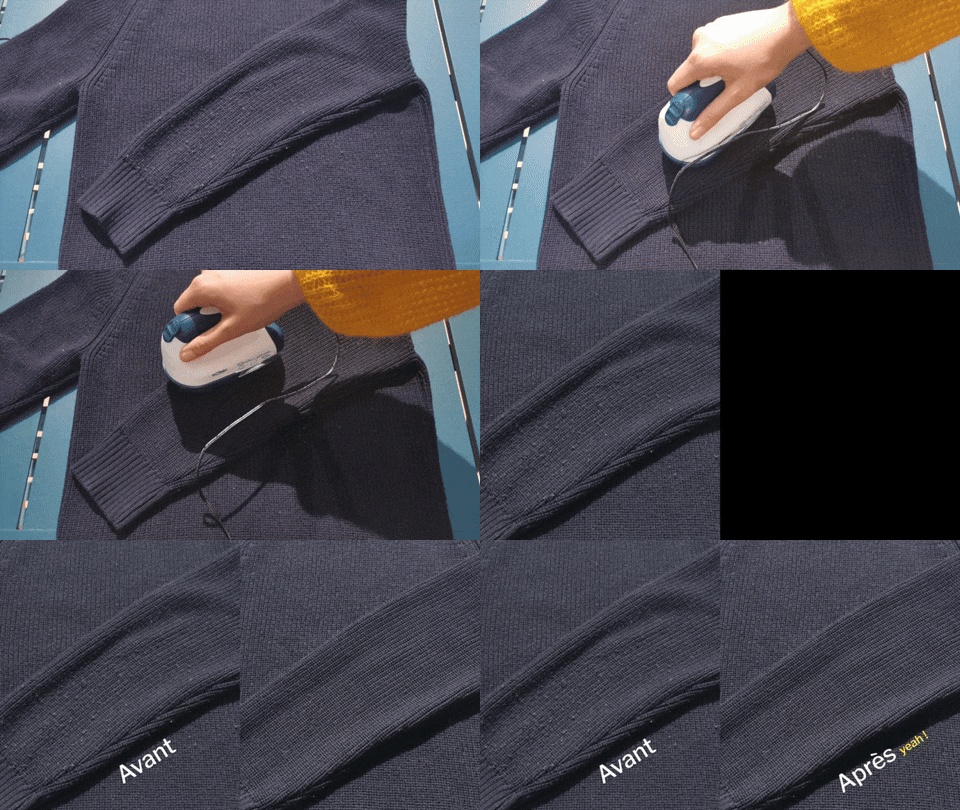
If you’ve ordered from us before, you might know that one year after your purchase, we send you an email to ask how your garment is holding up and, most importantly, if you’re still wearing it. Sometimes, you tell us you don’t wear your sweaters anymore because they’ve started to pill... and nothing saddens me more (except perhaps gargoyles or towel warmers) because with the right tools, you can remove pilling super easily. And that’s what I’m going to show you in this article.
Why does your sweater pill?
Pilling appears in areas subject to friction, such as under the arms, on the lower back (if you frequently carry a backpack), or on your collars (if you have a beard). The reason? Friction causes the tiny fibres protruding from the knit to tangle together, forming pills. Illustration:
This is the surface of your sweater, and the little lines sticking out are the fibres that will turn into pills.
The good news is that the more you remove the pills, the less they reappear. That’s right—de-pilling removes some of the tiny fibres that cause the pills to form in the first place. When there are no more fibres left, there’s no more pilling possible!
At Loom, to minimise pilling on our sweaters, we follow a two-step process:
We only select long-staple wool — because they have fewer protruding fibres.
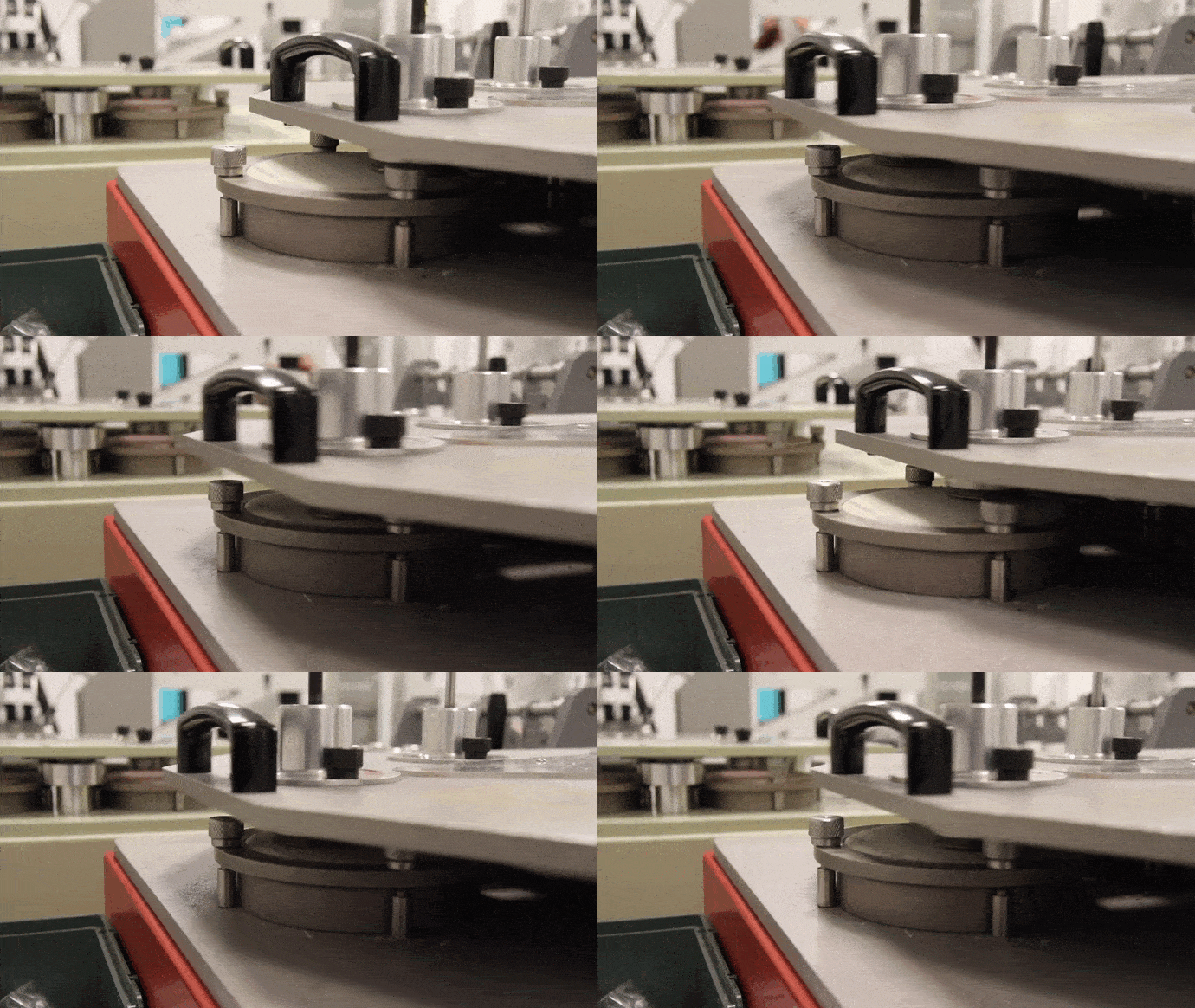
We test every selected wool in the lab (using the Martindale test) to see how it resists friction. This allows us to exclude those that pill too much.
The agony of the Martindale test — worse than a bout with Cylindric the German.
The real challenge then is finding the best balance between a fluffier wool that is soft but more prone to heavy pilling, and a coarser wool that pills very little but is less comfortable.
Testing de-pilling methods
A quick search online will reveal a bunch of tools for removing pills, from electric fabric shavers to specialised combs. But do all these methods actually work? And which one is the most effective? The most eco-friendly?
To answer our questions, we were lucky enough to meet Carole, a brilliant person who is always trying out all sorts of things, from studying recruitment biases to designing a quiz dedicated to puns. One of her projects is the "pilling project." She was tired of having to buy electric fabric shavers made in China to remove pills, so she decided to repurpose everyday objects to see what works best.
Carole’s test bench: 1 - lice comb, 2+3 - electric shavers and trimmers, 4 - abrasive side of a sponge, 5+9 - exfoliating gloves, 6+8+11+12+13+15 - electric fabric shavers, 7 - lint brush, 10 - rubber glove, 14 - disposable razor, 16 - sweater stone
She tested every object she thought might be relevant and rated them based on 6 criteria:
Does it actually remove the pills?
Does it damage the garment?
Is the de-pilling process quick?
Is the object durable, or do you have to buy a new one every 6 months?
Is it locally made?
Can it be used for other purposes?
Here are the most interesting results from her comparison:
Forget about sweater stones and lint brushes: tests showed that they are ineffective and damage the knit (perhaps they work better on wool fabrics like coats? We’ll test that one day). The same goes for disposable razors and abrasive sponges.
Lice comb or electric fabric shaver?
So, which is better? Actually, it depends on what you’re looking for.
For Carole, who is trying to own fewer things, the lice comb is her ideal solution: it’s small and multifunctional (unless you don’t have children at home, or you’re incredibly lucky that they’ve been spared by that playground scourge). Even though it takes a bit longer to use than an electric fabric shaver, she prefers it because it’s a "low-tech" tool. It’s a simple device that isn't likely to break after 10 minutes of use, consumes few resources, and isn't manufactured on the other side of the world in mega-factories that aren't necessarily concerned about people or the environment.
You can find them in any pharmacy. To remove pills using this method, simply comb your sweater while holding the comb parallel to the knit, and it will pull the pills off just like pesky nits.
As for me, since patience isn't my greatest virtue, my preferred solution is the electric fabric shaver. Granted, it’s neither a low-tech nor a multifunctional solution, but if you pay attention to certain details when choosing a good electric shaver (which I detail below), you’ll keep your device for many years without any issues.
The electric fabric shaver in action.
Be careful not to press the fabric shaver too hard against your garment, especially on textured knits. This is the case, for example, with the tops of our socks, which are knitted in a honeycomb pattern; the stitches can get caught in the shaver if you press too hard. The blade could then cut a thread and create a hole.
How to choose a good electric fabric shaver
If this article has inspired you to buy an electric fabric shaver, we recommend keeping the following points in mind:
No battery: opt for a corded model, as the batteries in these types of devices wear out too quickly. And make sure to choose one with a plug compatible with your region.
Customer reviews: not all electric shavers are created equal, so I recommend relying on customer reviews and choosing the device with the highest rating.
I am particularly satisfied with the Beautureal fabric shaver at €29; unfortunately, it is only available on Amazon, which we find disappointing, as well as the Solac fabric shaver, which can be found at Darty, where the price fluctuates between €24 and €50 depending on the time of year. On the other hand, I would advise against the Philips shaver , as its battery became extremely weak in less than two years. I cannot stress this enough: prioritise shavers that plug into a mains socket to extend the product's lifespan.
Unfortunately, there is no information available regarding the country of manufacture for the two electric fabric shavers we recommend (it is not indicated on the brand's website, the packaging, or the manual...). Since most other shavers come primarily from Asia, we assume the same is true for these two models. If you know of an electric fabric shaver made in Europe, let us know!
The Pilling Gang
If you have read this article to the end, you are now officially part of the pilling royalty. You will find that once you have the right tools, you will want to de-pill everything you can get your hands on: rugs, curtains, t-shirts, socks… Throwing away a product just because it is covered in pills will no longer be an option ;-)
Who am I to talk to you about garment care? My name is Claire and I am in charge of production monitoring at Loom. Basically, I try to avoid stock shortages on our site (well, it’s not perfect yet, but I’m working on it) and I ensure throughout the manufacturing stages that the clothes meet our quality requirements. Beyond that, I am passionate about everything that helps extend the lifespan of our clothes: maintenance, repairs, and other tried-and-true tips. I love adding a little extra soul to garments, reworking them, repairing them, and giving them a second chance when no one else wants them. On these pages, I will try to share what I know that might be useful to you. One last thing: I have personally tested all the tips you will find on this site to make sure they actually work (in other words, this isn't just a copy-paste job from internet searches). If you have any new ones to suggest, don't hesitate to leave a comment below this article.
I imagine that in December, many of us reminded Santa that we didn't need anything, and that if he really felt the urge to shop, we encouraged him to turn to second-hand sites. At the same time, several appliance brands (LG, Samsung, Asko) saw fit to tout the merits of their new drying cabinets. These are large, highly energy-intensive fridges (194 kWh/year* = 5% of the average electricity consumption of a French household) that promise to dry and de-wrinkle your clothes three at a time (and not one more) in an hour.
Can you feel that gentle breeze caressing your hair?
A few figures to truly grasp the absurdity of this product
De-wrinkling function of drying cabinets.
Drying function.
This drying cabinet therefore consumes 5 to 7 times more energy per garment than a standard appliance, depending on the function used (and that’s not even counting the embodied energy consumed during the manufacturing of these devices).
We could stop there and conclude that this device is absurd. Except that the brand LG is sowing doubt in our minds with this ad campaign where, with the help of guilt-tripping violins, we are told that this drying cabinet will allow us to keep our clothes longer, and thus pass on our old dinosaur sweatshirt to our grandchild. It is therefore legitimate to ask: why do we end up getting rid of our clothes? Is it because we didn't iron them enough?
That is highly unlikely, and we are in a good position to know.
For some time now at Loom, we have been contacting you a year after your purchase to ask what has become of your garment, and especially if you are still wearing it. Your answers help us improve our products and allow our future customers to wear their clothes even longer.
Of the 2,000 people who agreed to respond, 94% are still wearing their clothes a year after purchase. The remaining 6% have stopped wearing their garment for the following reasons (from most cited to least cited):
I don't like it: I should have returned it
Unsuitable for the season, but I will wear it soon
Came apart at the seams / broke
Too stretched out
Moth-eaten
I forgot I even owned this
The colors are dull
Disappeared from my closet
Stained
Pilling
The verdict is clear
None of our customers stop wearing their clothes just because they need ironing. After crunching the numbers, we’ve concluded that the promise of making your clothes last longer with this drying cabinet is a lie.
Rest assured: the LG Styler isn’t just an incredibly energy-hungry and useless drying cabinet; it’s also a mirror you can admire yourself in. Thanks, LG!
This example of a drying cabinet might seem trivial, but it’s actually anything but. It illustrates a technological race to the bottom, where we keep inventing more gadgets to solve problems that don’t even exist. These items, however, create very real environmental problems (raw material extraction, depletion of rare metals, transport, energy consumption leading to greenhouse gas emissions and global warming, the impossibility of repairing or recycling these products, and so on). Honestly, we’ve just crossed the fifth planetary boundary; we could really do without useless gadgets that only make the situation worse.
P.S. Taking good care of your clothes is actually quite simple and doesn’t cost €2,000. We explain how on this page to make your clothes last longer.
* Data provided by LG for the Styler S3MFC based on the following assumptions: average energy consumption per cycle: 0.38 kWh, 500 cycles per year on average.
Who am I to talk to you about garment care? My name is Claire and I am in charge of overseeing production at LoomBasically, I try to avoid stockouts on our site (it’s not perfect yet, but I’m working on it) and I ensure that our clothing meets our quality standards throughout every stage of production. Beyond that, I’m passionate about everything that helps extend the lifespan of our clothes: care, repairs, and other tried-and-true tips. I love adding a little extra soul to garments—reworking them, repairing them, and giving them a second chance when no one else wants them. On these pages, I’ll try to share what I know that might be useful to you. One last thing: I have personally tested every tip you’ll find on this site to make sure they actually work (in other words, this isn’t just a copy-paste job from internet searches). If you have any new ones to suggest, don’t hesitate to leave a comment below this article.
Like many people, we conscientiously drop off the clothes we no longer want in recycling bins, thinking they will be donated to those in need. But the French TV programme "Sur le Front", broadcast on France 5 on Sunday 19 December 2021, reveals that more than half of the clothes collected in these bins are sent to foreign countries, particularly in Africa, where they blight the lives of millions of people. In Ghana alone, with its 30 million inhabitants, 15 million items of clothing arrive every week, 40% of which end up piled in open-air landfills. These dumps are so overflowing that clothes spill into the sewers and end up piling up on the beach and in the ocean. What this documentary makes clear is that Africa has become the dumping ground for disposable fashion. This textile waste comes mainly from "fast fashion", which constantly offers us new clothes at very low prices. Because of this disposable fashion, we buy too much: on average, 42 items of clothing per year! We're not any better dressed for it – we just wear our clothes for a shorter time and throw them out sooner. We throw away so much that France can no longer manage these mountains of textiles and has to send them abroad. And that's not the only problem with fast fashion:
It accelerates global warming: manufacturing clothes emits greenhouse gases. Because it produces too much, the textile industry currently accounts for between 2% and 8% of global greenhouse gas emissions.
It exploits people all over the world: textile workers on the other side of the world are extremely poorly paid. Fast fashion is regularly involved in human tragedies, such as the exploitation of the Uyghurs.
It pollutes the countries that receive this textile waste, but also those that produce the clothes, such as Bangladesh, where toxic chemicals are dumped straight into rivers.
It destroys jobs in France: offshoring the textile industry has wiped out 300,000 jobs in France in 25 years.
It is unfair competition for French manufacturers: a textile worker in Bangladesh earns €80 a month, and in Ethiopia €23. How can French companies compete with such social dumping?
It threatens France's textile sorting industry: when it has to collect clothes that have no resale value in France, the whole economic model of textile sorting is put in serious danger.
Despite fashion brands' grand announcements, the volumes produced by the textile industry—and therefore the pollution—continue to rise. If nothing is done, fast fashion will keep growing, generating ever more waste, pollution, and misery. To stop sending our textile waste to Africa, we must develop the infrastructure to manage it locally, but above all, we must "turn off the tap" on disposable fashion, with laws! The En Mode Climat movement, which Loom is part of, is a collective of companies campaigning for laws that make the textile industry genuinely tackle climate change. This is why we are asking Barbara Pompili, Minister for the Ecological Transition, to take the following measures:
Adopt a bonus-malus system, similar to the one used in the automotive industry, of up to €5 for the worst garments. This eco-tax must penalise the most polluting practices and the brands that push overconsumption (a frantic stream of new collections, artificial discounts and rock-bottom prices).
Cap the number of fast fashion garments imported into France, as was the case until 2005.
Stop sending our waste to Africa and develop infrastructure and market outlets to process it locally, in France.
Fast fashion is good for no one: not for the planet, not for workers, not for jobs, and not for the people in the countries where we send our waste. Some brands and consumers are trying to change things, but their efforts will fall short without government action. Barbara Pompili can take steps to curb the growth of this destructive model. We have raised the alarm with her ministry several times, but so far we have failed to convince it to take strong action. Without real public mobilisation, fast fashion lobbyists will always manage to block laws that attempt to regulate it. But if thousands of us sign and share this appeal on social media, the media can pick it up and politicians will have to listen.
- Proportion of clothing sent abroad: Le Relais - Ghana figures: The OR Foundation - Textile greenhouse gas emissions: McKinsey, Quantis, WRI - Jobs lost: INSEE - Bangladesh wages: Éthique sur l'étiquette - Ethiopia wages: NYU Stern Center for Business and Human Rights - Economic balance of the sorting industry: FEDEREC
When a piece of equipment gets better, it also gets cheaper or easier to use, so we end up using even more of it.
And it works for loads of things:
Cars
Home heating
5G
Roads
High-speed trains
And of course, the textile industry is no exception. If we buy so many clothes today, it’s first and foremost because thousands of machines have replaced manual labour, which has drastically lowered the price of clothing. The faster the machines weave, the cheaper the fabric, and the more we buy. Back when wool was spun by hand on a spinning wheel, nobody was tempted to buy 10 t-shirts a year.
All these rebound effects have been described in plenty of scientific studies. The French energy and climate expert Jean-Marc Jancovici also summed up the problem beautifully in this sentence:
"In this whole debate, everyone confuses the energy per coffee maker with the total energy of all the coffee makers. What counts is the total energy of all the coffee makers."
And yet, to tackle the ecological crisis, all we work on is ever more efficient engines, ever more sophisticated technologies and ever better-insulated homes. Textiles are no different. To cut emissions from the manufacturing phase, one of the most authoritative reports on the subject (Fashion on Climate by the consulting firm McKinsey) explores only technological solutions, and never once looks at what pushes people to consume, even though that is the heart of the problem.
Make no mistake: chasing greater efficiency can be useful, but our priority has to be consuming less.
To sum up: the main question isn’t how to heat the hot water tank more efficiently…
The real question is how to shrink the tank.
Who are we to say that? You’re reading La Mode à l’Envers, a blog run by the clothing brand Loom. The textile industry is in a sorry state, and the planet is footing the bill. So whatever we manage to understand about this industry, we try to explain here. Because making clothes that last is good, but revealing, sharing and inspiring is even more powerful. We never advertise: if you like what we write and want more, subscribe to our newsletter by clicking here. We promise: we’ll write to you once a month at most.
It’s time to d-d-d-duel! Are you hopping with impatience too?
After reading our previous article on Gargouilles, several of you asked me, “Wait a minute, what about those other supposedly natural and eco-friendly detergents? Are they any good?”So, I tested several “alternative” and “natural” washing methods, and here are my results. But first, let’s meet the contenders:
IN THE RED CORNER… wood ash detergent!
Can you see where this extended metaphor is heading?
Not so long ago, people washed their clothes using wood ash because it naturally contains potash (a key ingredient in soap) and was considered an excellent stain remover.
Making laundry detergent from ash is very simple (provided you can get your hands on some ash):
Mix one part water with one part ash in a jar,
Let it steep for 2 days, stirring 3 times a day,
Strain the mixture through a cloth to keep only the liquid,
Done.
You’ll notice that after steeping for 2 days, the liquid becomes very viscous, with a texture similar to conventional laundry detergent. Your subconscious will likely tell you that if it has the same texture, it must work just as well… No spoilers – but it doesn’t.
Second contender: soap nuts
They were very trendy a few years ago and were touted as THE most eco-friendly solution for doing laundry. Since then, they’ve become quite hard to find, as if they were pulled from organic shop shelves to make room for laundry balls(which, let’s be clear, are useless)…
Soap nuts are the fruit of the Sapindus mukorossi, or “soapberry tree”, and contain a natural emulsifying and cleansing agent called saponin.
Washing your clothes with soap nuts is, once again, very simple:
Pop over to India and back to pick the fruit of a tree that never asked for any of this,
Place the nuts in a fabric pouch,
Put the pouch in your washing machine drum and run a 30°C cotton cycle,
Replace the nuts every 2 washes.
You’d be right to question my neutrality on soap nuts, I’ll grant you.
Final challenger: ivy laundry detergent
Like soap nuts, ivy contains saponin and can therefore also be used to make laundry detergent.
Pick and then rinse 10 young ivy leaves,
Boil the leaves in 20 cl of water for 15 minutes,
Turn off the heat and let the liquid steep for 2 days,
Strain your mixture through a cloth to keep only the liquid in a jar (the liquid will foam).
The opponents entering the ring.
Since my article on Gargouilles, I have slightly improved my testing protocol. Here is how I went about comparing these 3 detergents:
I cut 5 cloths, each 30 cm square, from a 100% cotton white sheet,
I stained each of these cloths with the 3 types of stain there are: greasy stains (olive oil), enzymatic stains (melted dark chocolate), and oxidisable stains (red wine). I made sure that each stain was the same weight and diameter on every cloth,
I'll let you guess who is who.
I waited 15 minutes and not a minute longer,
I washed my cloths in the machine on a standard 30°C cycle, using in turn: a dose of conventional detergent, a dose of tap water, a bag of 10 soap nuts, a dose of ivy-based detergent, and a dose of ash-based detergent.
I left the cloths to air-dry in the shade.
Based solely on the effectiveness of detergents at removing stains (1 = best, 5 = worst):
Conventional detergent ranks first, with the underdog—ivy detergent—not far behind, and soap nuts in third place. It’s a tough break for ash-based detergent, which comes in dead last, tied with plain water.
If we add other factors to the mix, such as price, origin, and ease of use and preparation (because my goal isn't to turn you into Caroline Ingalls from Little House on the Prairie, spending all day doing the laundry), the ranking becomes more objective in my opinion:
Ivy detergent then climbs to the top spot, tied with conventional detergent. Tap water moves up to third place, well ahead of ash-based detergent and soap nuts.
What can we take away from this action-packed bout?
I wouldn't have bet on it before looking into this, but my tests show that ivy detergent and soap nuts work better than washing without detergent, especially on certain types of stains: enzymatic stains like chocolate for ivy detergent, and oxidisable stains like red wine for soap nuts. That said, the effectiveness-only ranking and the overall ranking point to the same conclusion: good old conventional detergent, the kind you buy in the shop, is the most effective, despite its price and the fact that it doesn't grow in your garden (it is generally produced in France, though that isn't always indicated on the bottle).
In my view, just because something grows on a tree doesn't mean it should be canonised, especially if it comes from the depths of the Himalayas. Conversely, just because a product comes from a factory doesn't mean you should be wary of it, especially when you live in a country that regulates the use of chemicals, particularly those for domestic use. If your goal is truly to pour only biodegradable substances down your drains, remember that plain water cleans too, and it’s usually enough for lightly soiled everyday clothes.
P.S.: Why didn't I test soap flake detergent? The aim of this test was only to compare washing methods that grow ready-made in nature, so I didn’t include homemade soap-flake detergent in my line-up. Without having looked into it too much, I imagine this type of detergent must be quite effective, almost as effective as conventional detergents. My only doubt is how much it might clog up the pipes. Judging by how quickly my shower gets grimy when I use a bar of soap (and don't even get me started on cold-processed soaps...), I imagine it would be the same with a detergent made from soap flakes. If you have a more informed opinion than mine, feel free to write to me at hello@loom.fr, I'm all ears! P.P.S.: In French, "tâche" with a circumflex means "chore" or "task," while "tache" without one is a synonym for "stain." So don't work yourself to the bone (the "tâche") fighting stubborn stains (the "taches") with soap nuts. Use regular detergent instead... Good evening, fellow word lovers.
Who am I to talk to you about garment care? My name is Claire and I am in charge of monitoring production at Loom. Basically, I try to avoid stock shortages on our site (well, it's not perfect yet, but I'm working on it) and I make sure at every stage of manufacturing that the clothes meet our quality standards. On top of that, I’m passionate about everything that helps extend the lifespan of our clothes: care, repairs and other grandmother’s tricks. I love giving clothes a little extra soul: reworking them, repairing them and giving them a second chance when no one else wants them. On these pages, I will try to pass on what I know that might be useful to you. One last thing: I’ve genuinely tested every tip you’ll find on this site and checked for myself that they work (in other words, this isn’t a copy-paste of internet searches). If you have new ones to suggest, feel free to leave a comment below this article.
22 June 2017: Loom’s very first customers received a newsletter full of promises.
Yep, that’s our old logo, kids.
In 2017, we launched our first swim shorts and genuinely thought they would make waves on the swimming-pool scene (lol). After all, the fabric was made in France and water-repellent thanks to a “dryspeed” treatment, the inner mesh had a Teflon treatment to make it softer, and – the ultimate revolution – there was even a zipped side pocket for your keys. We could already see ourselves buying out Speedo.
A lesson in humility
But since we always ask buyers for their feedback a month after delivery (so they’ve had time to wear our products a few times), reality soon caught up with us. And – spoiler alert – they were far from finding these swim shorts as perfect as we’d announced.
Overall, it wasn’t a bad product (customers gave it 4 out of 5 on average), but there were still some pretty big things to fix:
About a dozen customers ended up with holes in the mesh (if that’s you and we haven’t made it up to you, email us at hello@loom.fr)
They didn’t dry all that quickly
The material was too stiff
The label was itchy
They were too tight around the thighs
Back to the drawing board
When we developed the second generation, what took us longest was figuring out why that ?!*$ mesh kept getting holes. It turned out the mesh itself wasn’t too fragile; the way it was sewn was the problem: the mesh was stitched directly into the waistband, and the topstitching weakened it. To prevent holes, it had to be attached to the waistband via a small strip of intermediate fabric.
How did our manufacturer make such a rookie mistake? Because they weren’t swimwear specialists.
So we went looking for a new factory that made nothing but swimwear. Easier said than done: all the ones people recommended were in Tunisia or Turkey (where a lot of the swimwear sold in France is made). Too far away for us. Things finally fell into place in 2020, when we found Be Simple in Portugal: a modest, family-run factory that showed us it could do good work.
In search of the right fabric
With swimwear, drying time is one of the things that matters most. But a water-repellent treatment was now out of the question: these are often based on PFCs, not-so-nice chemical compounds that can contaminate the environment for centuries.
And it looks like you agreed with us on that one.
So, to get swim shorts that dry quickly without any chemical treatment, we had to find a fabric light enough to dry “naturally”. We found just what we were looking for at Sofileta, a French mill: a fabric lighter than the one in our old swim shorts (120 g/m² instead of 140 g/m²) but still hard-wearing. We chose the recycled version: the polyester in these swim shorts is made in northern Italy from used plastic bottles. The same goes for the mesh.
Word of warning: recycled polyester is no answer to the textile industry’s environmental problems. Find out more here.
We had doubts about how well the recycled fabric would hold up, so we had its colourfastness tested in a lab, and the results reassured us: 5/5 for resistance to chlorinated water and 4/5 for UV. Nothing exceptional, though: all the other swimwear we tested scored roughly the same, from fast fashion to the very top end. In short, the dyeing is good quality, but that’s the market standard.
What about the other issues?
We also got to work on all the other problems our customers had flagged:
We reworked the cut so it doesn’t only suit slim thighs
We removed the itchy label at the back and replaced it with a tone-on-tone embroidered logo on the thigh
We chose a fairly thin drawstring so it dries quickly (because the fabric is often dry while the waistband stays wet, thanks to an overly thick drawstring)
We took the zip off the side pocket, where it was a bit rough on your hands, and put it on the back pocket instead, so your keys stay safe
We added two small embroidered eyelets at the back of the shorts to let air escape when you dive
And here’s the 2nd generation of our swim shorts.
The saggy elastic problem
When we asked you why you end up throwing your swimwear away, many of you told us the waistband elastic had completely lost its stretch.
This can be caused by heat (from the sun or a tumble dryer), but also by a chemical reaction that happens in the swimming pool: chlorine doesn’t just kill bacteria, it also eats away at elastane.
The good news: there are two really simple things you can do to stop your waistband from growing three sizes:
ALWAYS rinse your swimwear in clean water after swimming
NEVER put your swimwear in the tumble dryer
These tips apply to all your swimwear. Follow them, and even the cheapest pair of swim shorts will last for years.
No, these swim shorts aren’t perfect
We’re not promising that these swim shorts will be perfect: some people will find them too loose, others too tight; some will find them too shiny, others will think they don’t dry fast enough, and so on. In fact, we regret all that talk of perfection a few years back: there’s no such thing as a perfect garment. The more we learn about textiles, the more we realise that no garment will ever please everyone. And whatever we do, no garment will ever last forever. Above all, we’ve come to understand that over-promising pushes you to buy things you don’t necessarily need, and that’s the worst thing we can do for the planet.
We’ve simply made swim shorts that should, as far as we can tell, be fairly hard-wearing and well cut, made locally in France and Portugal, and that ought to do the job. But honestly, if you already have a pair, move along: wear yours for as long as you can. And rinse them well after swimming ;) If one day they really are past wearing, ours will still be here.
Who are we to say that? You’re reading La Mode à l’Envers, a blog run by the clothing brand Loom. The textile industry is in a sorry state, and the planet is footing the bill. So whatever we manage to understand about this industry, we try to explain here. Because making clothes that last is good, but revealing, sharing and inspiring is even more powerful. If you like what we write and want more, subscribe to our newsletter by clicking here. We promise: we write rarely and we never spam.
Spy pixels: why we’ve decided to stop keeping tabs on you at Loom
published on
September 4, 2026
Updated on
September 14, 2026
Reading time
3
minutes
Leave a comment
comments
This article was originally written in French, our native language. Apologies in advance if anything reads a little awkwardly – you can write to us at hello@loom.fr to help us improve our translations.
We’ve switched off individual email open tracking via tracking pixel – here’s why.
Over the past few weeks, you’ve probably received a whole bunch of newsletters telling you about their « tracking pixel », with a button to opt out (that’s because the CNIL has just said that these pixels are just like browser cookies: you have to be told they’re being used and asked for your consent).
But what exactly is a tracking pixel? It’s a tiny, blank, transparent image (one pixel wide by one pixel high). Every time you open an email, this little snitch reports it back to the sender (along with the time and the device you’re on). Hence the nickname « spy pixel ».
The code behind a tracking pixel
Why do brands use them? To do all sorts of things:
If you only open emails on one topic, from then on you only get that topic (fair enough)
If you open often, you get labelled an « engaged reader » and receive even more emails (hmm, more annoying)
If you didn’t open it, the same email is sent to you again a few days later with a different subject line (not cool)
If you stop opening anything at all, the brand exports your email address to Insta, Google and YouTube to find your profile and target you with ads on those platforms (not cool at all).
At Loom, though, we do none of that: no automatic follow-ups, no segmentation based on what you open (we wouldn’t know how anyway, and we can’t be bothered to learn), no exporting your address to Instagram to show you ads (because we don’t advertise). In fact, since we refuse to push people into buying more, we don’t really need any of those features.
So we’ve switched off individual email open tracking via tracking pixel. In other words, we no longer know who opens our emails, or when. YEYEYEYE FREEDOM!
It also means we’ll no longer measure the « open rate » of our newsletters. To tell whether what we write is any good, we still have other indicators, like the unsubscribe rate… or your replies (which are always welcome): when a newsletter is rubbish, we find out very quickly ;-)
The Commission nationale de l'informatique et des libertés, France’s data protection authority, whose job is to make sure that information technology harms neither human identity, nor human rights, nor privacy, nor individual or public freedoms.
We do still keep one piece of information that we need and that the CNIL allows us to keep without your consent: the date you last opened one of our emails (not the time, not how many times, not the content… just a date, overwritten every time you read a new one). We use it for one thing only: taking you off our list if you haven’t opened our emails in a long time, so that Gmail or Outlook don’t end up flagging Loom as spam.
Lorem ipsum dolor sit amet, consectetur adipiscing elit, sed do eiusmod tempor incididunt ut labore et dolore magna aliqua. Ut enim ad minim veniam, quis nostrud exercitation ullamco laboris nisi ut aliquip ex ea commodo consequat. Duis aute irure dolor in reprehenderit in voluptate velit esse cillum dolore eu fugiat nulla pariatur.


.gif)






.jpg)




.jpg)
.jpg)