Golfer’s syndrome: how we fixed the problem of shorts that fade
Golfer’s syndrome: how we fixed the problem of shorts that fade
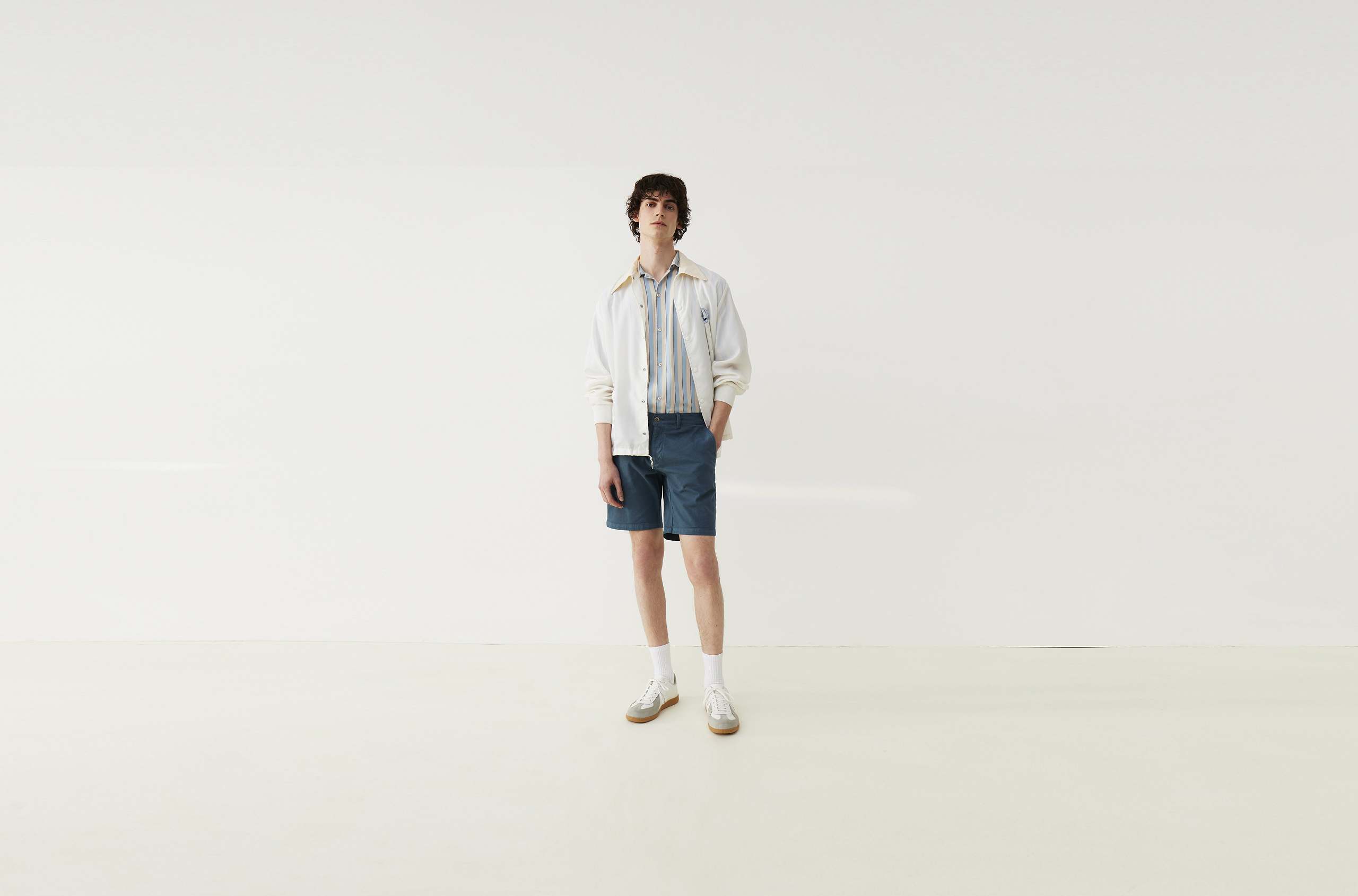

In this article, we’ll let you in on the secrets of making a pair of shorts that lasts. If you’re thinking “Well, you just do it like a pair of hard-wearing trousers, but with the legs cut off”, well, that’s exactly how we started out… and we ended up with dozens of pairs that had completely faded after their first summer, all because of that wretched “golfer’s syndrome”.
Our first shorts were a disaster
In June 2021, we released our first pair of shorts (or bermudas, much the same thing). Hard-wearing fabric made in France, double stitching at the crotch, reinforced waistband, a “jeans-style” button that won’t come loose, pre-washing to prevent shrinkage, roll dyeing for better colour retention, colourfastness tests in the wash... In short, we applied more or less the same recipe as for our trousers, and we thought we had every ingredient needed to make shorts that would last for years.
But barely a month after launching them, we got our first complaint:
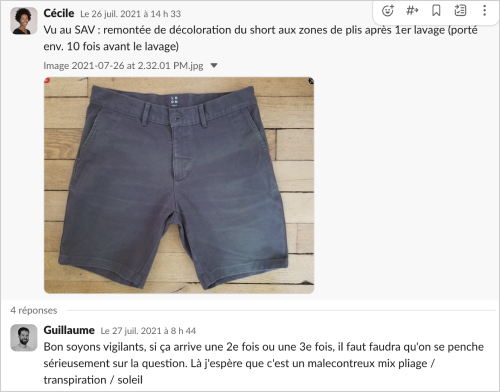
One complaint isn’t a big deal: it might just be an isolated case. Except that…
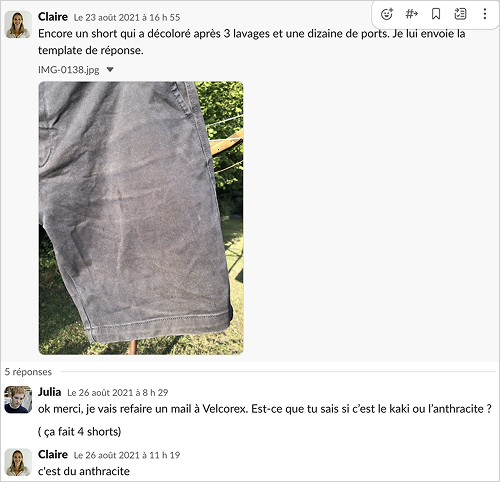
Not only were the shorts fading badly, they were also shifting colour! The charcoal grey, for instance, was turning reddish… By the sixth case, we started to panic and triggered our emergency procedure: we pulled the shorts from sale and commissioned laboratory tests to find the source of the problem.
Our hypothesis was that this fading came from the combined effect of UV rays and sweat – rather as if our shorts were getting badly sunburnt. So we ordered a test in which our fabrics were exposed to UV rays for 32 hours while soaking in sweat baths (not real sweat, don’t worry). And the results hurt:
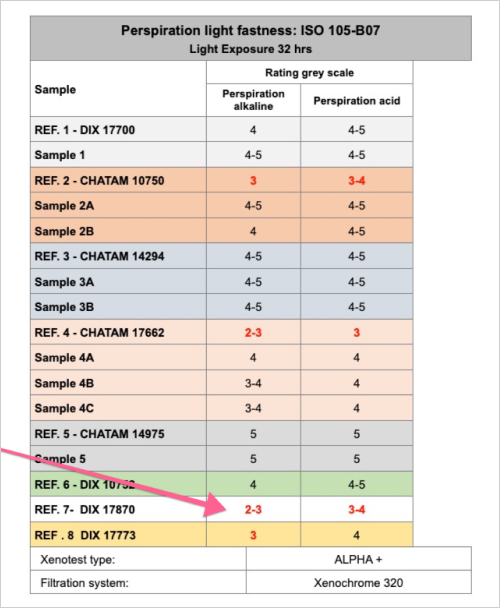
Translation: our shorts really do have a serious fading problem when UV rays and sweat are combined, especially with so-called “alkaline” sweat (meaning sweat with a high pH).
Our shorts were in fact victims of what dyers call “golfer’s syndrome”: the collars of golfers’ polo shirts (they spend dozens of hours in the sun with sweat around their necks) tend to shift colour under the combined effect of UV rays and sweat.
For us, this was a disaster: we had sold hundreds of shorts that were going to fade badly.
So we decided to organise a full product recall, rather like car manufacturers do when they discover a problem with the brakes or the airbags.
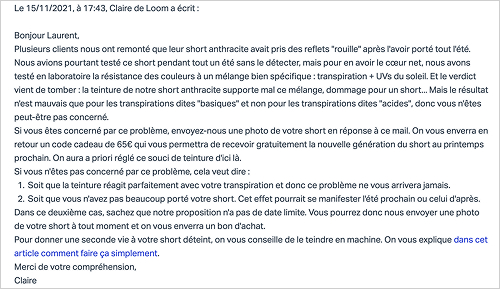
And the replies came in fast:
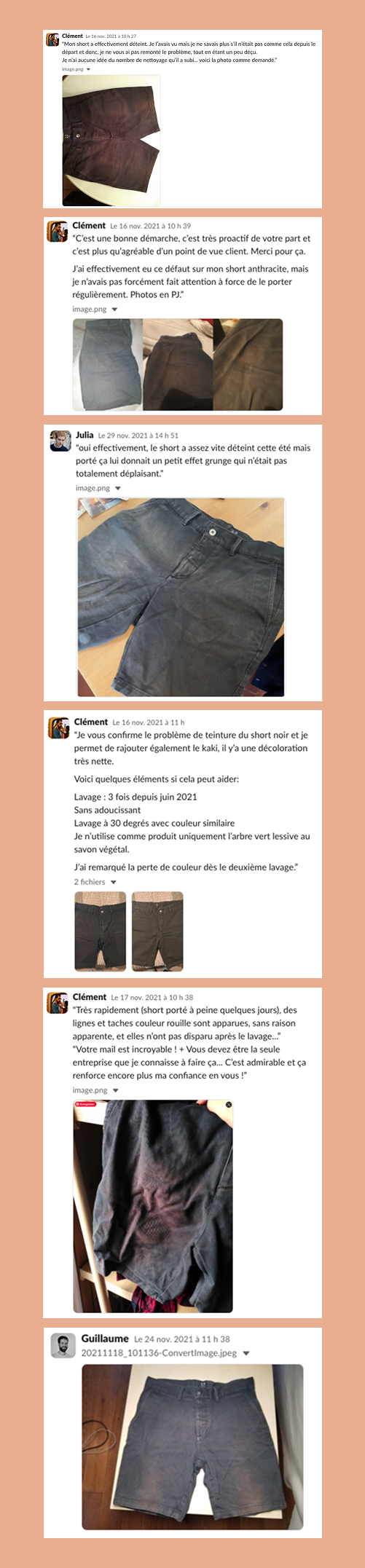
Over the following months, we worked with our factory to develop a dye recipe for shorts that would hold better. They improved it a little, but not enough. We had hit a wall: even after countless attempts, we couldn’t produce a dye that fully escaped UV fading. Time to go back to the drawing board.
The answer wasn’t a different dye, it was a different dyeing machine
At this point, one thing kept puzzling us: we had already made plenty of clothes that get exposed to sun and sweat… without ever running into fading like this. Starting with our t-shirts. So why now?
Our hypothesis: the fading actually came from the machines used to dye the shorts, which aren’t the same as the ones used for t-shirts.
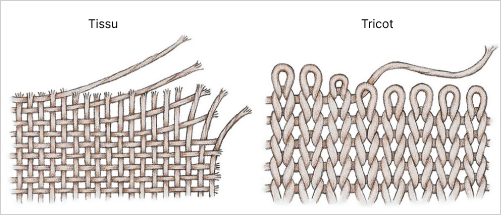
Here’s the thing: our t-shirt is knitted (to give it stretch), whereas our shorts are made from a woven fabric (to give them rigidity instead).
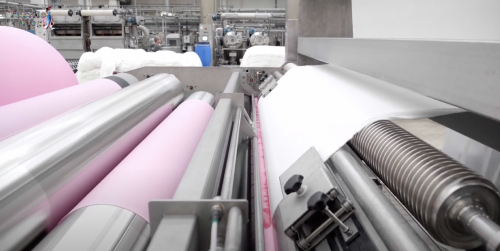
Because woven fabrics are fairly rigid, they can be dyed in so-called “continuous” machines: a system of rollers pulls them through a dye bath before they are wrung out and dried. It’s a fast, inexpensive process, with the advantage of using relatively little water and energy.
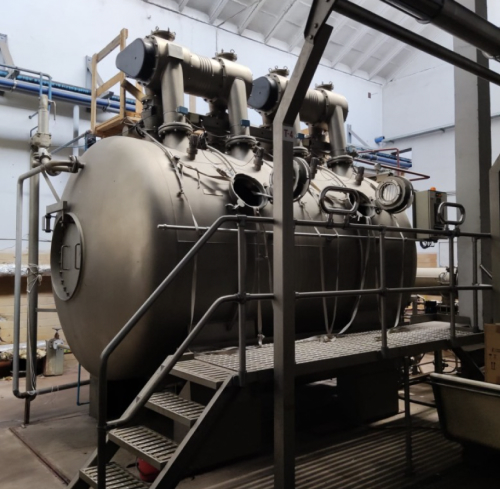
These machines can’t be used for knitted fabrics, though: they stretch more and would risk being pulled out of shape by the tension between the rollers. Instead, they are tumbled for several hours in an autoclave: a sort of large pressurised washing machine running at over 100°C.
Since the colours of our t-shirts hold up very well against UV rays and sweat, we wondered whether the secret lay precisely in that hours-long hot bath at high temperature and high pressure. Perhaps that’s what fixes the colours better than a quick dip in a dye bath between two rollers?
As it happens, there is a process for bath-dyeing garments made from woven fabrics too.
In factories it’s called “garment dyeing”. Instead of dyeing rolls of fabric and then making the garment, we do exactly the opposite: we make the garment and then put it in a dye bath, using almost the same machines used to dye the knitted fabric for our t-shirts.
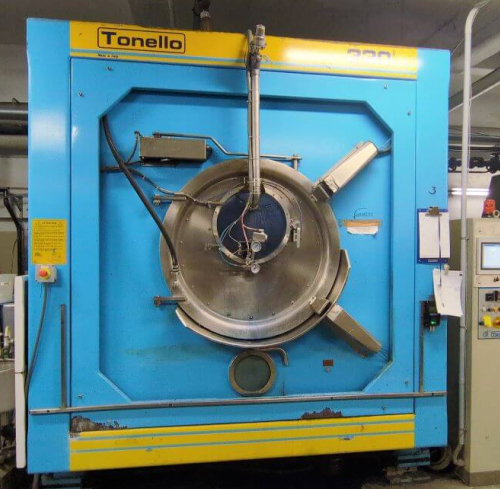
That got us very interested. So we decided to have a “garment dyed” prototype made.
When it arrived, we noticed it had a more irregular, more lived-in look than our previous shorts. That’s normal: because these new shorts are dyed after being sewn, the dye settles into the irregularities of the seams, the bumps formed by the buttons, and the folds of the fabric.
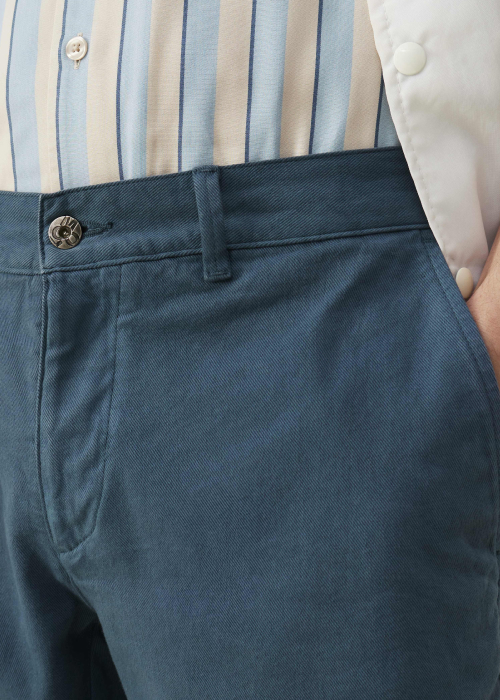
And that’s good news for how they age: because the fabric’s appearance isn’t perfectly uniform, wear from machine washing or UV exposure shows far less.
All well and good, but do the colours of a “garment dyed” pair of shorts actually hold up better against UV rays and sweat?
How it holds up in real life
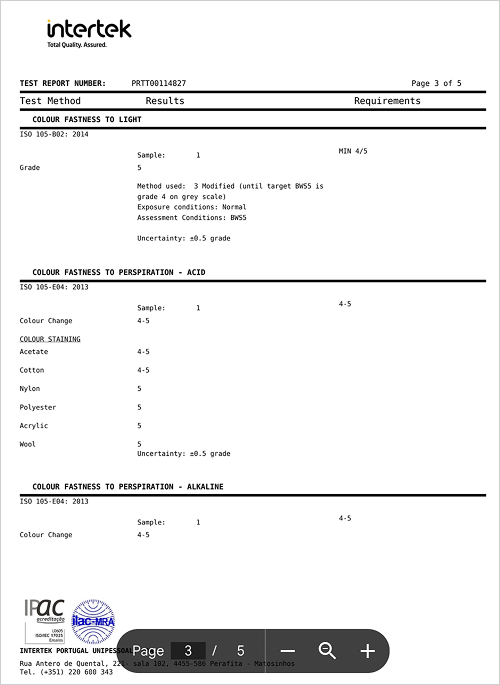
Before releasing our new shorts to the public, and after trying several different dye recipes, we ran a colourfastness test in the lab, which – fortunately – came back very convincing.
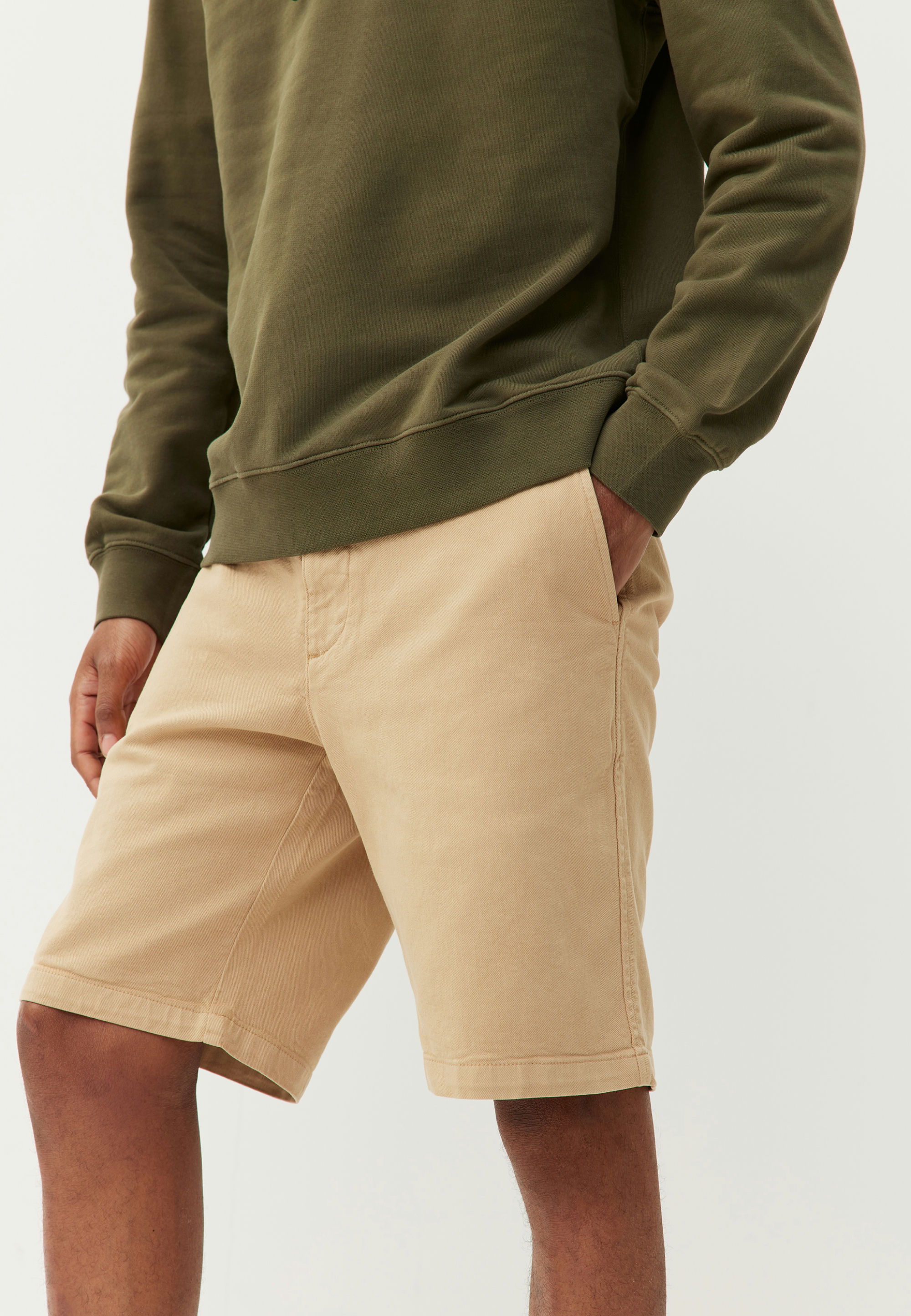
So we launched production of our “garment dyed” shorts, and 6 months later we started selling them… with a little apprehension: were these shorts going to end up fading too?
To find out, we had to wait at least a month, until our customers received an email asking what they thought of our products (long enough for them to have worn them a bit and put them through a first few washes). First sigh of relief: nothing to report! Our customers love the shorts.

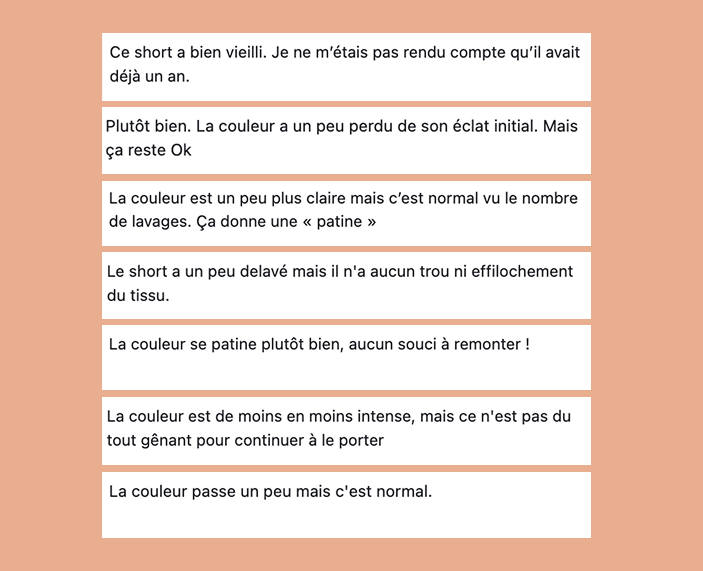
But the real verdict came in May 2025, when we got the first feedback from our customers one year after their purchase (the point at which we email them to find out how their clothes are ageing). And hallelujah: our customers are still delighted with the shorts. Across 65 reviews, they gave them an average rating of 4.7/5!
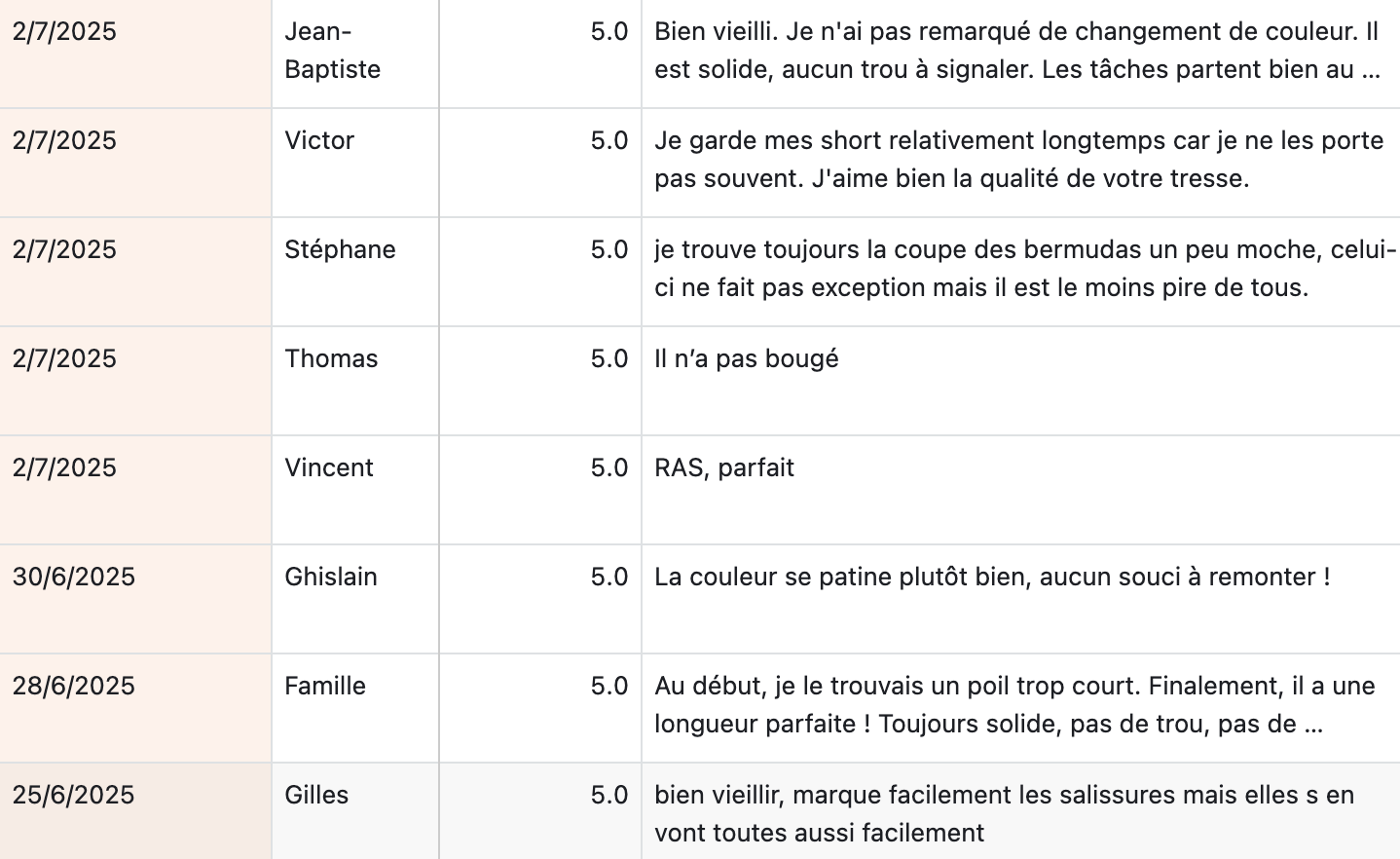
Admittedly, the colour of the shorts does shift a little...
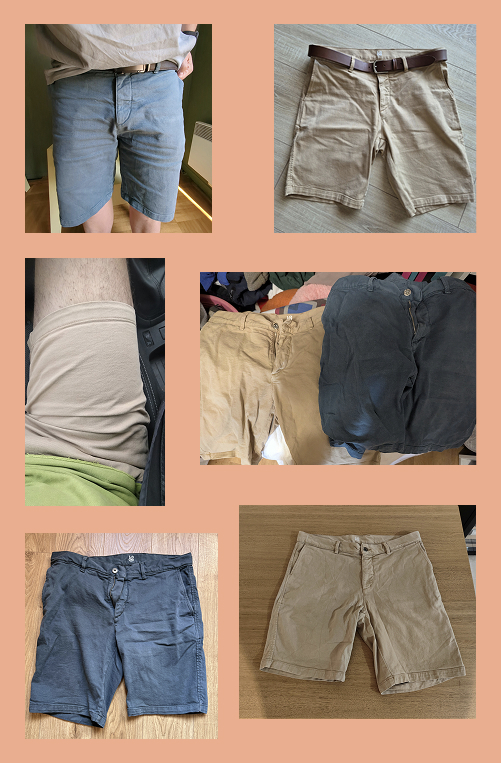
... but this time it takes on a lovely patina, not too strong and without shifting in tone.
Handy, but not magic
At this point you might be wondering: why don’t we use garment dyeing for all our Loom clothes?
Because this way of dyeing has its drawbacks too. First, as we saw above, it can produce a slightly irregular look: not remotely a problem on shorts – quite the opposite – but it can be on smarter garments, like chinos or a formal shirt. It’s also harder to manage at the factory: it costs a bit more (it uses more water and energy), there’s more waste, it’s difficult to land on exactly the right colour, and prolonged heat can sometimes weaken the garment.
In short, garment dyeing isn’t a magic solution. The further we get in our understanding of textiles, the more we realise how complex they are: to make clothes that last, you have to find the right industrial process for each individual piece.
And garment after garment, we’re also learning that you can’t have everything. To make shorts that don’t fade at all, we could go for a fabric containing polyester (colour is easier to fix on synthetics), as more and more brands do, but they would be less comfortable and less good-looking. Or we could have them made in Asia, where they use certain particularly aggressive (and dangerous) dyeing products that are banned here in Europe. In the end, every garment we develop is the result of a compromise across many dimensions: price, environmental impact, looks, ethics, comfort, and so on. For our shorts, the compromise we chose is organic cotton (a natural material), made close to home (in Portugal), that will take on a lovely patina over time.
Anyway, we hope you’ll like these shorts, that they’ll see you through many summers… and that they’ll age as well as you do.