Not a day goes by without someone we know asking what we think of this or that brand.
Just another Monday at the office.
They ask us about clothes, but also about food, banks, cosmetics and even bicycles. And it makes sense: right now, it looks as if every brand on earth, from the tiniest to the most gigantic, is committed to protecting the environment.
If every company is committing to the environment, you might think we’re heading in the right direction, that we’ll manage to limit global warming and the ecological crisis, and that yes, at last, the world is going to get better and better.
Us, seeing that every company is now committed to the environment.
But hang on: why is the climate still warming? Why are the oceans still being polluted? Why is biodiversity still collapsing? If every company is doing the right thing, why do all the experts say we’re still heading straight for disaster? Are these companies lying?
In the vast majority of cases, they’re telling the truth. Most of the time, brands aren’t greenwashing in the strict sense. Yes, H&M really is the world’s biggest buyer of organic cotton. Yes, Air France really does plant trees to offset all its domestic flights.
Yes, Monsanto really does... ah no, wait. Monsanto are just making it up.
The problem is the kind of commitments these brands make.
Environmental commitments that fall far short
In practice, most of the environmental efforts brands make come down to 2 things:
eco-design: using fewer resources to make a product (for example, switching to kraft packaging or using recycled materials…)
offsetting: paying to support actions that compensate for the pollution emitted, such as planting a tree or funding a charity (e.g. 1% for the Planet)
And honestly, eco-design and offsetting are essential. But they’re nowhere near enough.
First, because eco-design doesn’t always end up reducing resource consumption. Partly because of the rebound effect. The best example is the car. Sure, car engines use less and less energy, but because people drive more and buy heavier and heavier cars, the total emissions from cars keep rising year after year. Another example: if a t-shirt is organic, it’s tempting to think you can buy as many as you like without polluting (spoiler: you can’t).
As for offsetting, it’s far from a magic solution, for plenty of reasons. If you only remember one, it’s that it doesn’t work at scale. For instance, if we wanted to offset all of our CO2 emissions by planting trees, we’d have to plant forests on almost all the farmland in the world today (which means we’d all get pretty hungry after a while).
You might think that, added together, all these actions could eventually pay off. That’s what people call “green growth”: keep the same model and hope technology will save us. It’s true that thanks to renewable energy, energy-related CO2 emissions finally flattened out in 2019. But the road ahead is still very long and very uncertain. In France alone, to stay below 2 degrees of warming, we would have to cut our CO2 emissions by a factor of 5 by 2050.
It’s true that there’s a small chance we could solve the climate crisis without changing the way we live. The whole question is: do we want to take that risk? Imagine turning up with your whole family in front of a rickety old plane, and the pilot tells you there’s a 30% chance of landing in one piece. Would you get on board? Even with a 50% or 80% chance of arriving safe and sound, nobody gets on that plane with their family.
The only way to tackle climate change is to produce less and consume less. Whatever we’re told, whatever technological solutions get waved in front of our eyes, there’s one equation we will never be able to change: to produce is to pollute. As an open letter from 1,000 scientists in Le Monde just reminded us, “Our current way of life and economic growth are not compatible with limiting climate change to acceptable levels. Continuing to promote superfluous, energy-hungry technologies [...] is irresponsible at a time when our lifestyles need to move towards greater frugality.” In short, talking about eco-design or offsetting without tackling overproduction is like putting a plaster (with little cartoons on it) on an amputated leg. It’s better than nothing, but it won’t solve the problem.
To fight this overproduction and overconsumption, here’s what brands can do:
Offer products or services that save resources, such as lighter cars that use less energy (and not yet another SUV model).
Make products last longer: a real innovation would be phones that are easier to repair, for instance, not phones with a third camera lens
Stop pushing people to consume: that means an end to promotions at every turn, to dark patterns designed to make people buy, to endlessly refreshed collections that keep desire alive, and so on.
It’s great that Danone is getting B Corp certified, but it might want to stop selling water in plastic bottles first.
All these brands that care about the environment, that have created so many “CSR manager” jobs, that invest so much in the subject, must surely be reaching the same conclusions.
So why don’t they tackle the problem of overproduction and overconsumption?
Why brands don’t tackle the problem
It’s true that in some specific cases, a brand’s genuine environmental commitment can be a competitive advantage. If it weren’t, brands like ours, 1083 or Les Récupérables would probably never have seen the light of day.
But in most cases, it isn’t: tackling overconsumption and overproduction is bad for business.
Making more sustainable products (in other words, products that last longer or use fewer resources) means selling fewer of them. No longer pushing people to buy, by cutting back on promotions or flashy adverts, inevitably means lower sales.
And above all, offsetting and eco-design are the actions that consumers see most. Brands can easily turn them into marketing arguments to sell more: nothing like a nice bit of eco-friendly packaging to soothe customers’ eco-anxiety. They’re also a way to attract young talent: the growing awareness among young employees is a real headache for polluting companies, which are finding it harder and harder to recruit.
Phew, the planet is saved.
As a result, companies tend to drop the actions nobody sees, even though those are precisely the ones that matter for reducing a company’s environmental footprint. In fact, the company that makes the least environmental effort is the one that makes the most money. This is what the economist Gaël Giraud calls the “reward for vice”.
A little summary slide we made all by ourselves in PowerPoint. Pretty, isn’t it?
So yes, making real environmental efforts is worse for business. But Coca-Cola, Danone and the other giants are hardly on the verge of bankruptcy. If anyone can afford to accept slightly lower profits without having to shut up shop, it’s them. And after all, they’re made up of human beings, who are just as worried about the climate as we are. So why do they never agree to a bit less growth or a bit less profit, in the name of everyone’s survival?
The financialisation of companies
If you’ve been following our previous adventures, our first hypothesis won’t surprise you: the problem is finance.
Who said it before everyone else?
It’s true that today, nearly three quarters of the shares in French companies are held by financial institutions (asset managers, index funds, private equity funds…). And even when these financial entities don’t own 100% of a company, they can impose their vision on its executives through their voting rights on the board, and they also push those executives to chase ever more growth through “stock option” schemes.
And it’s true that what these financial entities are after, above all, is a financial return. They may claim otherwise, but at best, they will only push companies towards the environmental efforts that can help them grow: eco-design or offsetting. What investment fund would ever accept a company fighting overproduction if that hurt its financial performance?
The only companies that can afford to accept lower profits in the name of protecting the environment or social justice are the ones run by human beings, not the ones under pressure from a cold financial entity. Tellingly, the companies recognised as the most environmentally committed are very often independent, family-owned or cooperative businesses: Enercoop in energy, Fairphone in phones, La Nef or Crédit Coopératif in banking, Camif in furniture, Biocoop in supermarkets, MAIF in insurance, and so on.
Even with the best intentions in the world, a financialised company will struggle to take the environmental actions that really matter.
Except there’s a catch.
If we look at our own sector (ready-to-wear clothing brands), very few companies are actually financialised.
Of course, there are a few examples of French brands that have been transformed under financial pressure: Vivarte (Caroll, Kookaï, La Halle aux vêtements…), bought out by three successive funds since the 2000s, which has since had to close lots of shops and cut 7,000 jobs. Or Dim, bought out by two successive funds, which moved part of its production abroad. And then there are the many fashion brands bought by the fund Experienced Capital, which makes no secret of pushing its brands to grow, in particular by opening dozens of shops in record time...
But the vast majority of fashion companies are still family-owned groups, including the giants of fast fashion.
Who we imagined owned these brands.
Who actually owns these brands.
Now of course, some of these brands are partly listed on the stock market or have let investment funds into their capital. And they clearly feel the pressure too – or put it on themselves, since their personal fortune is directly tied to the share price.
But still, these families remain in control of their companies. The fashion industry should therefore have been a model sector. These families may one day hand their business down to their children, so you’d expect them to take a very long-term view, with no pressure to grow ever bigger, ever faster. And their name and reputation are on the line, so you’d expect them to be careful about the quality of their products, the working conditions of the people who make them, and their environmental impact.
Yet almost all of them, to varying degrees, have copied the destructive fast-fashion model: moving production abroad, ultra-fast collection turnover, declining quality, and new shops opened at a relentless pace.
How did these families get swept up in this race for growth?
The cult of growth at any cost
Let’s go back to the families listed above and take a look at their bank accounts:
In short, it’s fair to say that one more euro in their bank account isn’t going to change their lifestyle much.
And these people know it perfectly well. Amancio Ortega, the richest man in Spain and founder of Zara, says so himself: “I just want a normal life, to be able to sit quietly in a square and have a coffee with my wife without anyone paying attention to us.” He admits that earning more money won’t make him any happier.
It’s amazing how many guys only need a coffee to be happy.
And yet it’s the same man who set out to conquer the entire world and cover the planet with Zara shops, imposing his fast-fashion model on the rest of the industry.
So what’s going on in his head?
Actually, he gives us the answer himself:
“Even when I had nothing, I dreamed of growth. Without growth, a company dies. At 72, I still think the same thing: you must never stop growing."
For him, the optimal size of a company is necessarily its maximum size. Never mind if employees are buried under work. Never mind if that growth comes at the expense of the clothes’ quality. Never mind if it turns every city centre into the same row of clone shops. Never mind if it contributes to climate change.
This belief is not only dangerous, it’s largely wrong. First, people often forget the diseconomies of scale that big companies suffer from (communication problems, ever heavier processes, internal politics, inertia…) and that put them at a disadvantage against smaller ones. But above all, the world is full of counter-examples: perfectly viable companies without growth, which aim not to do “more” but to do “better”. They focus on innovation, on improving their products and services, on the well-being of their employees or their communities, without trying to increase their turnover at any cost. To start with, there are millions of craftspeople and local shops, like your neighbourhood baker, who has probably sold the same number of baguettes and croissants for years while being perfectly viable economically. There are also those small and medium-sized businesses that are a hundred or two hundred years old and still around without ever having grown out of all proportion. There are also the tech companies that chose not to make growth their goal, such as Basecamp, Buffer and Wistia. And there are even all those successful companies that have deliberately chosen not to grow, in order to protect the environment or their employees’ well-being.
So the forced-march growth of clothing brands isn’t only imposed by the financial system. Above all, it comes from a belief that is widely shared today: that you have to grow at any cost. “Grow or die”. “The bigger the better”.
How to get companies to stop dreaming only of growth
So why does a man whose real passion is lounging on a café terrace sipping the cheapest drink on the menu believe that the bigger a company is, the more successful it is?
Let’s be honest: that’s what most people think.
Because we live in a world where growth and success always go together, and where the big company is glorified. As a result, the people who built them and the people who run them are held up as role models for the rest of society.
The media celebrate record fundraising rounds and spectacular stock market listings. Here and there you can read that the holy grail for a company is to become a unicorn, in other words to be worth a billion euros.
Spoiler: this is not a ranking of the companies most useful to society.
The best-selling business biographies are the ones glorifying the people who built empires like Nike or Apple, and those books don’t dwell on the catastrophicconsequences of their “success”. And in business schools, students pore over case studies of these big companies and the recipes for their “success”.
In short, like you and us, Amancio Ortega is exposed every day to images that equate success with growth. No wonder he thinks his company always has to keep growing.
So if we want companies to rethink their ambitions, and Amancio to finally enjoy his coffee in peace without secretly planning to conquer (even more of) the world, we need to change our idea of what success looks like.
Make Amancio’s coffee great again! (Unrelated, but did you notice he’s wearing a Hugo Boss polo shirt? Not very on-brand.)
Good news, Amancio: these ideas are (slowly) starting to change.
But for our definition of success to change completely, it’s going to take time…
So what do we do in the meantime?
At Loom, as we’ve explained before, we decided not to take money from any investment fund that might push us too hard towards growth. But as we’ve just seen, that’s not enough. Even with the best intentions, anyone can get drunk on growth.
So here’s what we’re trying to put in place:
1/ a company culture of “non-growth”. We don’t refuse growth, but we don’t make it a goal. It has to be the consequence of solid fundamentals: satisfied customers, healthy relationships with our suppliers, quality products, motivated people working with us. For example, launching Loom abroad doesn’t interest us. Neither does building a network of shops across the country.
2/ safeguards. We’ve thought about it carefully, and we believe we’ll always be less tempted to chase growth at any cost if we have nothing to gain from it. So the most effective thing, in our view, is to cap our salaries so that nobody ever earns more than 5 times the minimum wage. What’s the point of hitting a billion in turnover if it changes nothing on the bottom line of our payslip?
We’re not saying every company should do exactly what we do. But many of them do need to change their philosophy. Of course they need to be profitable and pay their employees, their suppliers and their taxes properly. But once that profitability is reached, the people running companies need to stop talking about growth targets and start trying to do things better.
Quiz: judging by the vocabulary of this young CEO, would you say this company’s goal is to get bigger, or to be useful to society?
We need to stop celebrating growth figures and start celebrating a customer who says thank you, an employee who’s glad to get home a little earlier, or a supplier relieved to be given a longer production lead time. We need to give up doing more and simply want to do better. We need to choose between conquering the world and improving what is within our reach. It’s time success was measured not in money but in positive impact. And time for companies to work for the common good, not to make a handful of people richer.
And the great thing is, we’re far from alone in thinking this way. As we said earlier, all over France and around the world, there are thousands of companies that are useful to society, profitable, and not chasing growth at any cost. Theirs is the model that deserves the spotlight.
Today, they are still the exception.
Tomorrow, they need to become the rule.
Who are we to say this?
You're reading La Mode à l'Envers, a blog run by the clothing brand Loom. The textile industry is in a sorry state, and the planet is footing the bill. So whatever we manage to understand about this industry, we try to explain here. Because making clothes that last is good, but revealing, sharing and inspiring is even more powerful.
If you like what we write and want more, subscribe to our newsletter by clicking here. We promise: we write rarely and we never spam.
P.S.: By the way, if you know of companies with this kind of philosophy or commitments, tell us about them here. We’d like to make a list of them and find a way to put them in the spotlight.
P.S. 2: We had the chance to share this vision at TEDx Université de Tours a few weeks ago. Have a look at the video and tell us what you think in the comments.
Upside: your windscreen is clean. Downside: we’re all going to die.
The insectocalypse
Organic food has had a place on our plates for a decade or so now. When it comes to food, admittedly, organic farming has a weighty argument on its side: it doesn’t increase your risk of cancer.
Sprayed 35 times on average : the conventionally farmed apple has a lot in common with Snow White’s.
But when it comes to clothes, whether the cotton in your t-shirt is organic or doused by Monsanto makes no difference to your health: the toxic substances found in clothing come from dyes and other industrial treatments, not from growing the cotton1.
Something to impress people with at dinner: this is what cotton looks like. And even though everyone says “cotton flower”, what you’re actually looking at is the fruit.
That probably explains why organic cotton never took off the way organic food did: it accounts for just 0.95% of world production (versus more than 6% for food). So the overwhelming majority of cotton comes from so-called “conventional” farming. Meaning: the kind that piles on chemical fertilisers, irrigation and monoculture with no restraint whatsoever. And pesticides, too.
A 1945 photo of DDT, one of the first insecticides, being sprayed inside homes to fight malaria (before anyone realised it was wiping out birds and raising the risk of cancer, premature birth, autism and Alzheimer’s in humans).
The thing is, cotton is essentially a “self-pollinating” plant: it needs nobody to reproduce, not even bees. So you can kill every insect around it without doing much harm to your yields. The result: cotton takes up only 2-3% of the world’s farmland but consumes 10% of all the insecticides on the planet.
Step one in making a so-called “conventional” cotton t-shirt.
If you’re over 30, you know they’re not. Because you remember the “windscreen effect” we mentioned in the introduction. And if you don’t drive, here are a few figures. In Germany, in just 27 years, 75% of flying insects have disappeared. In the United States, two thirds of the insect populations studied have lost 45% of their numbers. And as the sweeping investigation by a journalist at Le Monde shows, neonicotinoids are the main reason they are vanishing. The phenomenon is so huge that scientists call it the “Insect Apocalypse”: these two studies suggest that in just 30 years, almost half the insects on the planet have disappeared.
Then again, who cares about insects? It’s not as if they were any use (apart from biting you right on the eyelid on summer evenings)...
If this carries on, you’ll have to explain to your children that this is not a mini badminton racket.
Actually, insects matter enormously to our survival.
If the bees die, for instance, flowering plants will no longer be pollinated: bye-bye fruit and vegetables and, more broadly, around a third of what’s on our plates.
You don’t need to be Neo in The Matrix to sink into depression when you eat this at every meal.
And if you knock out the first link in the food chain, you put the survival of every other species on the line2.
“We are all connected in the great circle of life.”
And the two other families of insecticides used on cotton? They’re hardly any better:
Pyrethroids, the stuff you find in Baygon-type bug sprays. They are suspected of being endocrine disruptors.
Organophosphates are nerve agents. Fine for the nasty moths, but also for farm workers. That’s according to the 35 studies listed in this report.
You get the picture: conventional farming has a lot to answer for, and cotton is a big part of it.
Official ranking of the worst villains of all time.
A problem with the whole agro-industrial system
In thirty years, the agrochemical industry has managed to spread the use of one product more toxic than the next. How is that possible? Because the agro-industrial system as a whole has no real safeguards. Under pressure from industry lobbying, the precautionary principle has gone straight out of the window3. France has just banned neonicotinoids (the first country to do so), but that doesn’t solve the problem:
these products stay active in the soil for a very long time (20 years for neonicotinoids)
an equally dangerous molecule will most likely come along to replace them. In fact, there are already other pesticides in circulation that are almost certainly just as dangerous (we simply haven’t had enough time to notice yet).
So what’s the solution?
GM cotton that resists caterpillars? Monsanto tried that with Bt cotton, which produces its own insecticide. At first it worked: pesticide use dropped quite a bit wherever it was introduced. Except that nature adapts: the caterpillars became resistant. A study carried out in China found that after seven years, farmers were back to the same level of pesticide use as before Bt cotton arrived.
Say what you like, they do have a sense of humour at Monsanto.
The only sensible thing to do is switch to organic farming (what, you’d guessed already?).
Why organic is a good thing
Organic cotton farming uses far fewer insecticides than “conventional” farming. To deal with pests, it keeps a balance between insects and their natural predators thanks to rich, living soil, and it plants trap crops4 around the edges of the fields it wants to protect…
And organic farming has plenty of other benefits:
It sharply reduces the use of chemical fertilisers (or does away with them altogether, in the case of agroecological farmers) through crop rotation, intercropping, minimal tillage, green manure, composting...
It uses no synthetic herbicides (so no glyphosate, obviously). To strip the leaves before harvest, for example, farmers prefer to wait for them to fall naturally with the first frosts.
It makes farmers less dependent on the agrochemical multinationals (to give you an idea, some small cotton farmers currently spend 60% of their income on pesticides)
Living soil that is ploughed less captures CO2 from the atmosphere. This is called regenerative agriculture, and it could absorb up to 13% of our annual CO2 emissions
So why aren’t all brands going organic?
Some brands have used organic cotton from day one (Ekyog, Hopaal, 1083, Patine, Armed Angels, People Tree, Patagonia, Organic Basics, Knowledge Cotton Apparel...) and we take our hats off to them. But the vast majority of clothes (including some of ours) are still made from conventional cotton. Why?
First bad argument: price
Yes, organic costs more than non-organic. Farming in a way that respects the soil is harder than drenching a field in pesticides. And then there is the very tricky period farmers go through when they move from one system to the other: it can take several years, during which they can’t sell under the organic label.
But in the total price of a garment, frankly, it doesn’t change much. In a 100% cotton shirt, the cotton costs about €1.50. So even if you pay twice as much for organic cotton, it will cost you €1.50 more. To give you an idea, for one of our shirts that we switched to organic cotton, our production cost went from €22 to €24.
Perfectly acceptable, no? What may be holding fast fashion brands back from organic cotton today is that their labour is so cheap that a rise in the price of cotton translates, in percentage terms, into a big jump in production cost.
Second bad argument: quality
Whether cotton is organic or not has no impact on its quality: that depends mainly on the seeds and the climate.
That said, we have been searching for over a year now, and we’ve found it very hard to find yarns that are organic AND hard-wearing… The reason is simple: demand is so low that quality organic cotton (known as “long-staple” and “extra-long-staple”) makes up less than 0.01% of world production.
Finding hard-wearing organic cotton is like looking for a needle in a cotton bale. Send us your own cotton puns at hello@loom.fr
But growers of quality organic cotton do exist. And the more brands turn to organic cotton, the more the supply will grow, quality organic cotton included.
Third bad argument: organic cotton is no better than traditional cotton
There may well be controversy in organic food farming, particularly over the use of Bordeaux mixture (a copper-based fungicide), or the fact that sprayed fields contaminate organic ones anyway. But in textiles, there are two labels that guarantee cotton is organic and that, as far as we know, have never been called into question (unlike the “Better Cotton Initiative” and other green labels):
OCS (Organic Content Standard)
GOTS (Global Organic Textile Standard), which also guarantees decent working conditions
The real reason: nobody knows enough about it
The real reason brands aren’t going organic is that very few people realise how serious the problems caused by conventional cotton are.
Why don’t we know? Because the pesticide manufacturers (Bayer, Syngenta, BASF…) throw up a smokescreen6 to make us believe that insects aren’t disappearing because of insecticides but for a whole host of other reasons: climate change, parasites, urbanisation, light pollution at night... All of it backed by lobbying and scientific studies funded to sow doubt (this one, for example, paid for by Bayer and Syngenta, tries to show that neonicotinoids on cotton are perfectly harmless). None of these theories, of course, can explain the sudden crash in insect populations in the mid-90s, just when neonics were introduced, but never mind.
“The agrochemical industry has pulled off a remarkable feat: making us forget that insecticides do exactly what they were designed to do, namely destroy insects.”
Conclusion
We’ll be honest with you: less than two years ago, we had no intention of switching to organic cotton. We thought it meant paying more for not much. We naively assumed that there were laws to protect us, and that manufacturers couldn’t just do whatever they liked. We thought global warming was such a serious problem that it outweighed all the others. Then we dug into the subject and realised we’d got it wrong.
For almost a year now, we have been working to move our entire range over to organic materials. Some products on our site already are, like most of our shirts and our sweaters. For the rest, it’s under way, but as we said above, finding the right materials is no picnic. Two or three times we thought we’d cracked it, only to go back to square one after running durability tests on the finished products. But by the end of 2020, we should manage to have our whole range in organic.
Actually, we shouldn’t say we’re switching to organic, but going back to it. Closing a chapter that should never have been opened.
Written by Guillaume Declair
Update, October 2021
We read an excellent report by the Transformers Foundation that debunks a number of myths about the cotton industry. After reading it, we corrected several points in this article:
We said that cotton uses 16% of the world’s insecticides: that was an outdated figure from 2014. In 2019, according to the International Cotton Advisory Committee (ICAC), cotton accounted for 10.24% of insecticide sales worldwide.
We said that organic cotton represents 0.5% of the world’s cotton. For 2019/2020 (source: Textile Exchange), that has risen to 0.95%.
While we’re at it, the report contains several very interesting debunks, including the oft-repeated claim that “the textile industry is responsible for 20% of global water pollution”. In all likelihood, the figure comes from a 2007 report by the World Bank and China, which stated that “industry” was behind 20% of the pollution in 7 Chinese rivers (textiles being one of the 6 industries mentioned). In short, nothing to do with it.
Oh, and today, we only use organic cotton in our clothes.
Notes
1 Pesticides stay on the outer husk of the cotton. And once the cotton boll is harvested, the fibre is washed so thoroughly that no pesticide is found in the finished products. According to Antoine Guian, director of the SMT textile testing laboratory.
2 Plenty of insects provide invisible services that agriculture needs just as much: ladybirds eat aphids, earthworms aerate and feed the soil... And insects get eaten by birds, which in turn get eaten by other animals, and so on.
3 One example: under pressure from industry lobbying, the Scopaff (the EU committee that decides how European farming laws are applied) has refused 27 times (!) to rule on a new pesticide approval process that takes chronic toxicity to bees into account (according to Stéphane Foucart in “Et le monde devint silencieux”).
4 Trap crops are crops planted to lure pests elsewhere: alfalfa for true bugs, for example, or chickpeas for certain caterpillars.
5 Granted, the critics of organic cotton are right to say that GM cotton plants yield more than non-GM plants (organic ones included), so they need less irrigation water per unit produced. But you also have to count “grey” water, in other words the water polluted by pesticides, which according to the NGO Water Footprint is five times lower in volume than in conventional farming.
6 It looks strangely like the tobacco industry’s strategy in the 1950s. When the first studies linking tobacco and cancer came out, the cigarette makers didn’t dispute them. They preferred to fund a huge number of other studies (more than 6,000) showing that cancer could have other causes (heredity, nutrition, etc.), to make us believe that smoking wasn’t such a big deal compared with all the rest.
Who are we to say this?
You’re reading La Mode à l’Envers, a blog run by the clothing brand Loom. The textile industry is in a sorry state, and the planet is footing the bill. So whatever we manage to understand about this industry, we try to explain here. Because making clothes that last is good, but revealing, sharing and inspiring is even more powerful.
If you like what we write and want more, subscribe to our newsletter by clicking here. We promise: we write rarely and we never spam.
It’s happened to you 10,000 times: you get an Instagram notification, open the app to see the comment your friend left and… you’re sucked into the vortex. Swept along by the stream, you spend ten minutes scrolling through the bottomless pit of your Insta feed. Several times a day.
And it’s very hard to resist, because the people who design Facebook, Instagram, YouTube and Netflix deliberately play on our psychological weaknesses so that we spend as much time as possible on their services.
We’re all more or less aware that social media manipulates us. What we realise less is that 99.9% of e-commerce sites pull similar levers, not to keep us on their pages, but to get us to buy.
They’re called dark patterns: an arsenal of techniques that target not our reason but our vulnerabilities.
If your smartphone were a person...
We tend to think the human brain is extremely rational when it makes a decision. In reality, some things constantly pull it off its nice logical path: cognitive biases.
Quick trivia break: a cognitive bias is something that makes the brain get things systematically wrong in certain situations. Example: answer this question in your head: “Are you a better or worse driver than average?” Done? Well, you most likely answered, like 9 out of 10 people, that you think you drive better than average. Which means 4 of you are overestimating yourselves… while being convinced you’re right. It’s called “overconfidence bias”, and everyone falls prey to it. And there are dozens and dozens of biases like this one.
Mind you, most of the time these biases are useful. Take overconfidence bias: it’s what encourages us to take the risks that move us forward, whereas overly analytical reasoning could paralyse us. It came in handy 10,000 years ago, when humans had to venture into the forest to hunt (at the risk of getting eaten), and it still does today when it nudges us to quit a job that makes us miserable.
But in online retail, these cognitive biases are harnessed by techniques with just one goal: getting us to buy more. And you probably know these sales techniques very well already.
Playing on scarcity
“Scarcity bias” makes us place disproportionate value on anything that seems rare. That was useful in the Palaeolithic era, when you had to find the motivation to chase a wild boar so as not to starve, in a world where resources really were limited.
But today, with a supermarket on every street corner, brands recreate this scarcity artificially: flash sales, “limited stock” warnings, collabs, collections that change at breakneck speed, drops (those ultra-limited-edition products hyped on social media).
This 1600-dollar suitcase sold out in 34 seconds
In cases like these, when it makes us overpay for a pair of shoes we don’t need, scarcity bias is working against us. Same goes for when it makes us book a slightly dodgy hotel room because 10 OTHER PEOPLE ARE LOOKING AT THIS PROPERTY RIGHT NOW AND THERE WON’T BE ENOUGH FOR EVERYONE.
Playing on the bargain
The classic example is the crossed-out price: you’re told the product used to cost much more (when that price was artificially inflated) or that it costs much more elsewhere (with no real idea where that figure comes from).
Plastic swan pins for €88: totally believable.
We then fall victim to anchoring bias: our brain treats the reference price as an anchor and gives it disproportionate weight. Whether or not the crossed-out price is genuine, we’re completely swayed by it. It’s exactly like when someone opens a negotiation with a very high price: psychologically, it’s very hard to come back with a much lower figure.
Playing on the herd effect
That’s when you’re invited to top up your basket with “items other customers also bought” or “products frequently bought together”.
Under the guise of doing customers a favour by making sure they don’t forget a “complementary” item, the site is using good old cross-selling techniques, but multiplying their impact thanks to the herd effect: basically, an individual will always prefer to copy the group (even if it means being wrong) rather than be right on their own (check out the brilliant Solomon Asch line experiment if you want to see just how powerful this effect is).
“Just so you know, most of our customers go for the massage seats option”
Playing on repeated exposure
You’ve surely been in this situation: you mention a perfume to your friends over a drink and, five minutes later, while browsing Facebook, Insta or a news site, you see an ad for that very perfume. And you think, "No way, my phone is listening to me."
You’re almost right.
Your phone isn’t listening to you, but it knows (sometimes better than you do) what you’re interested in, just by analysing your online behaviour over the past few days. As you browse the internet, every site you visit leaves a little spy in your browser – it’s called a “cookie” to make it sound cuter. That cookie is what’s used for “retargeting”. In other words, for weeks afterwards, on every site you visit, you’ll see ads for the products or services you searched for online… And you might just end up giving in.
If you ask us, it’s pure Black Mirror.
It’s called the familiarity principle, or mere-exposure effect, a cognitive bias behind every saturation ad campaign: the more often you see a product, the more familiar it feels, and the more you like it.
How else can you explain people actually buying this drink?
Playing on the 9s
One last bias for the road: the nine bias, which explains why so many brands have prices ending in 9. According to this study comparing sales of women’s clothing, a garment priced at 39 dollars reportedly sold 31% more than one priced at 34 dollars!
Either these guys have read the study, or 9 is their lucky number.
And then there are the champions, who manage to do it all at once:
Why are dark patterns a problem?
Brands that use dark patterns probably don’t think they’re doing any harm; they just want to boost their sales. And some of these techniques are used in the real world too: the Starbucks barista who asks if you’d like extra caramel, the car salesman who tells you the model you want is the last one in stock, the estate agent who says there are already "two other couples interested"…
So what’s the problem?
The first problem is that online, these techniques are used so systematically and are so finely tuned that they become formidably good at making you buy things you don’t need. As the biologist E.O. Wilson put it, humans have “paleolithic emotions and godlike technology”: even the smartest, savviest brain can’t fight the technological arsenal designed to manipulate it. It’s just like at a fast-food restaurant: the person at the till may ask you now and then if you’d like to add a dessert or go XXL, but nothing beats the self-service kiosk, which gets you to spend 34% more on average.
Another one who ordered at the kiosk.
Yet in a world where overproduction and overconsumption are putting our future at risk, brands have a responsibility: not to get their customers to buy more than they really need. Just because new technologies can do it doesn’t mean they should. Tristan Harris’s “Humane Tech” movement is calling on tech companies to stop playing on our vulnerabilities to grab every last scrap of our attention. In the same way, online brands need to stop manipulating us into overconsuming.
The second problem, just as important, is that dark patterns make us feel stress, fear, frustration... Deeply negative feelings that we already get more than enough of elsewhere in our lives.
Be a Jedi...
Granted, dark patterns are incredibly effective at selling a lot, fast. But a brand that bets on honesty can do just as well. Yes, it’s always tempting to click "buy" when you see -70%. But in the long run, you’ll always prefer the sweater that stands the test of time to the one you bought just because it was on sale. In fact, it’s a bit like refusing to give in to the dark side and trying to master the light side of the Force instead: it’s slower and harder work, but in the end far more powerful.
You and your friends on Black Friday.
Simply knowing that dark patterns exist already takes away some of their power. So keep your eyes peeled, and may the Force be with you.
PS:
For a long time, we used quite a few of these dark patterns on Loom’s site. Because we’d never really stopped to think about it.
If you gave up on a Loom order halfway through, we used to send you an email worded like this. Thanks to the customer who pointed out that we were being a little too pushy...
But when we thought about it, we really don’t want to manipulate you or get you to buy things you don’t need. In the past, pre-orders, retargeting, promotions and “limited stock” displays were valuable tools for growing Loom, but today we can afford to do without them.
So that we’re never tempted by dark patterns again, we’re making the following commitments:
We will never show prices ending in 9 (let alone 99)
No more “only X left”: we’ll never again display a time limit for ordering or the number of items left in stock
Bye-bye, cookies: we’re removing from our sites any cookies that can be used for ad retargeting on Facebook, Instagram or other websites you visit
Who are we to say that?
You’re reading La Mode à l’Envers (“fashion inside out”), a blog run by the clothing brand Loom. The textile industry is hanging by a thread, and it’s the planet that’s paying the price. So whatever we figure out about the industry, we try to explain here. Because making clothes that last is good, but lifting the lid, sharing and inspiring is even more powerful.
If you like what we write and want more, sign up to our newsletter by clicking here. Promise: we don’t write often and we never spam.
You’re reading La Mode à l’Envers, a blog run by the clothing brand Loom. The textile industry is coming apart at the seams, and the planet is footing the bill. So whatever we manage to understand about this industry, we try to explain here. Because making clothes that last is good, but revealing, sharing and inspiring is even more powerful.
If you like what we write and want more, subscribe to our newsletter by clicking here. Promise: we don’t write often, and we never spam.
Was our chino more gooder than the goodest of your chinos1? (spoiler: no)
At Loom, our mission is to design the most hard-wearing clothes possible with the smallest possible impact on the planet and on people, all without sending prices through the roof. In other words, we want our clothes to offer the best “quality-ethics-price” ratio. But in 2018, we realised that wasn’t really the case for the second generation of our chino. We bought half a dozen chinos from various brands and compared how well the colours held up after six fairly rough wash-and-dry cycles: 40°C without turning them inside out (sacrilege) + tumble dryer. And we weren’t exactly thrilled with the results: while not a disaster, our chino was far from the most hard-wearing.
So we decided not to place any new orders for this chino, and to stay out of stock until we’d taken the quality up a notch.
One small patch of indomitable fabric
A fabric is a bit like a dish at a restaurant. You can pick the one with the best ingredients, and sometimes the recipe still isn’t up to much. Even if you select the best yarn, the best weave and the best dye, the only way to be sure a fabric is the strongest is to test it. So we got hold of as many samples as we could, from different suppliers and in different compositions, and put them through the washing machine a dozen or so times. And we discovered that, somewhere deep in a small Gaulish village, one small patch of indomitable fabric was still holding out against the wash. That fabric was made by Velcorix, a company based in Alsace, in northeast France. Er, sorry: Velcorex.
The top 2 inventions ever to come out of Alsace, according to the official 2019 Loom rankings.
Velcorex’s trade is weaving and “finishing” fabrics, for example by turning them into velvet or dyeing them (handy, that). At a time when the entire French textile industry was moving production to Asia, Velcorex’s boss, Pierre Schmitt, did everything he could to keep the business in Alsace by going all out on quality. The upshot: the factory now employs 100 people and is running at full capacity (you can hear him talk here and join us in his fan club). Since dyeing and wastewater rarely get along, they built their own treatment plant and all their products are OEKO-TEX® certified. That’s how you end up with a textile factory in the middle of the Ballons des Vosges Nature Park.
Left, Pierre Schmitt; right, the entire Loom team.
Looking for the next sewing superstar
Our first garment maker was fine, but not great. We realised that to improve our chino, we needed to work with a factory as obsessed with quality as we are. That’s how the guys at Velcorex introduced us to Andreia. It was September 2018: Loom was still small, and so was Andreia’s factory in Porto. Since then, Andreia has taken on about ten people. Our two companies have been growing side by side, and we have to admit it’s made us a tiny bit sentimental about each other. We worked with her on every one of the chino’s weak points:
Seams splitting? We switched to a sewing thread three times thicker.
Threads getting pulled on the inside? We covered the seams with bias binding so that can’t happen.
Waistband sagging over time? We reinforced it with a thicker fusible interfacing.
Fly buttons always coming off in the end? We switched to a zip (YKK, naturally) and a metal button.
And to avoid selling you a pair of trousers for over 100 euros, we worked with her on simplifying the construction: a single back pocket, no coin pocket (who actually uses it?), no “V-notch” at the back, the size printed on the composition label instead of a second, separate label...
The "V-notch" is that split in the back of the waistband that lets your alterations tailor take your trousers in to fit your waist. We’ll let you guess what percentage of the population actually uses that feature.
The master of patterns
We had the fabric, we had the garment maker; all we needed now was the right pattern. Sure, it matters that a pair of trousers makes your backside look good, but if they’re going to last, a good cut also has to minimise stress on the seams and fabric rubbing. So we called in someone who knows their stuff: the trouser pattern maker at a major fashion house. It took us half a dozen prototypes to get to a cut we were really happy with.
We’re almost there.
Test me, hate me, but above all, look at meeeee
We don’t want to repeat our early mistakes, so we test the chino, then test it again. Step one: putting it through several 40°C-wash-plus-tumble-dryer-and-all-that-right-side-out cycles. You can see with the naked eye that the results are pretty good: there’s a little fading, but the colour holds up very well, even in high-friction areas like the fly and the belt loops.
Our chino after six wash-and-dry cycles right side out (and that’s not even its best angle).
Step two: wear this chino. A lot. For several weeks, the guys on the team wore one prototype after another, and in the end refused to take off the final version (legend has it they washed it overnight so they could put it back on in the morning). The verdict: not only is it super comfortable (with just enough elastane to hop on your bike easily), it also barely loses its shape (no “bagging” at the knees, for example). That’s down to a secret: our fabric contains elastomultiester filaments, which help it spring back very well to its original shape after being stretched.
Nobody’s perfect
This chino isn’t perfect. It’s simply the best compromise we’ve found so far between quality, ethics and price. Here’s everything we think could still be improved:
The fabric is mercerised to make it stronger, but at first this makes it a little shiny and prone to static. These effects wear off after one or two washes, but we’re working on changing that.
Before being dyed in Alsace, the cloth is woven in Pakistan. To insist on it being woven in Spain or Alsace (which is our plan), we need to place slightly bigger orders.
The cotton is conventional cotton. We’re working with Velcorex on an organic cotton version that’s just as hard-wearing, but we don’t know how long that will take.
One of the secrets behind this chino’s toughness is the use of elastomultiester (a polyester derivative).
Even after simplifying the construction and cutting our margin to the bone, we can’t sell it at the old price (60 euros). So it’s a little more expensive, at 75 euros.
January 2021 update
The cotton in the chino is now organic.
The fabric is less shiny and less prone to static than in the 3rd generation, thanks to a tweak in the fabric stabilisation process.
The crotch is now reinforced with a double seam.
The size chart has been adjusted so the chino is slightly slimmer at the hips.
The cotton yarn and the fabric are made closer to home: spinning in Turkey, weaving in France.
The chino costs 5 euros more than before, because it costs us 10% more to make.
1 This phrasing isn’t a grammatical mistake: it’s a nod to "plus bonne que la plus bonne de tes copines" (roughly “more gooder than the goodest of your girlfriends”) by the French rap group NTM, in case, like one inattentive member of the Loom team, you missed the reference.
Who are we to say that?
You’re reading La Mode à l’Envers, a blog run by the clothing brand Loom. The textile industry is in a sorry state, and the planet is footing the bill. So whatever we manage to understand about this industry, we try to explain here. Because making clothes that last is good, but revealing, sharing and inspiring is even more powerful.
If you like what we write and want more, subscribe to our newsletter by clicking here. Promise: we don’t write often, and we never spam.
In early 2017, we were running trials with a factory to develop both our polo and our hoodie (both pieces are knitted on the same type of machine).
A circular knitting machine that allows for all "fine gauge" stitches: t-shirts, polos, hoodies...
After a few months, we had to face the facts: the factory we were working with wasn’t up to scratch on either product. So we went looking for a better one. We'll spare you the details, but after visiting about ten of them, we met Jose-Pedro and realised it was no contest. It was with him that we made a hoodiethat’s seriously tough. So it made sense to develop our polo with him too.
Developing the right piqué
From our own modest experience, and after reading dozens of articles on the subject, we realised that three things usually let polo fabric down (the fabric is called “piqué”):
the collar curling;
the colour fading;
the polo shrinking.
We started with a 100% GOTS-certified organic cotton piqué, with long fibres (as always) and enough density (240 g/m2) to keep pilling to a minimum, stop it fading or shrinking in the wash, and help the collar keep its shape over time. Within a few weeks, we developed a piqué made from so-called "compact" yarn, a fairly recent spinning technique that makes it even stronger. The fabric looked beautiful and hard-wearing, but we still had to put it to the test.
On the left, a Portuguese piqué. On the right, a Spanish piqué.
Testing at home
Usually, we have our prototypes tested in specialist labs. But some kinds of wear, like a curling collar or uneven fading (both fairly specific to polo shirts), don’t show up well in the figures professional labs produce. So we decided to set up our own testing lab.
It’s actually not that hard. All you need is:
a washing machine;
a tumble dryer;
a measuring tape;
a good camera;
good lighting.
Buy about ten polo shirts from the shops: fast fashion, the brands famous for this garment, and brands with a reputation for great value for money. Measure them. Wash them. Tumble-dry them. Measure them again. Do that five times in a row. Photograph the polos after these five wash-and-dry cycles. Then compare.
That, my friends, is how you do it at home.
Do the big polo brands actually make good polo shirts? (spoiler: no)
Here’s what the different brands’ polos looked like after 5 wash-and-dry cycles:
What jumped out at us straight away was the fading: even on polos costing more than 100 euros, some of the results are pretty scandalous (and don’t get us started on the fast-fashion polo). Same story for the collar: whatever you pay, quality is rarely there.
Our other finding: every polo (even the good ones) lost between 5 and 13% of its length. That’s just the nature of piqué: even the best polo in the world shrinks a little in the wash.
The verdict: our polo is the one that shrinks least in the wash, and it comes second for colour fastness and collar hold. That doesn’t mean it won’t fade or that the collar will stay as crisp as on day one (that’s impossible with 100% cotton), or that it’s the best polo in the world. It just holds up better than the others we tested.
The details that make the difference
As usual, before making it, we sent you a questionnaire. And 1,700 of you told us what’s wrong with your polos.
Another victim of Desigual.
Unsurprisingly, huge numbers of you complained about fading and collars that lose their shape. You also mentioned fabric going out of shape and twisting. With the quality of piqué we’ve developed, we should have all that covered.
You also brought up shrinkage. To solve this, we did two things: we pre-wash the polo at the factory so it reaches you already pre-shrunk, and we added a little length compared with our usual size chart, so it doesn’t turn into a crop top after three washes.
A note for those born before 1996: a crop top is this.
After ripping two prototypes by yanking on them with all our might, we added reinforcement stitching above the side vents. And since several of you mentioned holes at the button placket, we used the same stitching as high-end polo shirts.
Finally, quite a few of you wanted the sleeves to hug your biceps. We made the opening a little snugger than average: if you pump enough iron, you should feel that gentle grip on your bulging biceps.
Style-wise, you went for a slim fit and tone-on-tone buttons. As for colours, your top 3 were navy blue, heather grey and black.
The 2nd-generation polo: the same, only better
(Article updated: April 2021)
A year on, 97% of people who bought the 1st-generation polo are still wearing it. The second generation is just as tough, and on top of that:
- It’s made from organic cotton (because anything else just isn’t an option). - The collar is lower at the back of the neck. - The stitching on the inside bottom hem has been improved to prevent fraying.
It costs 5 euros more than the 1st-generation polo, because it costs us 20% more to make on average.
(Article updated: July 2022)
The polo now comes in navy blue, heather grey and white.
You’re reading La Mode à l’Envers, a blog run by the clothing brand Loom. The textile industry is coming apart at the seams, and the planet is footing the bill. So whatever we manage to understand about this industry, we try to explain here. Because making clothes that last is good, but revealing, sharing and inspiring is even more powerful.
If you like what we write and want more, subscribe to our newsletter by clicking here. Promise: we don’t write often, and we never spam.
You can’t change an industry without asking one fundamental question: where does the money come from?
When you start a company, there are two possible strategies:
1/ The startup strategy, in other words exponential growth with the ambition of conquering the world as fast as possible 2/ The SME strategy, which means building a company that grows slowly but surely
Neither vision is better than the other: the two models simply reflect two different mindsets.
But these days, it feels like nobody starting a company even asks themselves the question: they want to create a startup. Because the media talk about nothing else, because it sounds cooler at parties (well, at some parties) and because, potentially, it could make them very rich.
These startups usually go on to “raise funds”, in other words ask for money from investment funds (= organisations that place large sums of private money in order to earn the biggest possible return). To pay that money back, these funds have to recover what they invested in the startups – with as much return as possible – within 4 to 10 years. There are three ways to do that:
1/ By selling the startup to another company. 2/ By selling the startup to another investment fund. 3/ By taking it public on the stock market (rarer).
Under no circumstances can the startup stay an independent company (except perhaps in the extremely rare case where it takes on debt to buy back its own independence). Once it has raised funds, it has to grow as fast as possible in order to be sold for as much as possible. That’s the growth race. Of course, some funds are more patient than others and stand by founders even through the hard times, but the long-term goal stays the same: sell as soon as possible, for the biggest possible gain.
Investment funds’ favourite image: the racing car (when it isn’t a rocket).
For some types of company, this rapid growth is essential, especially when they need to reach “critical mass” very quickly: Airbnb, for instance, needs lots of listings for tourists and lots of tourists for flat owners.
The real problem is that today, far too many new companies see themselves as startups. They raise funds and then throw themselves into a growth race that brings them far more risk than reward.
Do things too fast and you do them less well
Faster, but neither stronger nor better.
In a study of more than 3,000 startups, Stanford academics showed that the number one cause of failure was precisely premature growth.
Imagine you have just raised several million euros. If your company doesn’t grow fast enough, you’re trapped. You’ll spend on advertising instead of improving your product, hire a sales team instead of an engineering team, and so on.
Remember Groupon? One year after it was founded, the company was valued at 1 billion dollars. Today it’s a shadow of its former self. Why? Because instead of paying merchants properly, it blew everything on advertising and international expansion.
Fast growth undermines your chances of building lasting growth.
Like a tree that never had time to grow solid roots, growing too fast creates cracks that leave the company at the mercy of the first storm. For the investors, it’s no big deal: their money is spread across dozens of startups, so one that “works” is enough to make up for 15 that fail... For the people who lose their jobs when the company shuts its doors, it’s a bit more of a problem.
But this fragility is the least of it. The rapid growth of startups raises three other, far more worrying problems.
The collateral damage of rapid growth
There you go. It was bound to happen sooner or later.
Consumers foot the bill
There’s a very fashionable term in Silicon Valley: blitzscaling (“lightning growth”). It means growing as fast as possible to crush the competition – without necessarily building the best service or the best product.
Think of car/bike/scooter sharing, or on-demand delivery. Does Uber getting even bigger change anything for its customers? No. Waiting times are already so short that recruiting more drivers won’t noticeably reduce them. On the other hand, the bigger Uber gets, the better its chances of wiping out the competition... so the company pours ever more money into marketing and advertising.
Deliveroo and Uber Eats saw off Take Eat Easy and Foodora with wave after wave of ads on Facebook and in the metro. And once one of those two startups has a monopoly, it may well recoup its money through meal prices, courier pay and restaurant commissions.
In short: it’s cheap today, but tomorrow we’ll probably pay dearly for it.
Stress and pressure on the staff
With this growth race, the pace of work in a startup can become absurd. Special mention to Nikolay Storonsky, founder of the online bank Revolut, who asks his teams to work 12 to 13 hours a day and who declared: “I don’t understand how having a personal life can help you build a startup” (sic). It’s obviously not like that in every startup, but if the founders aren’t careful, the hours can quickly wreck their employees’ work-life balance.
A hefty bill for society
These startups, pumped full of investment-fund money, are upending our jobs and our habits at unprecedented speed. So fast that society has no time to adjust. Yes, Uber created hundreds of thousands of driving jobs in a few years… but it will destroy them even faster once it rolls out self-driving cars. How will governments protect people who find themselves unemployed overnight? (And that’s without mentioning how precarious all these new jobs are, whether it’s driving cars, delivering meals or recharging scooter batteries.) Startups are often born with the aim of making the world a better place, but the way they are funded can sometimes lead to the opposite.
And the planet picks up the pieces
Above all, these companies grow so fast that they have no time to measure their impact on the environment (assuming they care). They think in years, while environmental consequences are measured in decades or centuries. One example: by churning out millions of junk bikes that end up piled high in landfills, bike-sharing startups aren’t giving much thought to the world’s dwindling metal reserves.
Nature doesn’t run on an investment fund’s timescale.
Yvon Chouinard, founder of Patagonia (in 1969, as that glorious moustache testifies).
However admirable the founders’ original values, the growth race makes them irrelevant.
Without ethical finance, there can be no ethical company.
Patagonia is often held up as the ultimate example of an ethical company: deeply committed to protecting the environment, and a business success with more than 2,000 employees today. But would the brand still exist if it had been forced to keep up breakneck growth, even at the expense of quality? Probably not. When it decided in 1991 to cap its annual growth at 5%, which investment fund would have accepted that decision?
Patagonia belongs to nobody but its founders. That is what guarantees its freedom to act (and lets it threaten to take Trump to court).
Because in the textile industry, the growth race is especially dangerous:
It destroys the planet.
It hurts people.
It drags down the quality of clothes.
It pushes people to overconsume.
Will Loom ever reach Patagonia’s level of commitment? We’re working flat out on it, but nothing is certain. What we do know is that if we raise funds the conventional way, we will never get there.
We want to be free to leave a product out of stock for months if we think our prototypes aren’t good enough.
We want to be free to close our site on Black Friday to call out the absurdity of these promotions.
We want to be free to switch to organic cotton and cut our margin if that’s the price to pay.
We want to be free to have a rant and show what goes on behind the scenes, without worrying about frightening off a potential buyer.
Rant, example #6.
And yet, we want to grow
Even so, we are convinced that we need to grow if we want to really drive change.
First, to keep up with demand: right now, our products sell out barely a few weeks after going on sale. For some brands that might be a strategy; for us, it can only ever be temporary.
Yes, we know...
Second, getting bigger is our chance to turn the fashion industry the right way round. The bigger we are, the further our voice will carry, on the consumer side as much as on the manufacturing side. We dream of a day when clothes that last are the norm rather than the exception. We would like producing in Bangladesh to become unthinkable. We want environmental awareness to be at the heart of the textile industry, rather than boiling down to a CSR job created right after an environmental scandal.
In short, we have to grow. Grow at our own pace, without compromising on quality or ethics; grow knowing that our growth isn’t meant to be infinite, just enough to reach a sufficient size. And to grow, Loom needs money.
“But why do you need money if more and more people are buying from you?” Excellent question, Dominique.
To have products in stock, we order them and pay whoever makes them before we can sell them. That gap – our “working capital requirement” – is why we need money. The bigger we get, the bigger that requirement gets (up to a certain point).
Become a Loom shareholder
We would love to see our community own a share of our company. From the very beginning, you have helped create our clothes, improve them and spread the word about the brand. The logical next step1 is to give you the chance to become Loom shareholders.
“But if I invest in your company, what do I get in return (apart from a clear conscience)?” Honestly, Dominique, it’s one good question after another with you.
It’s very simple: we will pay you dividends. No, it isn’t a dirty word, and no, it isn’t just for fat men smoking cigars.
Classic photo of shareholders collecting dividends in a normal company.
Once we make enough profit, we will pay part of it back to you2. Little by little, year after year, you will get your initial investment back and (we hope) more. We won’t lie to you: we will do our best, but we might fail, or it might take a long time. So only invest what you are prepared to lose.
Classic photo of shareholders collecting dividends at Loom.
If you follow Loom, it’s because you too think the world of textiles has a problem. Being part of the solution means changing the way we dress. But also the way our companies work.
Update, April 2019
We were told that small shareholders would be nothing but trouble. That crowdfunding was a bad idea. That we wouldn’t raise enough money. That big investors are awfully convenient, all things considered. For the reasons explained above, we asked you to invest in Loom anyway.
It took just 3 days to raise 700,000 euros. More than 600 people answered the call. The team at LITA.co can’t believe it. Our campaign was supposed to run until the end of April. In the end, it was wrapped up on 31 March, at midnight.
You have given us the freedom we needed to keep going. We will never have to enter an absurd growth race. Nobody will ask us to sell Loom for the highest possible price. And we won’t keep quiet about our convictions for fear of scaring off a potential investor. In short, we won. And we received so many messages of support that we understood something: small shareholders aren’t trouble, they’re an enormous strength.
Thanks to your support, Loom can carry on the fight. Thanks to those of you who invested. But also to those of you who buy our clothes, answer our surveys and tell us how to improve. Those of you who tell your friends about us, who read our newsletters, who share our articles. In short, thanks to every one of you who, in one way or another, is part of this project. Today, Loom is no longer just our brand. It’s yours too.
Julia Faure and Guillaume Declair, co-founders of Loom
Footnotes
1 We have also activated three other sources of funding. 1/ Bank loans: we go through an ethical bank, la Nef, which focuses on projects with a social or environmental purpose (other banks run a mile when we tell them we sell online). 2/ So-called “evergreen” funds, which don’t have to give the money back to their own investors and therefore won’t force rapid growth on us. They are starting to appear, but – for now – they invest in companies much bigger than ours. 3/ “Business angels”: people who have often started a company themselves in the past and invest in other companies. Some have already agreed to invest in Loom.
2 Each year, we will have three options for what to do with the profits: reinvest them in Loom, share them with employees through profit-sharing schemes, or pay them out to shareholders as dividends in proportion to the number of shares they hold.
Who are we to say this?
You’re reading La Mode à l’Envers, a blog run by the clothing brand Loom. The textile industry is in a sorry state, and the planet is footing the bill. So whatever we manage to understand about this industry, we try to explain here. Because making clothes that last is good, but revealing, sharing and inspiring is even more powerful.
If you like what we write and want more, subscribe to our newsletter by clicking here. We promise: we write rarely and we never spam.
This article was originally written in French, our native language. Apologies in advance if anything reads a little awkwardly – you can write to us at hello@loom.fr to help us improve our translations.
In this article, we tell you the incredible story of the 3rd-generation fine-knit sweater.
Julia and Guillaume here, the founders of Loom. We’re picking up the pen today to tell you about an injustice that’s been weighing on us. It concerns the fine-knit sweater, whose 3rd generation has just come out. We first launched this piece in 2019, in 100% merino wool. Like any wool sweater, it looks good, it’s warm, it doesn’t fade and it doesn’t stretch out. But it has one big flaw.
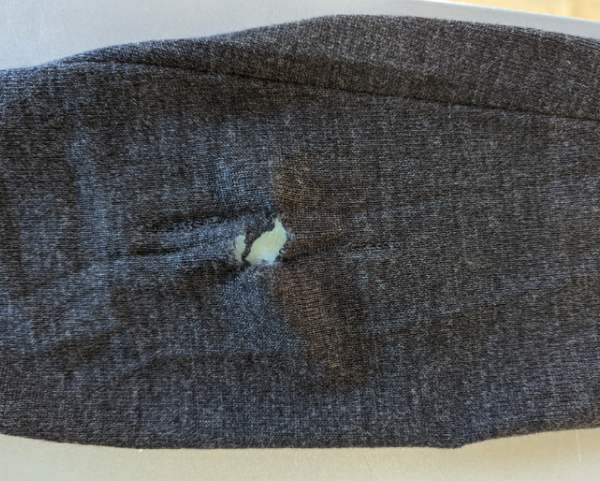
The kind of photo we used to get at customer service.
Several customers tell us that, because it’s so fine, the sweater quickly wears through at the elbows. So we stop selling it. And we look for a solution. We dive into a whirlwind of lab tests and prototype launches to confirm or rule out every one of our hypotheses.
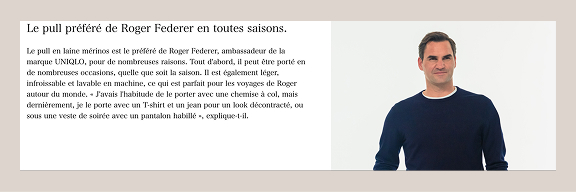
Hypothesis 1: Do other brands’ fine wool sweaters wear through as quickly as ours? Yes, even the €39.90 one from Uniqlo.
Roger clearly doesn’t lean his elbows on a desk very often.
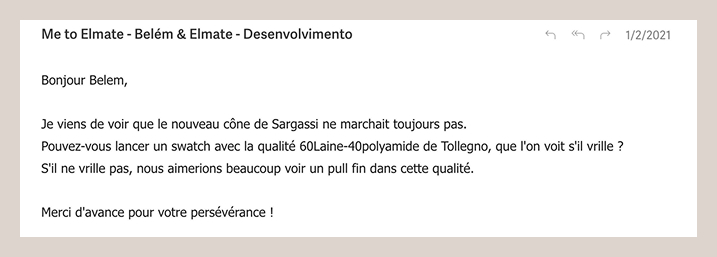
Hypothesis 2 : Does adding a bit of synthetic fibre work? No.
Email sent to the factory that knits our sweaters, asking them to add polyamide to the sweater. Spoiler: it came out all twisted.
Hypothesis 3 : Can we knit it with synthetic fibre added only at the elbows? Yes, but then the sweater becomes ridiculously expensive…
After a few months, we have to face facts: we need to launch this fine-knit sweater… in 100% cotton. Because when it comes to abrasion, it’s no contest: cotton is far more resistant than wool.
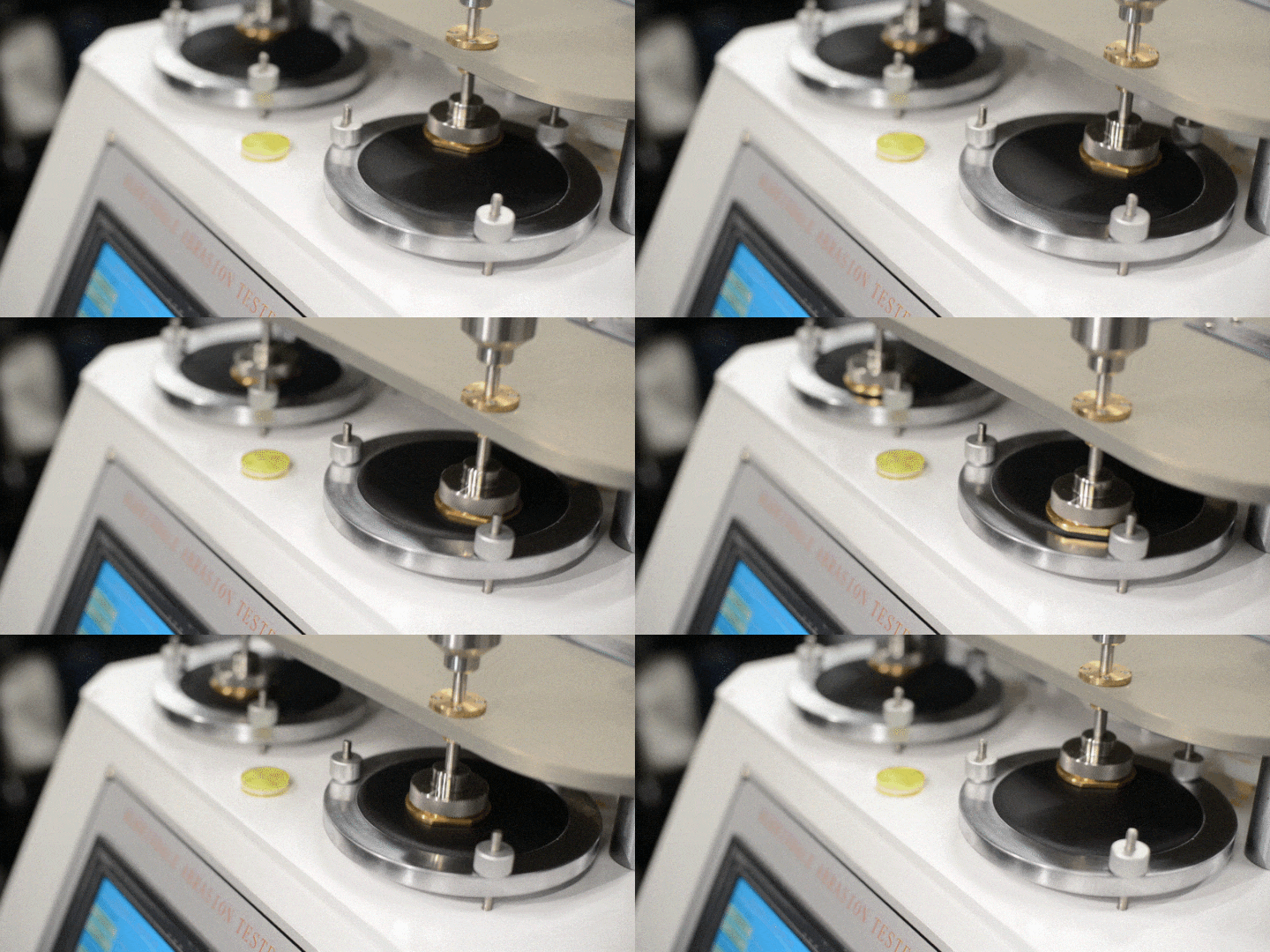
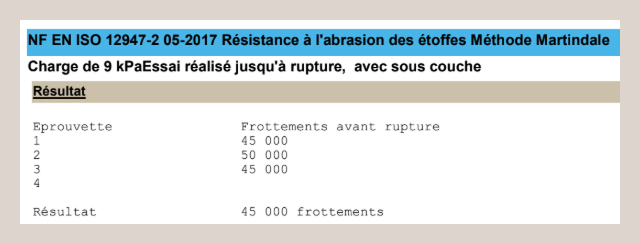
When we test it in the lab, our cotton fine-knit sweater prototype withstands 80,000 cycles, compared with 14,000 for its wool equivalent.
So in 2020, we release the 2nd generation of our fine-knit sweater, in Egyptian organic cotton with deep colours. This time, no more holes at the elbows… but we’ve lost the benefits of wool: odour resistance, warmth and shape retention. Don’t get us wrong: this sweater is really not bad (our customers give it an average rating of 4.8/5), but we just can’t bring ourselves to be satisfied with it. So, here too, we decide to stop selling it. We tell ourselves we’ll never manage to make a fine-knit sweater that’s both warm and durable, and we drop the project. Until one day in February 2024, when a factory tells us about a 53% wool, 47% cotton blend yarn. And then, LIGHTBULB MOMENT: could this be the answer to a fine-knit sweater that’s warm, good-looking, and resistant to losing its shape AND to abrasion? Without a second thought, we develop a prototype and test it in the lab. The results:
This fine-knit sweater is 3 times more resistant at the elbows than a 100% wool one (which, as a reminder, only lasted 14,000 cycles).
This fine-knit sweater is 2 times more resistant to losing its shape than a 100% cotton one.
Champagne! We hug, we cry, we start a conga line: at last, we’ve found the revolutionary process for making a fine-knit sweater that holds up. We can finally launch our 3rd-generation fine-knit sweater. Except that when we tell the rest of the team about this INCREDIBLE innovation, we get awkward silences at best, and more often than not, barely concealed mockery: “wow, you’ve made a sweater in a wool-cotton blend…”
Luckily, it’s all water off a duck’s back. We won’t be inviting them to the ceremony when we win first prize at the Concours Lépine, France’s famous inventors’ competition.
Julia & Guillaume
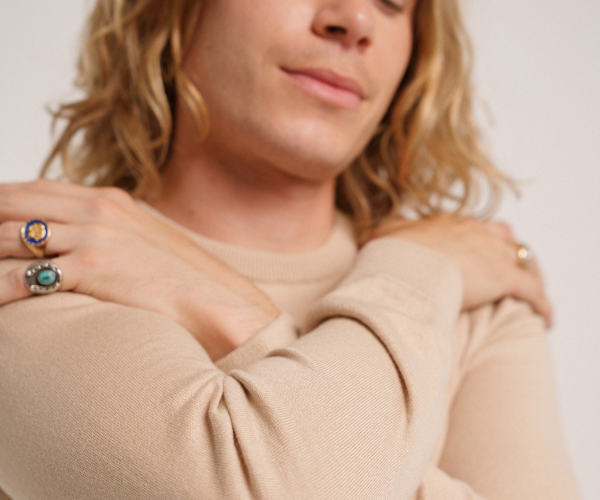
The 3rd-generation fine-knit sweater – good-looking too, isn’t it?
Lorem ipsum dolor sit amet, consectetur adipiscing elit, sed do eiusmod tempor incididunt ut labore et dolore magna aliqua. Ut enim ad minim veniam, quis nostrud exercitation ullamco laboris nisi ut aliquip ex ea commodo consequat. Duis aute irure dolor in reprehenderit in voluptate velit esse cillum dolore eu fugiat nulla pariatur.


.jpg)





.jpg)
.jpg)