Before getting to the heart of the matter, let’s set out a few orders of magnitude on how many new clothes are bought every year. In France, without even counting bed linen, towels and shoes, 2.7 billion garments were put on the market in 20221. That’s more than boxes of six eggs.
In 2022, we got through clothes faster than boxes of eggs. Source: En Mode Climat.
Once you take out unsold stock2, that works out at an average of 40 new garments per person in France every year3. That’s a lot: in the 1980s, it was about half that4. Were people badly dressed back then? We’ll let you be the judge, but they did have something to put on their backs.
Proof that BHL (the French philosopher) didn’t invent the shirt unbuttoned down to the navel.
2. For the planet, we need to buy less
Consuming clothes on such a massive scale has environmental consequences. We’ve already described them in several articles: greenhouse gas emissions, destruction of biodiversity, microplastics… If you don’t have time to read them, remember one thing: to produce is to pollute.
Could we cut that pollution significantly and quickly, while keeping consumption at the same level, by relying on technical innovation? It’s pretty unlikely:
The reductions that technical innovation can deliver are too small. Take “recycling”, for example, which brands often wave around as the ultimate solution: it would cut the textile sector’s greenhouse gas emissions and water consumption by only 5 or 6%, and even that would take enormous effort5.
These innovations aren’t rolling out fast enough. For example, many brands want to “decarbonise” their factories, in other words run them on green energy rather than gas, coal or oil… A great intention, but look at Bangladesh (France’s second-largest clothing supplier after China): the share of renewables in its electricity production is negligible and barely moving (see this article if you want to dig into cutting CO2 emissions in textiles).
The share of solar and wind in Bangladesh’s electricity mix = the almost invisible red line. Source: IEA.
Some technical innovations can help, but they can also act as a smokescreen that stops us seeing the elephant in the room: to produce is to pollute (again). So the fastest and most effective way to reduce fashion’s pollution really is to make fewer clothes.
But what the avalanche of reactions to the “de-salesman” ad suggests is this: even if buying fewer clothes were necessary from an environmental point of view, it would be a disaster from an economic one. We would risk pushing hundreds of clothing companies over the edge and out of business. In other words, the ad has reopened a kind of “end of the world vs. end of the month” debate, this time applied to companies.
So is that really true? Would buying fewer clothes inevitably cause an economic disaster?
3. For the economy, we need to buy less and make more locally
Before we talk about the economic health of clothing companies, let’s start with the health of the country as a whole.
The risks of overconsumption for the French economy
Since most textile factories are in Asia, every time we buy a garment, money leaves France.
Where the clothes bought in France are made. Or Pac-Man wearing a shirt. Source: FIMIF
In 2021, with a deficit of over €12 billion, textiles were our third-biggest loss-making industry, on its own responsible for more than 20% of the overall trade deficit excluding energy6. And France’s gaping trade deficits have consequences. To pay for them, we have to borrow from other countries. There’s more detail in this report, but to put it (very) simply, it’s like borrowing money from the bank to eat out every day instead of cooking at home.
Now, borrowing isn’t necessarily a bad thing: it makes sense if it’s to buy rare metals to invest in the energy transition, or machinery to bring our pharmaceutical industry back home. But if it’s to ship in billions of low-cost garments, it simply means living beyond our means. And that can’t go on forever7. So all these clothes imported from abroad are money we won’t be able to invest in things that are actually useful to our economy.
Then there’s the tax revenue the country misses out on, with all those factories moved abroad. Fewer companies in France means less tax collected, and in the end less money to pay for schools and hospitals.
In short, this overconsumption of imported clothing is risky for the French economy as a whole. But if we look at the clothing sector itself, wouldn’t buying less put retailers that are already struggling in even more danger?
The problem with French textiles isn’t buying less, it’s low cost
Yes, 2022 and 2023 were catastrophic for some French brands. You may remember the bankruptcies of Camaïeu, Kookaï, San Marina, Jennyfer and Pimkie… It is clearly a very hard period to get through.
But what’s behind it? Is it because the French, on the whole, have started buying far fewer clothes because of inflation and falling purchasing power?
That doesn’t really seem to be the case. We don’t have official figures for 2023 yet, but in 2022 the number of garments produced kept on rising (+2%8). And what we can see is that some brands are doing rather well. Kiabi grew its sales by 10% in 2022, and the foreign fast fashion chains are breaking every record, whether Uniqlo, H&M, Zara or Primark9. Not forgetting, of course, the ultra fast fashion newcomers like Shein and Temu.
In other words, what’s hurting these chains isn’t that the French have become more frugal with clothes: it’s that inflation has pushed shoppers towards low-cost chains10. And it really is the cheap chains that now capture most of French clothing spending: 7 out of 10 garments sold in France are now low cost11. It’s striking when you look at the top 10 best-selling brands in France:
Market share by volume of the 10 biggest chains in France in 202312
OK, but even if the market is dominated by these low-cost chains, French or foreign, that must still mean a lot of retail jobs, right? If the French really did start buying fewer clothes over the next few years, wouldn’t that risk creating unemployment?
Far from it. Over the past 50 years, the very rapid rise in the number of garments sold hasn’t created jobs in clothing retail. Quite the opposite.
Between 1971 and today, while the volume of clothes consumed has more than doubled, 30,000 jobs have disappeared from clothing retail13. We have never bought so many clothes, and we have never had so few jobs in shops. Is online shopping to blame? Partly, but not as much as you’d think. Look at the figures: retail jobs in clothing had already fallen sharply before the internet took off14.
The real culprit behind the loss of clothing retail jobs in France is low cost. The relative price of clothes (compared with income) has halved in 30 years. So shops may well sell more clothes, but they don’t earn more from them15. Roughly speaking, selling clothes used to keep a lot of small shops going; today, cheap clothes are sold in bigger stores that shift huge quantities with fewer staff.
And shops aren’t the only place where low cost has wiped out jobs. It has destroyed a huge number elsewhere in textiles too:
In factories: as fewer and fewer of these clothes are made in France, the number of jobs in the textile industry has been divided by three in 30 years16.
In alteration workshops and cobblers’ shops: since the French now buy far more new clothes, they have fewer of them repaired. To give you an idea, the number of cobblers in France has gone from 45,000 in the 1950s17… to just 3,500 today18.
And then there are all the indirect jobs lost in the old textile regions: when a factory closes, the bakery, the café, the bank and the post office close too. In hard-hit textile areas such as the Nord, the Aube or the Vosges (in northern and eastern France), unemployment remains far higher than in the rest of the country19.
Roubaix, in northern France, once known as the “city of a thousand chimneys” and the former capital of French textiles, now has nearly 30% unemployment20.
***** A short aside *****
But low-cost chains are a good thing, surely: they let poorer people dress themselves, don’t they?
Yes, but no. It’s true that cheap clothes boost purchasing power and make it easier for some struggling households in France to buy new clothes. But take a step back and you realise it’s a poisoned gift:
Working-class people are the first victims of low cost: the offshoring of the textile industry since the 1980s has destroyed a huge number of jobs, as explained above. Some of those former factory jobs (making our clothes here) have turned into jobs in logistics and transport (importing our clothes from abroad), but there are fewer of them, and they are more precarious and worse paid.
Clothes are so absurdly cheap and the pressure to consume so strong (new collections, promotions…) that even people on low incomes can end up buying more than they had budgeted for (like the woman in this documentary who is “often counting every euro”).
Offshoring means lost tax revenue for the country, with all those factories moved abroad. Fewer companies in France means less tax collected, and in the end less money to fund education and healthcare. And public services are the wealth of those who have none.
Poorer people are the first to suffer the long-term consequences of overconsumption, especially those of climate change
Most low-cost sales are not made by the poorest: if 7 out of 10 garments sold in France are cheap ones, it’s because the customers of low-cost chains go well beyond the poorest households. So the argument that low-cost models should be supported in their name is seriously skewed.
***** End of aside *****
If we bring the industry home, we can buy less and still have healthy companies
To create wealth and jobs in textiles again, we need to go back to… how things used to be: making fewer clothes, but making them closer to home, in France or in Europe.
That would create jobs:
In factories: to give you an idea, the textile industry in Italy still employs 464,000 people, compared with just 105,000 in France21.
In clothing shops, since higher-value garments would allow retailers to earn a better living;
In alteration workshops and cobblers’ shops: fewer new clothes means more clothes getting repaired;
Not forgetting indirect jobs: when a factory sets up somewhere, it brings work to the other factories around it and to local shops22.
And as a bonus, it would mean not wrecking our planet and not making clothes on the other side of the world in shameful conditions. Remember that in terms of purchasing power, working in textiles in Bangladesh is like working more than 60 hours a week in France23 for around €391 a month24 (even after the recent pay rises won through mass protests in the country). How can anyone live decently on that?
It’s understandable that the video upset some clothing retailers, who felt that in the short term, a message telling people to buy less could hurt them even more. But let’s not pick the wrong enemy: the real threat to the textile sector isn’t buying less, it’s low cost. The absurdly low prices in fashion endanger our environment and make it impossible to pay manufacturers and shops properly. Buying less, on the other hand, can be a source of hope, as long as “buy less” comes with “buy better”: clothes made closer to home, sold at inevitably higher prices, but providing a decent income for everyone.
What the government can be blamed for, when it comes to this video, is stopping at an awareness campaign aimed at the general public, when the problem needs tackling at the root, with laws that encourage buying less and producing locally. For example: penalising fast fashion brands that make clothes on poverty wages and push customers to buy ever more (which is what we, along with many other clothing brands, are calling for through the En Mode Climat movement).
In the end, what the outcry over a video that simply encourages people to buy less reveals is a belief that “restraint” and “prosperity” must be at odds. But the textile example shows that this opposition isn’t backed by the numbers: if we bring production home, we can have both.
Finally, by turning a blind eye to the environmental consequences of what they produce, companies are sawing off the branch they’re sitting on. In the long run, they will need energy to run their machines, resources to feed them and healthy people to work in them… in short, the very preconditions that the ecological crisis is destroying bit by bit. The economy doesn’t float in mid-air: there will never be healthy companies on a burnt-out planet.
To go further:
Read the excellent book La Sobriété Gagnante by Benjamin Brice, which shows that consuming less should be seen not as a constraint but as an opportunity for our economy. Combined with an ambitious policy of bringing industrial activity back home, it can help us reduce our environmental footprint, our deficits and our social inequalities all at once.
Watch this debate we took part in, which covers the main arguments of this article.
Who are we to say this?
You’re reading La Mode à l’Envers, a blog run by the clothing brand Loom. The textile industry is coming apart at the seams, and the planet is footing the bill. So whatever we manage to understand about this industry, we try to explain here. Because making clothes that last is good, but revealing, sharing and inspiring is even more powerful.
We never run ads: if you like what we write and want more, subscribe to our newsletter by clicking here. We promise: we’ll write to you once a month at most.
2 3.3 billion * 83% clothing / 67.8 million inhabitants * 99% = 40 garments per person. Only 1% of textiles go unsold. See the 2021 Ademe report: “Étude des gisements et des causes des invendus non alimentaires et de leurs voies d’écoulement” (study of unsold non-food goods): gross unsold stock represents 4.1% of turnover in the clothing and footwear sector. 65% of that unsold stock is then sold on to discounters, 20% is donated to charities, 10% is recycled or repaired and 5% is destroyed. So of the items declared “unsold”, at most 20% can be assumed to end up destroyed or “downcycled” (if we assume that some donations to charities end up that way). In the end, destroyed unsold stock therefore represents less than 1% of sales (20% x 4.1% = 0.8%).
3 If you add shoes and household linen, it comes to almost 50 textile items per person in France.
4 In 1984, clothing consumption in France was 1.3 billion items, or 23 garments per inhabitant. Source: 1984 INSEE survey of 7,500 households (INSEE is the French national statistics office).
5 Quantis, Measuring Fashion, 2018: reaching 40% recycled fibres would cut greenhouse gas emissions by 5.9% and water consumption by 4.5%.
7 France’s net international investment position (how much France owes the rest of the world) stands at -€800 billion, or 32% of GDP. France is getting close to the ceiling of 35% of GDP set by European agreements. That figure is only a convention: exceeding it wouldn’t be dramatic in itself, but it shows there are limits you shouldn’t cross if you want a healthy economy. Note that in the early 2000s, France was still a net creditor (in other words, it had a positive net international investment position). Source.
9 We don’t know the details of their figures for the French market, but there is no reason to think they aren’t growing there too.
10 Some experts also point out that these brands missed the digital turn or didn’t invest enough in their “branding”. That may play a part too, but probably less than the shift towards cheaper prices in a period of inflation. Take Leclerc, the supermarket chain: being nothing special at branding or e-commerce doesn’t stop it being the second-biggest clothing seller in France...
13 INSEE sources, in full-time equivalents, employees + self-employed. For 1971, we rely on the annual business survey, which puts the figure at 161,000 in clothing and 32,620 in footwear. For current jobs, we rely on the 2009 retail outlets survey, which puts the figure at 134,608 in clothing and 27,914 in footwear.
14 The INSEE retail outlets survey that shows the job losses in retail dates from 2009, when online clothing sales were still a small share of the market. You could also blame supermarkets for destroying clothing retail jobs, but they don’t account for that big a share of clothing sales: in 2011, 17% of clothing sales were made in supermarkets, according to INSEE.
15 Over the past 30 years, clothing prices have stayed fairly stable in absolute terms (between 1990 and 2020, clothing prices rose by only 15%, according to INSEE), but average incomes in France have more than doubled (gross discretionary income per person rose by 92% between 1990 and 2020, according to INSEE, source). So for a retailer to reach an income comparable to 30 years ago, they have to sell almost twice as many clothes.
18 3,462 businesses registered in the RNM (the French trades register) under activity code 95.23Z, Ademe 2022 study “Fonds réemploi réutilisation réparation de la filière TLC”, assuming one job per business.
19 Unemployment rate, Q3 2021, according to INSEE: 10.0% in the Nord, 10.2% in the Aube, 8.5% in the Vosges vs. 7.9% in mainland France.
20 Source INSEE 2020: 29.7% unemployment among 15-64 year olds in Roubaix. And with the closure of Camaïeu, which had its head office in Roubaix, misfortune keeps piling up on a city that is more than ever a victim of low-cost textiles.
22 It is generally accepted that one industrial job generates two to three indirect jobs at other industrial companies, plus induced jobs in services and shops across the surrounding area. Source: Anaïs Voy-Gillis, reindustrialisation specialist.
23 The Garment Worker Diaries initiative reports that between December 2021 and December 2022, Bangladeshi garment workers worked an average of 248 hours a month, or 62 hours a week (source).
24 The minimum wage in Bangladesh has just been raised to 12,500 taka after the recent protests. But according to the Asia Floor Wage Alliance, a living wage there is 53,104 taka, so the current minimum wage is 24% of a living wage. Since a living wage in France is €1,630 (source), it’s as if someone in France were paid €391 a month. Source: Clean Clothes Campaign.
In January 2019, we explained in this article how our socks came to be: 2 years of research and development with a factory in the Tarn region to create ultra-durable, made-in-France socks. How did we do it? We added "Cordura" reinforcements to high-wear areas—a military-grade yarn with exceptional abrasion resistance. This allowed us to achieve incredible lab results: resistance to over 150,000 abrasion cycles, whereas other socks would develop holes after just 10,000.
But that was just the theory.
3 years later, have these socks lived up to their promises in the real world?
It’s an interesting question to ask at this stage, because over 90% of the socks on the market last less than 3 years. We know this for a fact... because you told us so:
100% - 9% = over 90%. The math checks out, Blandine.
To find out if our socks really last longer, we simply decided to email all our customers who have owned them for at least 3 years and ask them: "Have your socks developed any holes?"
The answer:
Three-quarters of our customers haven't had a single hole in their Loom socks after 3 years. That’s already much better than the average sock, but we think they’re actually performing even better than that... Fortunately, we asked a second question: "Where did your socks develop holes?"
The answer:
Most people found holes around the Achilles tendon. This didn't surprise us much: over time, we realized that this area was essentially the... Achilles' heel of our socks.
Thanks to this customer for posing to help us explain the issue.
In the meantime, we created a second generation of these socks where we raised the Cordura reinforcement by a few centimeters (among other improvements) to protect this area from harsh friction against the back of your shoes.
Our 2nd generation socks with a higher Cordura reinforcement.
In short, these 2nd generation socks are much less likely to develop holes. If we take a stab at some clever math, we could even estimate that 84% of our customers wouldn't have worn holes in their socks after 3 years if they’d been wearing our 2nd generation ones.
In other words, if standard socks have a 1 in 10 chance of making it to the 3-year mark, ours have an 8 in 10 chance. It’s not a stretch to say our socks are 8 times more durable than the rest ;-).
“I’ll calculate the derivative, integrate the linear function, carry the 2, put down the 3, and conclude that YOUR STATISTICAL ANALYSIS IS COMPLETELY BROKEN”
To back up our number-crunching with some “qualitative” analysis, here are a few testimonials:
“I’ve never seen socks last this long; their lifespan is at least 10 times longer than the ones I had before.” - Martin
“I can hardly believe they still don’t have any holes.” - Elisabeth
“I was a career soldier, and I was provided with socks to go with my uniform the whole time. Twelve years after leaving active duty, I threw away the last pair I was issued. That’s how solid those products were. And after that... despair!! It was impossible to find socks that lasted more than a year. Then I discovered Loom, and I found socks that last and are actually comfortable, too.” - Marc
The bottom line: we can confirm that yes, our socks have kept their promise of longevity in the real world.
Could we make even tougher socks? Maybe by replacing the cotton entirely with polyamide, or by using a much thicker fabric... in short, by making technical socks. But our goal is to make everyday city socks, not to outfit your friends who have become obsessed with trail running (yes, we have friends like that too).
Anyway, while we’re generally advocates of “we can always do better,” we’re going to stop here with these socks. We think we’ve found the perfect balance between comfort (which is what we hear from those who wear them), quality (they are significantly more durable than average), and ethics (made in France with organic cotton).
What this means is that there won’t be a next “generation.” This is the first time we’ve been able to write that on our website:
Yes, the “final” generation!
We know some people who don’t ask themselves the same questions we do.
These socks are the first to reach this milestone, but other items in our collection will very likely reach their final generation in the coming months as well. For example, we think there isn’t much left to improve on our boxer briefs, our oxford shirt, our chino or our belt for example. It’s normal: we’ve been developing, testing, selling, and improving our clothes for 6 years, so there’s bound to be a point where the saying “perfect is the enemy of good” rings true.
“Does that mean these products will never evolve again?”
No, because we will always have to slightly adjust our fits, size charts, and colors, production after production – and that will never stop. But there won’t be any more major changes: if you buy a sock today and another one in 5 years, they’ll make a perfect pair—they’ll look exactly the same.
In any case, even though we’ve significantly improved these socks, the price hasn’t budged: the final generation of these ultra-durable, made-in-France socks is still €12.
Other things that have changed between the first and second generation of our socks
- Switched from a tag to a band: originally, we attached our tag with a small stitch. But some people were damaging their socks when removing it. So, we replaced the sewn-on tag with a band.
- Switched to a honeycomb elastic: for the first generation of these socks, we used a narrow, strong elastic to keep them from slipping. For some calves, it was too tight. For the second version, we replaced that elastic with a wide honeycomb band, which distributes the tension over a larger area. This provides the same hold without the tightness. Plus, it looks better.
- Added size labels to the sole: oh yes: at first, our socks were plain, with no markings at all. We believe this anonymity caused serious tension in couples and families where multiple members were fans of Loom socks. Following our instinct for disruptive innovation, we courageously added the size to the sole of the foot.
- Reinforced the ankle bone: the area where the 3 different threads meet can be a weak point, especially if the foot is a bit wide or if you’ve chosen a size that’s a little too small. We reduced this issue by raising the reinforcement under the foot so it better protects the ankle bone.
Switched to organic cotton: at first, we used conventional (i.e., “non-organic”) cotton. But in the meantime, we realized that it was really a bad idea, and we changed it.
Dozens of you have told us: our raw jeans (the darkest wash) bleed. Sometimes with dramatic consequences, like the time they stained a customer’s sofa (which was beige) ((and didn’t have removable covers)).
That’s right: like almost all jeans, ours are dyed with indigo. And unlike most cotton dyes, which are known as “reactive” dyes and penetrate right to the core of the yarn, indigo is a so-called “pigment” dye that sits on the surface of the yarn without fully soaking in. That’s actually what makes jeans such beautiful garments: the colour is slightly uneven, it develops a patina wherever there’s friction… in short, it’s alive.
The problem is that when you buy jeans in a raw wash (= neither faded at the factory nor washed at home yet), the indigo can sometimes rub off onto whatever they touch: skin, clothes… and sofas.
Our care instructions do warn you to be careful and not to wear them with your spotless white shoes when it’s raining… but that isn’t always enough. And every now and then, you tell us you’re disappointed by how much these raw jeans bleed.
So we asked ourselves two questions:
Do our jeans really bleed more than others? (If so, we’ll need to find a new way of doing things with our denim supplier.)
How can you limit bleeding in raw jeans?
This article sets out to answer both questions with some home-made tests.
Yes, our jeans bleed, but no more than other brands’ jeans
In fact, when customers tell us their jeans have “bled”, they actually mean one of two things: 1- bleeding in water: when you wash your white t-shirts with your jeans and they come out blue, and 2- colour transfer through rubbing: when you rub your hands on your thighs and they – too – turn blue.
To find out whether our jeans bleed more than others, I soaked jeans from several brands (ours included, obviously) for an hour, stirring each pair for 4 minutes, then compared the colour of the soaking water.
"We are the champions, we are the champions, we are - we are - we are the champions"
Great news: of the 4 brands of jeans I tested, ours bled the least.
The colour transfer rub test
It’s lovely to see that Loom’s jeans bleed the least, but I’d rather run a second test to be absolutely sure: the rub test. I rubbed each pair by hand with white fabric for exactly 3 minutes, then compared the colour of the fabric.
The result is less glorious than the first test’s: of the 4 pairs tested, the Muji jeans bled the least. Loom’s jeans, on the other hand, bled just as much as two others: the COS and the Levi’s.
Back down to earth.
So, based on these two tests, there’s nothing to worry about: our jeans do bleed, but no more than other brands’. No reason to change our manufacturing process with our supplier, then (which would be very difficult and extremely costly anyway…).
Our tips to keep your jeans from bleeding
Right, there’s no doubt about it now: our jeans bleed. But are there ways to set the dye better at home? I found plenty of “grandma’s tricks” online: soaking your jeans in a basin of water with vinegar or coarse salt, washing them at a high temperature… But do they really work?
You know me by now: I tested every one of these methods. And since our jeans bleed very little in water, I focused on rub tests for colour transfer. So I cut 6 squares out of our jeans:
New denim,
New denim washed 3 times at 30°C and air-dried,
New denim soaked overnight in water and vinegar, rinsed the next day and air-dried,
New denim soaked overnight in salt water, rinsed the next day and air-dried,
New denim soaked overnight in salt water + vinegar, rinsed the next day and air-dried,
New denim washed 3 times at 60°C and air-dried.
To improve my rub test, I had the idea of using my electric sander with white fabric in place of the sandpaper, and “sanding” each square for 3 minutes. This upgraded method has two advantages: the results are much more marked, and it’s kinder to my wrist.
The verdict is clear: the best trick to stop your jeans bleeding is to wash them 3 times at 60°C (6). The denim soaked overnight in salt water (4) also gives very good results, followed by the denim washed 3 times at 30°C (2). On the other hand, the squares soaked overnight in vinegar water, with or without salt (3 and 5), show nothing conclusive: they bleed just as much as the new denim (1).
Conclusion
So the most effective way to limit colour transfer through rubbing is to wash your jeans 3 times at 60°C. But that’s not at all what I’ve chosen to recommend, because 1- it will fade your jeans considerably (they’ll lose their lovely raw colour) and 2- they could shrink in the washing machine.
The denim washed 3 times at 60°C (square 6, on the right) faded the most. The denim washed 3 times at 30°C (square 2) faded only slightly compared with the new denim (square 1). The squares soaked in vinegar and/or salt water didn’t fade at all. In fact, if you’re going to wash your jeans 3 times at 60°C, you might as well buy stone-wash jeans (= already faded at the factory) in the first place! It comes to much the same thing, with far less hassle.
So if you want to set the dye better AND keep your jeans a lovely raw colour, I recommend the salt water method: leave your new jeans to soak overnight in a basin of lukewarm water with a glass of coarse salt dissolved in it (salt helps fix the colour). Then wash them at 30°C with other dark clothes and let them air-dry.
But it will never work miracles: raw jeans, whatever the brand, will bleed the first few times you wear them. So until you’ve washed them at least three times, avoid wearing white sneakers or sitting on a light-coloured sofa.
And if you’d rather not worry about any of this, I’d suggest going for jeans that have already been faded at the factory, like the stone (a slightly lighter wash than raw) or the bleached (a much paler wash), as they bleed far less.
Who am I to give you advice on caring for your clothes?
My name is Claire, and I keep track of production at Loom. Basically, I try to keep things from going out of stock on our site (it’s not perfect yet, but I’m working on it), and I make sure at every stage of manufacturing that our clothes meet our quality standards. On top of that, I’m passionate about anything that helps our clothes last longer: care, repairs and good old grandma’s tricks. I love giving clothes “a little extra soul”: reworking them, mending them, giving them another chance when nobody wants them any more. On these pages, I’ll try to pass on whatever I know that might come in handy. One last thing: I’ve genuinely tried every tip you’ll find on this site and checked for myself that it works (in other words, it’s not just copied and pasted from a quick internet search). If you have new ones to suggest, feel free to leave a comment below this article.
Before we get to recycled polyester, let us introduce its “virgin” version (in other words, not recycled). And to do that, we'd like to show you the company that calls itself the biggest textile company in the world: Hengli.
If you were expecting thousands of women at sewing machines, think again. A Hengli factory in China looks more like this:
Two supertankers pouring millions of litres of oil into a mega-plant, where it goes through heavy industrial refining and steam-cracking steps until it becomes… polyester. That's right: polyester starts out as oil.
Polyester: the kind of growth curve finance ministers dream about.
How do you explain such a rise?
Because polyester has always been cheaper than cotton? Like most people, that's what we assumed. But look at the figures and it turns out not to be true. Until 2010, the two materials cost roughly the same2:
Price of polyester fibre versus cotton in Asia over time, in US cents per pound (click here for the full analysis).
The real reason polyester took off is that, for a lot of uses, it makes clothes that simply work better than cotton ones3:
Quick-drying clothes for sport: Nike, Adidas and Decathlon know all about that
Warmer or more waterproof clothes for the outdoors: it's no coincidence that Patagonia and The North Face were among the first to use it
More technical everyday clothes: think Uniqlo's Heattech to keep you warm or Airism to keep you cool
More fluid fabrics that crease less, perfect for women's dresses and tops
Materials that hold their shape better, ideal for joggers or leggings, for instance
Fabrics that stand up better to rubbing and washing, and are therefore used widely in workwear, upholstery and the medical sector.
And so on.
And where does the planet fit into all this?
At first glance, nothing alarming. To assess the environmental impact of materials – and tell their customers about it – most brands rely on the Higg Index. According to this tool, polyester is one of the greenest materials in the world… greener even than organic cotton!
Impact of various textile materials according to the Higg Index (click here for the source).
It's not completely absurd: in the giant polyester plants, the manufacturing process is so optimised and industrialised that, brought down to the scale of a single garment, the environmental impact may not be that high.
So is it true? Is polyester green?
Sadly, no.
First of all, the Higg Index may be the reference brands use the world over, but it offers little transparency about how it calculates things and isn't very reliable. According to a recent investigation, its assessment of polyester is based on data from a European plant, when the overwhelming majority of production happens in Asia, under environmental (and working) conditions that are probably a lot less glorious. In fact, after criticism from several media outlets and organisations, the index was officially put on hold in mid-2022 while independent auditors review its data and calculation methods.
But the main problem with the Higg Index isn't its lack of reliability: it's what it doesn't measure. Three things in particular.
1/ Making polyester also means making petrol
Back to Hengli, the Chinese polyester company. When they refine oil, they don't just get “naphtha”, the base product that will eventually become polyester. They also get a few liquids we all know: petrol, diesel, heating oil and kerosene.
The machine that refines oil:a sort of giant still, except no whisky comes out at the end
And they sell all of those products. In 2019, Hengli even became the first private Chinese company allowed to sell kerosene to airlines. And every year, they sell more than 6 million tonnes of petrol and diesel – over 10% of what the whole of France consumes (!)4.
Hengli is the perfect illustration of where the oil and gas industry is heading5: what drives demand now is plastics (yes, polyester is plastic), which will account for more than half of the growth in oil demand between now and 2050. When Uganda's dictator defends the economic logic of Total's highly controversial EACOP pipeline, what does he bring up? His polyester shirt, and the market for synthetic materials.
Who would have thought a canary-yellow shirt would serve as an alibi for one of the biggest climate bombs of our time? Ah, fashion, fashion, fashion…
So making synthetic materials like polyester brings in money for the oil industry. That in turn props up the production of petrol and kerosene, when fossil fuels are behind two-thirds of the world's CO2 emissions.
But polyester has another by-product that is almost as much of a headache: fast fashion.
2/ No polyester, no fast fashion
We all know about the disastrous environmental consequences of fast fashion and its 100 billion garments produced worldwide every year, mostly because of the greenhouse gases emitted while making them: spinning, weaving, dyeing, sewing…
What allowed the H&Ms and Zaras of this world to multiply was, first and foremost, rock-bottom prices (obtained by moving production to countries with poorly paid workers) and a frantic turnover of collections designed to make people buy more. As we've seen, cheap polyester is not what made fast fashion possible in the 1990s and 2000s: until 2010, its price was about the same as cotton's.
But fast fashion could never have grown so big without a glut of polyester on the market. Today, synthetics make up 64% of all textile materials. If fast fashion had to do without them – and switch to cotton, say – there almost certainly wouldn't be enough natural fibre to keep up these production levels: it would take nearly 7% of our arable land (versus 2.5% today), as much as we use to grow every fruit and vegetable on the planet. Hard to imagine with soils losing fertility and the climate in crisis.
In other words, polyester may not be what got fast fashion started, but it is what keeps it alive today. It's the fuel that keeps the fast-fashion engine running, the one thing you can't do without if you want to churn out ever more clothes.
And you can't talk about polyester without mentioning ultra fast fashion. Shein, the new giant of global fashion, makes 85% of its clothes from polyester. If this Chinese brand was able to emerge a few years ago, it is partly thanks to the recent collapse in polyester prices, itself caused by the drop in the price of its main component (ethylene) brought on by shale gas extraction in the United States. Without shale gas and dirt-cheap polyester, this ultra fast fashion might never have existed at all.
No shale, no Shein.
Finally, polyester's third problem has nothing to do with how it's made… but with what happens to it afterwards.
3/ Polyester and microplastics
Back to our famous Higg Index one more time: we still hadn't told you everything (no wonder it was put on hold). The index relies on a so-called “cradle-to-gate” life-cycle assessment – from raw material to factory gate – which means it leaves out how products are used and what happens at the end of their life. And for polyester, those two phases are where the serious trouble starts.
First, when you wash them or when you wear them, polyester clothes shed millions of microplastics into the environment6. The effects of these microfibres are still uncertain but potentially very dangerous for biodiversity, human health… and even global warming.
Then there's the end of life of polyester clothes, which isn't very glorious either. Once nobody wants them any more, there are only two options:
Either the clothes get incinerated, which produces greenhouse gases. Since polyester is made from oil, this is even worse than incinerating a cotton garment (burning oil releases CO2 that has been locked underground for millions of years, whereas cotton's carbon cycle is much shorter7: cotton plants capture CO2 as they grow). Not to mention some potentially toxic fumes, in particular from antimony, a carcinogenic compound found in polyester that turns up in incinerator ash.
Or the clothes end up in landfill or dumped in nature, particularly in Africa, which receives more than half of our used clothes. The problem is that plastic, unlike cotton or wool, doesn't biodegrade in the environment. Inevitably, these polyester garments will break down in the soil, century after century, into billions upon billions of microplastics (contrary to what you might think, the vast majority of polyester microfibres released into the environment come from end of life, not from our washing machines). As researcher Nathalie Gontard explains, plastics in landfill are a gigantic time bomb for the centuries to come.
Textile dump in Nairobi, photo taken from the excellent Trashion report (click here to read it).
In short: a choice between the plague and cholera.
Fast fashion brands can sense that all these problems with polyester aren't great for their image… and, in the end, not great for business either.
So they found a magic solution. Ladies and gentlemen, please welcome:
Chapter 2 – What's wrong with recycled polyester
A word of caution before we get to the heart of the matter. We don't want to point fingers at the small and medium-sized brands that use recycled polyester today. Choosing materials is an extremely complex subject, and there is so much misinformation around that any of us can fall for it… We certainly did: at Loom, we used to proudly explain why we used recycled polyester in our swim shorts, for example. Seeing clearly through all this is almost a full-time job! And of course, it's very awkward for an “ethical” brand not to use a material that looks green and that even fast fashion uses widely! What would its customers think?
Recycling draws on a very powerful image. Say the word and what comes to mind is nature's magic cycle: dead plants break down in the soil and, hey presto, the nutrients they release let a new plant grow. Nothing is lost, nothing is created, everything is transformed.
How our brain pictures recycling:so magical you could almost break into the Lion King soundtrack:“It's the Ciiiiiircle of life”.
A recent TV report filmed in a Primark shop showed just how powerful recycled materials are as a marketing tool. A customer interviewed at the till explains:
“They tell us it's recycled cotton, so it's doubly worth it. I feel less bad about buying it because I tell myself it's good for the planet.”
On top of that, recycled polyester is barely more expensive than virgin polyester8. Which makes it the absolutely perfect material for brands: it looks green, it sells by taking the guilt out of shopping, and it doesn't cost the earth.
So naturally, almost every fast fashion brand has jumped on board: today, 8% of the clothes sold worldwide are made with recycled polyester. That's 10 billion garments sold every year.
Thank you, recycled polyester, for giving brands billions of cute little labels as the ultimate proof that they've gone “sustainable”.
Even fashion's worst offenders have switched to recycled polyester. At Primark, 45% of the polyester is recycled. And Shein, the brand we mentioned earlier, now swears by it.
When we say recycled polyester doesn't cost an arm and a leg…
Today, fast fashion still rests largely on virgin polyester. But tomorrow, it could well be recycled polyester.
According to a report by the NGO Changing Markets Foundation, which asked 46 major brands about their strategy on synthetic materials, recycled polyester is “their main strategy for reducing their carbon footprint”.
But is it really the right strategy?
Not at all.
First of all, industrial recycling is a long way from the “magic cycle of nature” we mentioned earlier. True, it saves having to extract and refine oil. But it also takes a fair amount of machinery: transport, sorting, washing, shredding, melting, extruding into filament… and all that equipment needs energy and materials. According to the famous Higg Index, which can hardly be accused of being anti-polyester, the carbon footprint of a very efficiently recycled polyester (from the company Repreve) is only 42% lower than its non-recycled equivalent.
They look like little four-poster beds, but these are the machines that extrude polyester… recycled or not.
42% is still not bad, right? Except that to make a garment out of recycled polyester, you then have to go through all the usual steps: spinning, weaving or knitting, dyeing, sewing, distribution… And since the raw material only accounts for about 30% of the final footprint, the carbon impact of a garment made with a very good recycled polyester is only 13% lower than its virgin-polyester equivalent9. Well, it's something… but that order of magnitude makes it hard to claim the garment is “good for the planet”, to borrow the words of the Primark customer in the report.
And that's not the end of it.
For one thing, chemically, recycled polyester is exactly the same as ordinary polyester. So when it comes to use and end of life, the problem is the same as with virgin polyester: millions of plastic microfibres released into nature, and/or greenhouse gases and toxic fumes when it's incinerated.
And perhaps the biggest problem of all: this recycled polyester… doesn't come from other polyester clothes. Nobody today has the technology to recycle polyester garments at scale, mainly because polyester is often blended with other materials (like cotton or elastane) and contains a lot of impurities (starting with the dye).
In fact, 99% of recycled polyester comes from a source that is much easier to process industrially: PET plastic bottles, which happen to be made of the same molecules as polyester. To give you an idea, 13 plastic bottles give you enough yarn to make a t-shirt.
Rare picture of a Primark t-shirt, 2028 collection.
“Well, surely it's better for those plastic bottles to end up as polyester yarn than on a beach or in an open-air dump, no?”
Excellent question, Jean-Michel.
When fast fashion brands explain that their recycled polyester comes from plastic bottles, they often keep up the illusion that they are stopping plastic bottles from polluting the environment. The main supplier of recycled polyester yarn (Unifi) even says so on its website: “we created this yarn to build a more sustainable world, where we keep billions of plastic bottles out of landfill and the oceans”.
Touching… but the truth is quite different.
If those bottles hadn't been used to make polyester, they would in fact have been used to make… more plastic bottles. The reality is that the textile industry is grabbing plastic bottles that could be recycled several times over and turning them into clothes, which in turn cannot be recycled at scale.
The plastic bottle industry is actually furious with the textile industry for pinching most of its bottles to make “recycled” polyester10. Because textile companies take so many bottles, the bottle industry can't reach its own recycling targets. So it is asking for first access to its own bottles, ahead of other industries. Nicholas Hodac, head of the European soft drinks association, put it this way recently: “Using someone else's material – as the textile industry does with PET bottles – is not circularity. […] It is downcycling.” In the past few months, the bottle industry has even started trying to build its own street collection network to make sure it gets back as many bottles as possible and keeps them out of textiles. Even the European Union said as much in its recent strategy for sustainable textiles: “Such a practice is not in line with the circular model for plastic bottles”. And a European directive will require bottles to contain at least 25% recycled plastic from 2025.
Visual from the “Give us our bottles back” campaign: the bottle industry is not happy.
In short, the day may come when the textile industry can no longer get its hands on this stock of bottles to “recycle” into clothes… One more sign that polyester recycled from bottles is no magic answer to the textile industry's environmental problem. If anything, it works as a smokescreen that delays the wake-up call… and distracts us from the real solutions.
So what are they? How do we get a textile industry that can clothe the planet without destroying it at the same time?
Chapter 3 – The solution: reduction
First, could we imagine closed-loop recycling of polyester, using polyester from old clothes?
Still, there are a number of projects of this kind that give cause for hope. And – we're allowed a little national pride – France isn't badly placed here. The company Carbios claims it can recycle 90% of the polyester in clothes using a so-called “enzymatic” process and is currently building a pilot plant in Meurthe-et-Moselle, in north-eastern France. And the American company Eastman is investing a billion dollars to build, by 2025, the world's largest “chemical” polyester recycling plant near Le Havre, in Normandy (it will mainly take PET packaging, but Eastman says it can recycle textile polyester too).
Eastman's recycling plant in Tennessee,which will soon host a chemical recycling site like the one in Le Havre(soon we'll all be wearing a little piece of Tennessee).
But would closed-loop polyester recycling be enough to clean up the textile industry's act?
Unfortunately not.
First, there is still a lot of uncertainty about whether these projects can recycle textiles at scale, in terms of both cost and energy. For instance, the public consultation file for the giant Eastman plant tells us it hopes to recycle less than 3% of the volumes put on the market in France10. More to the point, that target is fairly theoretical, since Eastman admits that “the purity and design of textiles is a challenge” and would start with… “100% polyester seat belts”. We're still a long way from recycling Shein t-shirts or H&M dresses.
But let's picture an ideal world where polyester recycling is close to perfect. Let's imagine that:
half of all textile polyester comes from other polyester clothes (as a reminder, it's less than 1% today)
chemical or enzymatic recycling is ultra-efficient and gives recycled polyester a climate impact 70% lower than virgin (which is very, very optimistic)11
Under these ideal conditions, since the material only accounts for 30% of the impact (compared with making the garment itself), the reduction in climate impact across all polyester clothing production would come to… 10%13.
10%? That's barely more than the growth in worldwide sales of polyester clothing forecast for next year.
In other words, in terms of climate impact, if we pulled off the technological and industrial feat of rolling out garment-to-garment polyester recycling plants across the world, it would be exactly as if we had frozen the growth of polyester clothing for… one year. That is the first reason recycled polyester is a smokescreen: the word “recycled” gives us the illusion that we're solving the textile industry's pollution problem, when we're nowhere near the right order of magnitude.
In short, unless closed-loop recycling comes with a drastic cut in the amount of polyester clothing we consume, it will be a drop in the ocean.
This is actually a good moment to remember the good old three Rs: to cut the environmental impact of clothes, before recycling, you should first reuse – and, better still, reduce.
The 3R pyramid: recycle, yes, but only as a last resort.
So what does that mean in practice?
First, reuse.
Most of our clothes can have a second life, provided we look after them and repair them as much as we can. If needles (the sewing kind) scare you, thousands of alteration shops all over France are waiting for your clothes.
But there's another form of reuse, halfway between recycling and upcycling, that we may soon be able to count on: plants that automatically sort our old clothes by composition and colour, then tear them into fibre to spin new yarn that doesn't need dyeing again (which skips the dyeing stage, a huge energy consumer). That's the project run by CETI, a textile research centre near Lille, in northern France, together with several French mills. Admittedly, the yarns obtained so far are less perfect than those made from virgin material, but the initiative deserves support.
And finally (above all), reduction! When it comes to cutting fashion's environmental impact, everyone has a part to play.
What we can do as a brand:
Polyester makes up half of the world's textile fibres, and the share grows year after year. Sure, it's handy for quick-drying sportswear… but do we really need it to make dresses or t-shirts? Ideally, synthetic materials should be used in the smallest possible proportions, and only when there really is no alternative.
For clothes that do need synthetics, we can keep using recycled polyester (which is still a tiny bit less bad than the virgin version). But we mustn't lose sight of the orders of magnitude, which means not making a big deal of this material's supposed virtues: through a halo effect, customers might come away thinking the garment is “good for the planet”.
Focus on what really matters: not producing on the other side of the world, not launching a new collection every 2 days, and so on.
What the state can do:
Give the bottle industry first call on its own plastic, as many NGOs are asking. Without access to bottle-based recycled polyester, the textile industry could no longer hide behind this solution and would have to ask itself some real questions about reducing its environmental impact.
Penalise virgin polyester (and every other fossil-based material) in upcoming regulations, especially the environmental labelling scheme about to be rolled out in France and then across Europe. That is far from a done deal, because the European environmental labelling scheme is coordinated by the organisation behind the Higg Index – the very one that rates polyester as one of the greenest materials on the market.
Penalise fast fashion's business practices, which keep fuelling overconsumption. Alongside hundreds of other brands, that's what we're fighting for through the En Mode Climat coalition.
Favour natural materials, especially from low-impact and/or local farming: there are plenty of cases where you can easily do without polyester or other synthetics. And for anything worn next to the skin, they will always beat polyester because they resist odours better (underwear, t-shirts, shirts and so on).
We'd all love to believe the answer to the environmental crisis lies in one simple technical invention: a giant CO2 vacuum cleaner so we can keep burning fossil fuels, hydrogen planes so we can keep flying to New York for the weekend… and recycled polyester so we can keep buying more and more clothes. The real solutions to the textile problem are both simpler and harder for the clothing giants to swallow: first, they have to give up selling ever more. And for you, it means buying fewer clothes and pampering the ones you already own. The fight for the planet may well start in front of our washing machines…
And what about synthetics at Loom? We try to use as many natural materials as possible, but we do sometimes add a little synthetic material when it significantly extends the life of our clothes. Elastane: we put a small amount of elastane in our cotton trousers, our underwear and the ribbing of our cotton sweaters and sweatshirts, so they keep their shape over time. Polyamide: we use polyamide to reinforce our socks, our merino t-shirt and our backpack. Polyester: we use polyester in our swim shorts (because we can't see what could replace it), a little in our joggers (so they keep their shape) and in our chinos, in the form of elastomultiester (to stop the knees bagging).
Who are we to say this? You're reading La Mode à l'Envers, a blog run by the clothing brand Loom. The textile industry is hanging by a thread, and it's the planet that's footing the bill. So whatever we manage to understand about this industry, we try to explain here. Because making clothes that last is good, but lifting the lid, sharing and inspiring is even more powerful. We never advertise: if you like what we write and want more, subscribe to our newsletter by clicking here. We promise: one email a month at most.
Notes
1 In France, the textiles collected at end of life show a smaller share of polyester (only 19%). According to Refashion, two main reasons can explain the gap: “global textile production is not only for clothing (a multitude of technical uses, in construction or sports goods for example, absorb a lot of synthetic textiles); and synthetic clothes are probably collected less because they wear out more slowly or are seen as lower value (and therefore thrown out with household rubbish)”.
2 Admittedly, cotton loses a little more during spinning because of impurities and fibres that are too short, but the difference in loss compared with polyester is around 8%, so an impact of less than 1% on the price of the garment. Not enough to explain the explosion in polyester use.
3 Not in every case: cotton is better suited to clothes worn close to the body like t-shirts and underwear, or to clothes you want less shiny like shirts or jeans, and so on. Not forgetting other natural materials, like wool, which is better for warm clothes.
5 Admittedly, Hengli is a bit of a special case. Most of the time, it's conventional refineries that sell naphtha to polyester plants: so polyester is first and foremost a co-product of petrol (not the other way round).
6 The same goes for cellulosic fibres like cotton, but cotton fibres biodegrade more easily in the environment (in soil, though not necessarily in the ocean, where studies seem to show that dyed cotton fibres biodegrade poorly).
7 Nor does it mean the energy from incinerating cotton clothes should count as renewable: a lot of energy went into making them.
8 The price of recycled polyester pellets is actually lower than that of virgin pellets. But brands using recycled polyester have told us it is still slightly more expensive to buy, no doubt because production volumes are lower than for virgin polyester, so economies of scale are smaller.
11 The public consultation file mentions “20,000 tonnes of textile waste by 2028”.
12 There are still few life-cycle assessments of “fibre-to-fibre” polyester… But, for example, the first studies of enzymatic recycling, like this one, show a worse environmental balance than virgin polyester. This review of chemical recycling isn't very encouraging either.
13 Environmental gain = % of clothes recycled × % attributable to raw materials × climate gain from recycling = 50% × 30% × 70% = 10%
You don’t need to have the most obscure stain-removing soaps at home (ox gall, anyone?) or break the bank on the most expensive washing machine on the market. There’s just one thing to do:
Yes. Wherever you are. Even if it sometimes means spending the rest of your meal soaked to the skin because of a wine stain.
For the sceptics among you
I stained 4 pieces of cotton fabric, numbered 1 to 4, with the 3 types of stain there are: grease stains (olive oil), enzymatic stains (melted dark chocolate) and oxidisable stains (red wine), to answer two questions:
Is it really that bad to wait a few days before washing a stained garment?
Should you rub the stain with soap before putting the garment in the washing machine?
To find out, I washed my 4 fabrics in different ways:
Fabric no. 1 wasn’t soaped, but was machine-washed within an hour of being stained
Fabric no. 2 was soaped immediately, then machine-washed within an hour
Fabric no. 3 wasn’t soaped, and was machine-washed 7 days after being stained. Why 7 days? Because I do one wash a week, so a stained garment can end up sitting in my laundry basket for 7 days (which is a really bad idea, mind you)
Fabric no. 4 was soaped immediately, then machine-washed 7 days later
And here are the results after machine washing and air drying:
The verdict is clear: fabric no. 2 is almost spotless. So here’s my best advice when you’re faced with a stain: soap it immediately and put it in the wash as soon as you can.
If you can’t run a wash right away, still make sure you soap the stain immediately: the two soaped fabrics (no. 2 and no. 4) came out of the machine cleaner than the other two (you’ll have to take my word for it, as it doesn’t really show in the photo). And if you can, get it in the wash quickly too: the two fabrics washed 7 days after being stained (no. 3 and no. 4) came out less clean than the other two. It’s particularly visible with oxidisable stains (the wine stains at the bottom) and with enzymatic stains, because the chocolate went mouldy and marked the fabric (yuck).
Which soap should you use?
To give you the best possible advice in my care articles, I regularly look into the latest laundry and care trends (or sometimes the big scams) and add products to my long list of things to test. Plus, the comments are full of gems, like this one about a stain-removing soap:
Your sons can get the stains out of their own underpants, Valérie.
As I said above, I haven’t noticed any difference in effectiveness between the various soaps I’ve tested, whether “stain-specific” soaps (like ox gall soap or soap made with terre de Sommières, a French absorbent clay) or really basic supermarket soaps that cost next to nothing.
So while you’re at it, you might as well buy locally made soap. In France, we’re lucky to still have soap makers who produce soap the traditional way, such as the Fer à Cheval soap works in Marseille (we actually sell one of their soaps on the Loom website). Their soaps are made in cauldrons from olive pomace oil, which comes from the second pressing of the olives (the first gives you the olive oil you cook with). But any little bit of old soap will do the trick AS LONG AS YOU SOAP YOUR STAINS IMMEDIATELY, BEFORE THEY GO IN THE MACHINE.
PS: For grease stains, dish soap works very well too. Just make sure you pick a clear one, so it doesn’t leave a coloured mark.
Who am I to give you advice on clothes care? My name is Claire and I oversee production at Loom. Basically, I try to keep things from going out of stock on our site (OK, it’s not perfect yet, but I’m working on it) and I make sure, at every stage of manufacturing, that the clothes meet our quality standards. On top of that, I’m passionate about anything that helps our clothes last longer: care, repairs and good old grandma’s tricks. I love giving clothes a little extra soul, reworking them, repairing them, and giving them a second chance when no one else wants them. On these pages, I’ll try to pass on anything I know that might be useful to you. One last thing: I’ve personally tested every tip you’ll find on this site to make sure it actually works (in other words, this isn’t just a copy-paste of internet searches). If you have new ones to suggest, feel free to leave a comment below this article.
The clothes moth, whose old French name, “teigne”, also means a nasty piece of work (AND RIGHTLY SO), is a night-flying moth whose larvae feed on keratin. Their normal job in the ecosystem is to break down the slowest-decaying parts of animal carcasses: skin, fur, claws, horns, hooves, and so on. So we’re very grateful to these extremely useful little larvae, but we’d rather they left our wool sweaters alone.
Before putting your winter clothes away, you need to make sure no moths have moved into your wardrobe. Here are a few ways to find out for sure:
In your wardrobe: - while rummaging through your clothes or shaking out your sweaters, small silvery moths flew out (a clothes moth is just under 1 cm long), - you found white, cotton-like cocoons in the corners of your wardrobe (spoiler: those are moth cocoons),
On your clothes: - you’ve spotted some tell-tale holes: it looks as if a stitch has been pulled, but with no loose threads hanging from the hole, - one of your sweaters has several holes in the same area, - the holes are irregular and small (about 0.5 cm in diameter) and appear on animal-based fabrics, especially wool or silk.
The experts are clear: a moth has been there.
If you answered yes to any of these, take a deep breath and follow the guide:
How to get rid of moths
Or more accurately: how to get rid of moth larvae, because as we explained above, it’s the larvae that feed on keratin and chew holes in your sweaters. Adult moths, on the other hand, don’t eat: they have a lifespan of about ten days, during which their only goal is to find a suitable place to lay their eggs. #mumlife #proudmama
Moth larvae hate being disturbed, and their survival instinct can drive them to hide in any garment or nook (even though they only eat animal fibres in the end). So I’d recommend treating all the clothes stored near your holey woollens, as well as the wardrobe itself, to be sure you get every last larva. Here’s how:
For delicate or wool garments, leave them in the freezer for 72 hours, then wash them on a wool cycle at 30°C: the cold and the water should kill them,
For garments that can tolerate it (such as cotton clothing), wash them at 60°C and then tumble dry or iron them: the heat will put an end to their destructive habits,
Vacuum your wardrobe from top to bottom, paying close attention to the corners, to eliminate any moth cocoons,
Sprinkle diatomaceous earth in the corners of your wardrobe to kill off any larvae hiding there that the vacuum may have missed. It’s an algae powder you can find in supermarkets, and it works as a mechanical insecticide. Remember to vacuum it up after a week, as it can be irritating over the long term, and of course, be sure to read the warnings on the back of the bottle,
For extra peace of mind, you can also use pheromone moth traps that lure any remaining male moths, which then get stuck to them: that should put a stop to these little critters’ breeding.
No moth will be able to resist you.
Once you’ve done all that, you can put your clothes back in your wardrobe with a light heart. But don’t declare victory too soon: you now need to make sure the moths don't come back.
How to stop moths from moving in
To keep moths away from your wardrobe, there are a few things you should know:
First, moths love darkness and hate movement—yes, I’ve said it before, but it’s very important, so I’m saying it again. So don’t leave sweaters untouched in a wardrobe for years. Wear them often, and don’t buy sweaters you don’t need.
These critters love body odour. Remember to air your sweater at the end of the day after wearing it, for example by hanging it over the back of a chair.
Slip some cedar wood into your stack of sweaters to keep moths away. Add a drop of cedar essential oil to it every three months so it doesn’t lose its scent (and therefore its effectiveness).
Why cedar is the best moth repellent
To keep these wardrobe wreckers at bay, people traditionally used mothballs, until it emerged that they irritated the skin, eyes and airways in humans (especially children), and they were banned from sale in 2008.
With mothballs off the table, you have to fall back on the best-known natural repellent for clothes moths: cedarwood, which contains several types of alcohols that kill larvae (after all, that is how cedar protects itself from insects that might devour it). As early as 1682, there are writings recommending that woollens be stored in cedarwood wardrobes. A popular belief that was scientifically confirmed in 1952 by researchers Huddle and Mills with a crystal-clear conclusion: “Larvae exposed to 0.6 mg/l of cedarwood oil vapor had a 91% mortality rate within a week. Another batch of larvae exposed to 1-2 mg/l of cedarwood oil vapor had a 100% mortality rate within 8 to 24 hours of exposure. [...] ”. Splendid!
You can find cedar moth-repellent sticks in most supermarkets, but they are generally made from North American wood and then shaped in China. Which seems a shame: why import this kind of product when you live in a country full of cedar forests (aka France)?
So we went the extra mile at Loom and designed our own 100% local moth-repellent kit, working with these two great companies:
Tabletterie des Lacs (in the Jura mountains, in eastern France) made us discs of cedarwood from local forests, with a hole in the centre so you can either hang them on your coat hangers or slip them between your piles of sweaters.
Since the scent of cedarwood fades after a few months, we teamed up with Distillerie Bel Air (in the Gard, in southern France), which makes French cedar essential oil by traditional methods.
How do you repair a garment with moth holes?
You’ve finally got rid of your clothes moths for good, but their stay has left a few holes in your knitwear. To prevent these holes from getting bigger over time, I recommend mending them properly.
Option 1 - Do it yourself
Arm yourself with patience, a needle and darning wool in the right colour like this one and follow the instructions in this video, which explains step by step how to darn your holey sweaters.
There are also excellent, more in-depth courses to learn how to mend holes in your clothes:
You can also hand your sweaters over to specialist menders. One of them is Julie, founder of La Clinique du Pull, who is based in Paris but happily takes sweaters sent by post. She works wonders, as you can see:
For invisible, stitch-by-stitch darning like the one in the photo above, expect to pay around ten euros per hole. The result is completely invisible, but if a moth has feasted on your sweater, the bill can add up fast.
If your budget is tighter, or your sweater has so many holes it looks like a wheel of Emmental (PGI Savoie, no less), there’s the “patching” option, which is simpler to do: Julie knots together all the threads eaten by the moth larvae to prevent the hole from getting bigger, then covers the area with wool felt to hide and reinforce it. This technique costs a few euros per hole. I went for a visible patch in brightly coloured wool, but you can absolutely ask her for a tone-on-tone patch if you’d rather not look like a ladybird on ecstasy, as seen by someone colour-blind.
Big shout-out to La Clinique du Pull!
There you go: you now know just about everything there is to know about moths, their larvae, French cedar forests, and repair by patching. Take care of your wool sweaters and, most importantly: death to the moths!
Who am I to talk to you about garment care? My name is Claire and I keep track of production at Loom. Basically, I try to stop things selling out on our site (OK, it’s not perfect yet, but I’m working on it), and I make sure at every stage of manufacturing that the clothes meet our quality standards. On top of that, I’m passionate about anything that makes our clothes last longer: care, repairs and other grandma’s tricks. I love giving clothes “a little extra soul”, reworking them, repairing them, giving them another chance when nobody wants them any more. On these pages, I’ll try to pass on what I know that might come in handy. One last thing: I’ve genuinely tested every tip you’ll find on this site and checked for myself that they work (in other words, this isn’t copied and pasted from an internet search). If you have new ones to suggest, feel free to leave a comment below this article.
23 May 2022. We press the button that sends out the newsletter announcing the launch of our men’s blue jeans. At first sight, nothing revolutionary for a clothing brand. Except that these jeans are a bit special: they should take longer than most to wear through at the crotch. Getting there took us three years, a brand-new wear test invented with our laboratory, and, in the end, our own fabric developed in the Vosges mountains, in eastern France. Come along for the ride.
Crotch holes: the curse of jeans
Before we started making our jeans, we sent you a short questionnaire: “What’s the problem with your jeans, generally speaking?”. Simple question, simple answer: the problem is holes at the crotch.
We got this, times 500.
Yes: when you walk, one thigh rubs against the other (or rather, against the bottom of the buttock), which weakens the denim and eventually wears a hole in it.
So before making ours, we first had to understand why some jeans wear through faster than others. Our first reflex: trawl through the hundreds of articles online about the “crotch blow out” (that’s what they call a crotch hole in the homeland of jeans) and its cause – or causes. But on American sites and forums, nobody agreed: fabric too thin, elastane, poor-quality cotton, cut too tight, seams too thick, moisture from sweat…
The Americans invented ChatGPT, but the answer to holes in jeans still eludes them.
So… how do we get to the bottom of this?
One day, we had a revelation: the truth about holes in jeans was most probably hiding… in chinos. Think about it: we’ve been selling our Loom chinos since 2019 and we’re sure of one thing: we’ve had almost no reports of crotch holes, and the rare customers who did wear through that area are heavy cyclists or motorbike riders. In short, our chinos don’t wear through from the rubbing of walking.
Taor (our model wearing the chinos) won’t tell you otherwise.
So the question was simply this: what is different about jeans compared to chinos that could explain the holes at the crotch?
Looking for the culprit
This question let us rule out most of the theories found on those American sites:
Jeans wear through because they are too thin: no, chinos are generally thinner than jeans.
Jeans wear through because they are too tight around the thighs: no, at the crotch, jeans and chinos have more or less the same cut.
Jeans wear through because of outside factors (moisture from sweat, strain when you move…): no, in principle you do pretty much the same things in jeans as in chinos.
Jeans wear through because they contain elastane: no, like most jeans, most chinos contain a small percentage of elastane for comfort.
Jeans wear through because their cotton is poor quality: no, there is no reason why the cotton fibres used in jeans should be shorter or worse than those used in chinos.
Jeans wear through because their yarns are lower quality: no. It’s true that in the 70s, some jeans were woven with so-called “open-end” yarns (cheaper and possibly less resistant to abrasion), but today 95% of jeans are woven with traditional “ringspun” yarns, just like chinos.
That left us with just two theories to test:
Theory no. 1: the double seam. The inner leg seam of jeans is thicker than on chinos – a double seam that could cause more rubbing than on chinos.
Suspect no. 1: the double seam of the jeans, possibly guilty despite its innocent looks.
Theory no. 2: roughness. The yarns in jeans are thicker than those in chinos, so the fabric is rougher. When one thigh rubs against the other, it’s a bit like sandpaper rubbing against the fabric.
Suspect no. 2: the roughness of the denim (not this nice little horse).
Our laboratory tests
To test our theories, we decided to simulate the rubbing with our laboratory (SMT), using a so-called “Martindale” test: a machine rubs the fabric until a hole appears. The result is a number of cycles: the higher the number, the more resistant the fabric.
A Martindale machine at work.
First, we wanted to check that the Martindale test really does simulate what happens in real life. So we tested a denim fabric and a chino fabric, to confirm that in the lab too, the denim wears through faster than the chino.
But when the results came in, surprise: in the lab, the denim had lasted twice as long as the chino (100,000 vs. 50,000 cycles). The opposite of what happens in real life…
So we thought about it for a couple of seconds (ok, more like a couple of weeks): this Martindale test can’t simulate what really happens at the crotch, because it uses the same standard material to rub against the fabric every time. But when you walk, the fabric rubs against itself! We called our lab and together came up with a different kind of test, replacing the standard “abrasive wool” with the fabric itself. After a few adjustments to get the pressure right, the test was christened with the catchy name “Abrasion resistance of fabrics, modified Martindale method, fabric against fabric, 12 kPa pressure”.
A few days later, the results of the new test came in:
Bingo! We had found a lab test that reflects what happens in real life: chino fabric resists rubbing (at least) three times better than denim: 100,000 vs. 35,000 cycles.
So we could move on to the next step: testing our two theories to find the cause of those unwelcome holes in your jeans.
To test the first theory (the double seam), we swapped the plain fabric on the Martindale machine for a piece of fabric with a seam in it… When the results came back, we saw that it changed nothing: the seam does not weaken the fabric. Found not guilty.
No holes after 100,000 cycles.
By elimination, that left only one possible culprit: roughness. To check this theory, we had several types of jeans tested: some fairly smooth, some fairly rough. And every result confirmed it: the thicker and rougher the denim, the faster it wears through:
The thinnest jeans we could find (from Muji) held up extremely well: they sailed past 100,000 cycles.
A fairly thick pair of raw jeans (from Uniqlo) didn’t do so well: 35,000 cycles. But when we smoothed the fabric down by hand with sandpaper before sending it for testing, it held up much better and also passed 100,000 cycles!
A fairly rough pair of jeans made with “open-end” yarn didn’t hold up well at all: just 16,000 cycles.
A pair of raw jeans and its washed (and therefore less rough) equivalent: the first lasted 70,000 cycles, far less than the second, which gave way at 100,000 cycles.
Long story short: after several months of trials (and a few thousand euros spent…), we had finally identified the culprit: roughness. Exactly the opposite of what intuition would suggest: a thick cowboy-style pair of jeans is likely to wear through at the crotch faster than a thin, lightweight pair.
If only they’d known, cowboys would all have worn yoga trousers.
Now all that was left was to develop our fabric. We had two options.
Test loads of existing fabrics from suppliers and pick the best one.
Develop our own: less certain, slower, more expensive… but with the hope of creating a fabric that might outperform anything already out there!
You can already guess which one we chose, can’t you?
Off to the Vosges
Finding a mill willing to take on this kind of development with us was no easy task. It costs time and money, and we’re not Levi’s. At the outset, we were hoping to order at most 10,000 metres of fabric a year, or a little over €100,000… Not very interesting, financially, for a manufacturer.
And yet Tissage de France, the mill in the Vosges that weaves the denim for the brand 1083, agreed straight away to work with us on the project. The deal: we share the development costs, and if it works, the mill can reuse everything we learned together in other projects with other customers (which is exactly what we had done, successfully, when we developed our socks).
Us in the Vosges with Tissage de France (6 clues in this photo will help you work out the year of our visit).
To develop a denim that isn’t too rough but still has a nice, sturdy hand, we decided together to weave:
A denim that isn’t too thick (12 oz weight),
... with a so-called “ringspun” yarn (softer than its “open-end” equivalent),
... spun from combed cotton (with the shortest fibres removed for extra softness and strength, something normally reserved for t-shirts or shirts, where softness is what you’re after)
... and all of it in organic cotton, of course.
But we didn’t stop there. We also wanted to solve the second big problem raised in our questionnaire: jeans that stretch out and end up a size too big. For that, instead of spinning the elastane together with the cotton fibres (the classic “corespun” method), Denis, the mill’s manager, recommended twisting two cotton yarns around an elastane filament (the “covered” method, more expensive but in principle more effective).
On the left: the “corespun” method; on the right, the “covered” method.
It took us a few trials to make the final adjustments (notably to the size of the elastane thread), and finally: we had woven a denim that holds up. The proof:
On the test we invented (fabric-against-fabric abrasion), our jeans pass 200,000 cycles! That’s more than any of the jeans we tested.
On the residual deformation test, residual stretch after 1 minute is only 1.8%, which is perfectly respectable: of the 6 other jeans we tested, only one did better.
Right, but a denim that’s tough and ugly isn’t much use, is it? Good news: our fabric looks like this:
A denim with just enough texture (thanks in part to the covered elastane) to give it character.
In the pocket
With the fabric developed, the hardest part was done. Because when it came to making the jeans, we knew exactly who to call: 5D, our brilliant Portuguese factory, a trousers specialist (which also makes clothes for plenty of great French brands).
Compared with the fabric, our brief for the making-up was fairly simple… We wanted:
A semi-slim cut.
Pockets deep enough for your phone and strong enough for your keys.
A zip fly, because it’s more practical and fades more nicely.
A first pre-wash on the raw denim so it doesn’t shrink at home.
Reinforced belt loops.
After a bit of back and forth on the cut, we had our jeans! Good-looking, comfortable and tough. Time for the first production run.
A successful fitting session.
A quick aside: ouch, the price We sell these jeans for €100. Yes, that’s not cheap… but it’s not as expensive as it looks. First, the development phase cost us a fair amount of money: between the lab tests, the weaving trials and the back and forth on prototypes, we spent around ten thousand euros (not counting our own working time). Second, the fabric costs about €15/m to produce, almost twice the price of classic made-in-Italy denim: organic cotton, ringspun yarn, combed cotton, covered rather than corespun elastane, made in France… our ethics and our quality choices come at a cost. Finally, the making-up is careful and done in Portugal, with wages far higher than those behind 95% of the jeans on the market, most of which are made in Asia or North Africa. But because we do no collections, no sales and no advertising, and our shareholders don’t push us to make a fat margin (more details here), we sell them for “only” 100 euros (for now – this price may change with inflation on energy and raw materials).
Tough, but not indestructible
It’s been almost a year since we launched these jeans, so we’re starting to get some perspective on how they age. First, the people who bought them seem very happy: they’re rated 4.7/5 by more than 100 people, which is truly great.
Compliments that fill us with joy – and worry us a little about this Guillaume’s social life.
Will these jeans resist crotch holes for all eternity?
No.
First, out of more than 2000 pairs sold, we’ve already had 3 reports of holes: from people who regularly cycle or ride a motorbike. We designed these jeans to stand up well to “thigh against thigh” rubbing… but they won’t be much more resistant than other jeans to “thigh against saddle” rubbing (although every time, the customers concerned told us their Loom jeans had lasted longer than their other jeans).
And even with the rubbing of ordinary walking, while they will probably last longer than average, it’s very likely that one day they too will wear through. In short, like any garment made of natural fibres, these jeans will eventually wear out.
Could we make an even more resistant pair of jeans?
Not without using a lot of synthetic materials: the simplest way to make a garment more resistant is still to replace cotton with polyester. The problems: it isn’t pleasant to wear, it holds on to odours and, above all, we think fashion urgently needs to kick its plastic addiction (we talk about it in this article).
Are these holes really such a big deal?
Not really. Because like any garment, jeans can be repaired. In fact, jeans are even easier to repair than other clothes. For a start, their mix of blue and white yarns means they aren’t visually uniform… so repairs can be almost invisible. For crotch holes, you can add a patch of fabric inside the jeans behind the hole, then stitch it down with thread of the right colour… And here is the result:
A repair that costs between €20 and €30 and that most alteration and repair shops know how to do very well.
Besides, even if the repair shows a little, it’s no tragedy: denim experts consider that what makes a pair of jeans beautiful is the marks of what it has lived through. The fading (we wrote a whole article on the subject), the snags, the repairs – in short, the “patina” – are all scars that add value. So much so that plenty of brands try to reproduce them artificially in the factory.
The brand A.P.C even sells “naturally worn” jeans for more than its new ones.
Conclusion: let’s pick the right battle
If our jeans will wear out in the end, and holes are relatively easy to repair, was it worth going to all that trouble?
We hope so: if the first crotch hole appears a year or two later than usual, that’s still a win. And to develop these jeans, we had to understand the science behind clothes, which is something we really love. Finally, supporting French factories by doing R&D with them is a mission we find both worthwhile and exciting.
But let’s be clear-headed: the garment that never wears out doesn’t exist… and never will. The most important thing for keeping a garment a long time isn’t its built-in quality: it’s mostly how you look after it. Our grandparents’ clothes were probably far less resistant than today’s. Yet they kept them much longer. Because they knew how to care for them, repair them and mend them.
Now it’s our turn to relearn, together, how to look after our clothes. Tucking in a napkin before eating pasta with tomato sauce, shaving the pilling off our sweaters or socks, washing wool sweaters gently, sewing buttons back on, fixing snags… and mending the crotch holes in our jeans.
In short, clothes that last a long time are above all clothes that age well.
Let’s buy fewer of them, and take care of them.
Update, March 2024
The fabric for these jeans is now woven in Italy (no longer in France). Sadly, in France the minimum order quantities were too high and the production lead times too long for us. In a difficult period for ethical brands, and with our cash reserves limited, we opted for an Italian denim (from Candiani, a well-known weaver). To keep a fabric that resists crotch holes for as long as our French one, we put several through the abrasion test we had invented with our laboratory (more details here). We hope to be able to go back to our French fabric one day.
The Italian fabric is roughly the same weight as the French one. It is slightly stretchier, which makes it a little more comfortable and means it loosens up a bit more as you wear it.
One advantage of Italian know-how: the raw colour no longer bleeds
Who are we to say this? You’re reading La Mode à l’Envers, a blog run by the clothing brand Loom. The textile industry is coming apart at the seams, and the planet is footing the bill. So whatever we manage to understand about this industry, we try to explain here. Because making clothes that last is good, but revealing, sharing and inspiring is even more powerful. If you like what we write and want more, subscribe to our newsletter by clicking here. Promise: we don’t write often, and we never spam.
Cela peut sembler surprenant mais si on parle juste d’argent, ouvrir une boutique, ce n’était pas forcément une bonne idée pour nous. Certes, pour les marques nées sur internet, c'est assez tentant d’avoir pignon sur rue : dans une boutique, les gens viennent gratuitement, alors que pour les faire venir sur un site de e-commerce, en général, il faut faire de la pub. Dans la rue, pour se faire connaître, il suffit d’avoir une jolie vitrine et d’être au bon endroit. Alors c'est vrai que ça coûte un peu de sous au départ (joie des “fonds de commerce” et des travaux) mais sur le long terme, ça revient moins cher que les dépenses marketing en ligne.
Oui mais voilà, avec Loom, on a la chance de ne pas avoir besoin de faire de pub : tous nos clients viennent par bouche-à-oreille (ou parce qu’ils ont entendu parler de nous dans les médias). Alors forcément, le choix d'ouvrir une boutique est moins évident pour nous. C’est d’ailleurs une question qu’on nous a posée à chaque rendez-vous avec les banques : “Pourquoi vous embêter avec une boutique alors que votre business en ligne est rentable ?”.
Et c’est vrai vendre en magasin, c’est beaaaaucoup plus compliqué que de vendre en ligne : dégâts des eaux, vols, travail le week-end etc… Alors qu'en ligne, on reste tranquillou derrière notre ordi.
Notre vie avant de décider d'ouvrir la boutique.
Si on s’est décidé à avoir un magasin, ce n’est pas par masochisme : il y a pleins d'avantages, pour nous comme pour vous. D'abord, parce que c'est génial d'imaginer une boutique : on découvre un nouveau monde, on apprend plein de trucs et on décide ce qu'on y met, ce qu'on ne veut pas. Et puis, pouvoir vous rencontrer en chair et en os, entendre vos histoires et vos blagues sur nos vêtements, ça n'a pas de prix.
De manière plus pragmatique, une boutique, cela va vous permettre d’essayer, toucher et voir nos vêtements avant de les acheter. Finis les échanges de colis parce que la taille n’est pas la bonne ou parce que la couleur ne rend pas pareil que sur le site. Ça fait des économies pour nous, et c’est moins de galères pour vous.
De notre côté, on pourra se rendre compte de comment nos vêtements vous vont en vrai. Et vous pourrez nous dire directement ce qui vous plaît et ce qui ne va pas : on va apprendre plein de nouvelles choses pour améliorer nos vêtements, des choses qui ne se disent pas sur les messageries ou avec des sms et qu’on n’aurait jamais pu comprendre autrement.
Ça serait plus facile de nous expliquer si on était face à face.
Bref, on pense que cette boutique va nous permettre de fabriquer de meilleurs vêtements. Et si on pense "long terme", faire de meilleurs vêtements, c'est bon pour notre business.
Une France de commerçants, pas de livreurs
L’autre raison qui nous donne envie de d'ouvrir un magasin physique, c’est qu’on se rend compte qu’avec la montée des ventes en ligne, ils sont de plus en plus nombreux à disparaître. Selon cette étude, la croissance du e-commerce a entraîné la destruction de 114 000 emplois entre 2009 et 2018. Pour, à la place, embaucher… des livreurs. Aujourd’hui en France, livrer, c’est un job mal payé, mal protégé et risqué. Certes, on entend souvent parler de ce que fait Amazon, mais on retrouve des conditions difficiles chez toutes les entreprises de livraison : par exemple, les livreurs Colissimo de la région parisienne sont à 85% des sous-traitants, obligés parfois de faire du 5h-20h pour finir leur tournée. Chez Loom, comme on ne peut pas livrer nous-même les produits commandés en ligne partout en France, on délègue l’activité de livraison. Bref, on doit être lucide : on participe à ce système.
Ce film raconte la vie d’un livreur au Royaume Uni. Impossible de le regarder sans pleurer.
Et puis, au-delà des conditions de travail des livreurs, il faut bien admettre que la disparition des petits commerces pose de graves problèmes dans les villes. Avec toutes ces vitrines vides et ces rideaux baissés, les centre-villes se désertifient. Avec pour conséquences une perte de qualité de vie pour les habitants, un sentiment d’abandon et une montée de l'extrême droite (cf. cet article). Les commerces ne sont pas que des lieux de transaction financière, ce sont aussi des lieux de vie sociale extrêmement importants pour les villes. Certes, cette dévitalisation urbaine n’est pas nouvelle et est d’abord liée au développement des zones commerciales de périphérie, mais on n’a pas trop envie que le e-commerce finisse le travail.
"Euh vous ouvrez une boutique au centre ville de Paris et vous prétendez sauver les petits commerces et revitaliser les centre-villes abandonnés ?"
Non, on est bien conscients qu’ouvrir un magasin à Paris ne changera pas grand-chose. D’ailleurs, même si cette boutique cartonne, on fera encore la majorité de nos ventes sur internet. Mais on espère que c'est un premier pas vers un autre modèle...
Vive les commerces indépendants !
Récapitulons : à l'avenir, si cette première boutique tourne (ce qui n’est pas encore gagné), on voudrait vendre plus en ville et moins en ligne. Et plutôt dans les villes où il n'y a plus beaucoup de magasins.
Alors, comment pourrait-on s'y prendre ?
En gros, on a deux options.
La première option, ce serait d’ouvrir des boutiques Loom dans plein de villes. Bof. Aujourd’hui, quand on se balade dans les centre-villes, on retrouve partout les mêmes enseignes qu’on soit à Bordeaux, Lyon ou Clermont-Ferrand (les franchises représentent déjà plus de 60% des commerces dans les grandes villes) et on pense que cette uniformisation des villes est un peu triste. Et à nouveau, il faut qu’on soit lucide : ça ne change pas grand-chose que ces boutiques soient des H&M, des Mango ou des Loom. Ce qui fait l’âme d’une ville, ce sont les petits commerces indépendants : ceux qui ont monté leur affaire, qui connaissent les clients et clientes et qui font, par définition, que leur ville ne ressemble à aucune autre.
Alors notre vision à long terme, ce serait plutôt de proposer nos vêtements Loom via des revendeurs multimarques indépendants, comme le font par exemple Patagonia ou Veja. Pour l'instant, on ne peut pas se le permettre car notre marge est trop petite pour pouvoir rémunérer convenablement des éventuels revendeurs. A l’avenir, on espère pouvoir changer cela, non pas en augmentant le prix de nos vêtements mais parce qu'on aura déjà rentabilisé tel ou tel investissement, qu'on aura moins besoin d'argent pour faire tourner notre entreprise et qu'on pourra donc laisser à ces commerces de centre ville suffisamment d'argent pour qu'ils assurent la commercialisation de nos vêtements.
Une boutique chelou in Paris
“Franchement, cette couleur ne vous va pas”
Même si on ouvre notre boutique, notre credo reste le même : ne pas vous faire acheter des choses dont vous n’avez pas besoin. Comment on fait ? D’abord on y applique les mêmes règles que sur notre site : pas de collections, pas de soldes, pas de promos, pas de prix en 9,99… Et puis, on a revu le mode de rémunération de l'équipe en boutique. Généralement, quand on travaille en magasin, plus on vend, plus on touche de primes. Ce système peut encourager à vendre des vêtements à tout prix... On a préféré indéxer la part variable de la rémunération sur les avis Google afin que le seul intérêt économique de l'équipe en boutique, c'est que vous vous y sentiez bien - pas que vous achetiez beaucoup.
Bons salaires, bas prix
Dans les magasins de prêt-à-porter, les gens sont souvent au salaire minimum. Avec les loyers parisiens, c’est insuffisant pour vivre dignement. Dans notre boutique, le salaire de base pour les conseillers et conseillères de vente est donc supérieur de 20% au SMIC.
Proposer un niveau de rémunération juste, ça nous semble être la base. En plus, à moyen terme, ça a des avantages économiques pour nous : on peut recruter des personnes plus calées et motivées, qui vont mieux gérer la boutique. Et puis on espère aussi avoir moins de démissions qu’ailleurs (pour les boutiques de vêtements, c’est un gros problème, un peu comme dans les métiers de la restauration dont on parle beaucoup en ce moment).
Le problème, comme on commençait à l’expliquer plus haut, c’est que notre marge est assez faible : pour définir nos prix de vente (TVA comprise), on multiplie les coûts de production par 2,5, quand certaines marques font jusqu’à x10. Sur internet, on arrive quand même à être rentable, notamment parce qu’on ne fait pas de pub. Mais en boutique, c’est beaucoup plus compliqué. Il y a beaucoup plus de frais de personnel : il faut des gens pour vous conseiller, vous encaisser, replier les vêtements que vous avez essayés… Autant de tâches qui n’existent pas sur un site web.
Alors si on met tous ces paramètres en équation, on se rend compte qu’on a un petit problème d’équilibre économique.
Une boutique en self-service
Pour que notre projet tienne la route économiquement, on a fait un choix qui pourrait paraître un peu surprenant : on a pensé notre boutique pour qu’elle soit “self-service”, c’est-à-dire que vous pourrez y être relativement autonomes. Alors une fois n’est pas coutume, on fera comme dans les boutiques de fast fashion : chez nous, toutes les tailles seront disponibles sur les étagères. Par exemple, si vous voulez essayer votre jean brut en taille 31, vous pourrez vous servir sans être obligé de demander à quelqu’un d’aller chercher votre taille dans les stocks. D’une part, c’est plus pratique pour vous… et d’autre part, c’est moins cher en salaires pour nous. Par contre, on sera bien sûr toujours là pour vous conseiller : vous montrer comment enlever les bouloches d’un pull en laine, expliquer l’intérêt de la mercerisation sur le tissu de notre chino ou vous dire honnêtement si cette couleur vous va ou si elle vous fait le teint rougeaud.
Exemple : là, ça lui fait le teint rougeaud (source ici).
Mais la conséquence de ce choix de boutique en self-service, c’est qu’il nous fallait une surface assez grande pour y caser toutes les tailles de chacun de nos produits. Du coup, notre espace de vente fait 120 m2, quand plein de boutiques classiques peuvent se contenter de 30 ou 40 m2.
15 mètres de façade quand même… moins mais mieux SAUF QUAND IL S’AGIT DE LA TAILLE DE LA VITRINE.
En plus, on la voulait assez centrale, cette boutique, pour qu’elle soit pratique d’accès pour les gens de passage à Paris. Poussant l’originalité à son paroxysme, nous avons décidé d’ouvrir notre magasin dans un petit quartier qui monte, très peu commercial, connu des initiés sous le nom de “Marais”.
Le problème, c’est que le loyer d'une grande surface dans le Marais... ce n'est pas très abordable. Alors, on a choisi une rue très sympa mais pas très passante, beaucoup moins chère que les rues touristiques juste à côté.
Au passage, on doit avouer qu’on a eu des sacrés coups de pouce de notre écosystème pour faire des économies : pas de fonds de commerce à payer grâce à notre bailleur social, un prêt à un taux intéressant grâce à l’association Paris Initiative Entreprise et à la banque éthique La Nef, plein d’articles instructifs de l’école du recrutement, des conseils de la Fédé du prêt à porter, un stage dans une boutique APC pour apprendre le métier…
Au final, ce choix de boutique en self-service dans une rue pas trop passante, ça change pas mal l’équation qu’on vous avait présentée tout à l’heure :
Notre fibre écolo est invisible à l’oeil nu
Alors, y'a des panneaux solaires ?
Non, il n’y a pas de panneaux solaires sur les stores, nos meubles ne sont pas fabriqués en plastique recyclé, il n’y a pas de borne de recyclage et on a même installé une clim’ (pour offrir des conditions de travail convenables à l’équipe de la boutique pendant les périodes de canicule). Parce que, si on regarde les ordres de grandeur, l’écoconception d’une boutique, ce n’est pas ce qui compte vraiment si on veut réduire l’impact écologique de l’industrie textile. De la même façon que les packagings "éco-responsables" ont un impact environnemental dérisoire par rapport aux vêtements, le mobilier des boutiques a un impact négligeable par rapport aux vêtements qui y sont vendus.
Preuve irréfutable que l’impact du mobilier de la boutique c’est pas énorme.
Ce qui pollue vraiment dans une boutique d’habillement, ce sont les fringues qu’on y vend.
Ça ne veut pas dire qu’on ne fait pas attention à l’impact environnemental de la boutique : nos étagères sont en mélaminé (de la sciure recyclée et compactée), tous les gravats ont été triés et recyclés, on fermera la porte quand il fait chaud ou froid, on ne mettra jamais la clim à 18°, on a mis des stores pour limiter la chaleur en été, on n’imprimera pas systématiquement les tickets de caisse et on évitera de donner des sacs à usage unique… Mais ce qui compte vraiment, c’est qu’on a choisi des matériaux résistants et des meubles modulables pour ne pas avoir à tout refaire dans 2 ans.
Venez pour des vêtements, repartez avec des idées
Au-delà des vêtements, ce qui compte vraiment pour nous, c’est que vous repartiez de la boutique en sachant un peu plus de choses qu’en y rentrant. C’est pour ça que dans notre boutique, vous allez avoir beaucoup de lecture, avec un paquet de textes et d’explications sur notre démarche et nos produits (en particulier, l'ingénierie textile qu’il y a derrière). Et vous allez même pouvoir repartir avec de la lecture pour chez vous : on y vend nos 10 livres préférés (ou en tout cas, tous ceux qui nous ont aidés à mieux comprendre le monde et à construire Loom).
Et surtout, on a recruté une équipe différente de celles qu’on a l’habitude de croiser quand on fait du shopping, une équipe qui se forme plus aux enjeux écologiques qu’aux techniques de ventes : avec Boris, Clara et Clément, vous pourrez parler techniques textiles, réparation des vêtements, avenir de la mode ou écologie. Le temps qu’on économise grâce au caractère “self-service” de la boutique, on espère pouvoir le consacrer à discuter avec vous.
Conclusion
Si vous passez nous voir à la boutique, il est probable que vous vous disiez qu’elle n’a finalement rien d’exceptionnel. Comme notre site internet qui ressemble à celui de milliers d’autres marques de vêtements, notre boutique n’est pas très différente de celles que vous trouverez dans toutes les rues commerçantes de France : des t-shirts sur des étagères, des chemises sur des cintres, des cabines d’essayage, des personnes qui vous conseillent et rangent les vêtements. Chez nous, pas de déco ultra-stylée, pas de panneaux solaires, pas d’intelligence artificielle dans nos cabines… Nous croyons que le changement dont on a besoin dans le secteur de la mode ne requiert aucune technologie mais un retournement des mentalités : produire mieux même si cela coûte plus cher, consommer moins en renonçant à vous faire acheter des choses dont vous n’avez pas besoin.
Si vous voulez passer à la boutique, on est au 4 rue Barbette dans le 3e arrondissement de Paris et on est ouvert du mardi au samedi, de 11h à 19h30. Le samedi il y a souvent beaucoup de monde : si vous voulez être tranquille, venez plutôt en semaine.
This article was originally written in French, our native language. Apologies in advance if anything reads a little awkwardly – you can write to us at hello@loom.fr to help us improve our translations.
In 2019, we told you how we managed to create ultra-durable, made-in-France socks. 3 years later, have these socks lived up to their promises in the real world?
In January 2019, we explained in this article how our socks came to be: 2 years of research and development with a factory in the Tarn region to create ultra-durable, made-in-France socks. How did we do it? We added "Cordura" reinforcements to high-wear areas—a military-grade yarn with exceptional abrasion resistance. This allowed us to achieve incredible lab results: resistance to over 150,000 abrasion cycles, whereas other socks would develop holes after just 10,000.
But that was just the theory.
3 years later, have these socks lived up to their promises in the real world?
It’s an interesting question to ask at this stage, because over 90% of the socks on the market last less than 3 years. We know this for a fact... because you told us so:
100% - 9% = over 90%. The math checks out, Blandine.
To find out if our socks really last longer, we simply decided to email all our customers who have owned them for at least 3 years and ask them: "Have your socks developed any holes?"
The answer:
Three-quarters of our customers haven't had a single hole in their Loom socks after 3 years. That’s already much better than the average sock, but we think they’re actually performing even better than that... Fortunately, we asked a second question: "Where did your socks develop holes?"
The answer:
Most people found holes around the Achilles tendon. This didn't surprise us much: over time, we realized that this area was essentially the... Achilles' heel of our socks.
Thanks to this customer for posing to help us explain the issue.
In the meantime, we created a second generation of these socks where we raised the Cordura reinforcement by a few centimeters (among other improvements) to protect this area from harsh friction against the back of your shoes.
Our 2nd generation socks with a higher Cordura reinforcement.
In short, these 2nd generation socks are much less likely to develop holes. If we take a stab at some clever math, we could even estimate that 84% of our customers wouldn't have worn holes in their socks after 3 years if they’d been wearing our 2nd generation ones.
In other words, if standard socks have a 1 in 10 chance of making it to the 3-year mark, ours have an 8 in 10 chance. It’s not a stretch to say our socks are 8 times more durable than the rest ;-).
“I’ll calculate the derivative, integrate the linear function, carry the 2, put down the 3, and conclude that YOUR STATISTICAL ANALYSIS IS COMPLETELY BROKEN”
To back up our number-crunching with some “qualitative” analysis, here are a few testimonials:
“I’ve never seen socks last this long; their lifespan is at least 10 times longer than the ones I had before.” - Martin
“I can hardly believe they still don’t have any holes.” - Elisabeth
“I was a career soldier, and I was provided with socks to go with my uniform the whole time. Twelve years after leaving active duty, I threw away the last pair I was issued. That’s how solid those products were. And after that... despair!! It was impossible to find socks that lasted more than a year. Then I discovered Loom, and I found socks that last and are actually comfortable, too.” - Marc
The bottom line: we can confirm that yes, our socks have kept their promise of longevity in the real world.
Could we make even tougher socks? Maybe by replacing the cotton entirely with polyamide, or by using a much thicker fabric... in short, by making technical socks. But our goal is to make everyday city socks, not to outfit your friends who have become obsessed with trail running (yes, we have friends like that too).
Anyway, while we’re generally advocates of “we can always do better,” we’re going to stop here with these socks. We think we’ve found the perfect balance between comfort (which is what we hear from those who wear them), quality (they are significantly more durable than average), and ethics (made in France with organic cotton).
What this means is that there won’t be a next “generation.” This is the first time we’ve been able to write that on our website:
Yes, the “final” generation!
We know some people who don’t ask themselves the same questions we do.
These socks are the first to reach this milestone, but other items in our collection will very likely reach their final generation in the coming months as well. For example, we think there isn’t much left to improve on our boxer briefs, our oxford shirt, our chino or our belt for example. It’s normal: we’ve been developing, testing, selling, and improving our clothes for 6 years, so there’s bound to be a point where the saying “perfect is the enemy of good” rings true.
“Does that mean these products will never evolve again?”
No, because we will always have to slightly adjust our fits, size charts, and colors, production after production – and that will never stop. But there won’t be any more major changes: if you buy a sock today and another one in 5 years, they’ll make a perfect pair—they’ll look exactly the same.
In any case, even though we’ve significantly improved these socks, the price hasn’t budged: the final generation of these ultra-durable, made-in-France socks is still €12.
Other things that have changed between the first and second generation of our socks
- Switched from a tag to a band: originally, we attached our tag with a small stitch. But some people were damaging their socks when removing it. So, we replaced the sewn-on tag with a band.
- Switched to a honeycomb elastic: for the first generation of these socks, we used a narrow, strong elastic to keep them from slipping. For some calves, it was too tight. For the second version, we replaced that elastic with a wide honeycomb band, which distributes the tension over a larger area. This provides the same hold without the tightness. Plus, it looks better.
- Added size labels to the sole: oh yes: at first, our socks were plain, with no markings at all. We believe this anonymity caused serious tension in couples and families where multiple members were fans of Loom socks. Following our instinct for disruptive innovation, we courageously added the size to the sole of the foot.
- Reinforced the ankle bone: the area where the 3 different threads meet can be a weak point, especially if the foot is a bit wide or if you’ve chosen a size that’s a little too small. We reduced this issue by raising the reinforcement under the foot so it better protects the ankle bone.
Switched to organic cotton: at first, we used conventional (i.e., “non-organic”) cotton. But in the meantime, we realized that it was really a bad idea, and we changed it.
And yes: 1 - 26.4% * (1-37.5%) = 83.5%
Because there are variables we can’t control: a supplier closing down, the price of a material skyrocketing, a war causing dye prices to explode… In a world that is becoming increasingly unstable, there may be times when we have to adapt.
Lorem ipsum dolor sit amet, consectetur adipiscing elit, sed do eiusmod tempor incididunt ut labore et dolore magna aliqua. Ut enim ad minim veniam, quis nostrud exercitation ullamco laboris nisi ut aliquip ex ea commodo consequat. Duis aute irure dolor in reprehenderit in voluptate velit esse cillum dolore eu fugiat nulla pariatur.





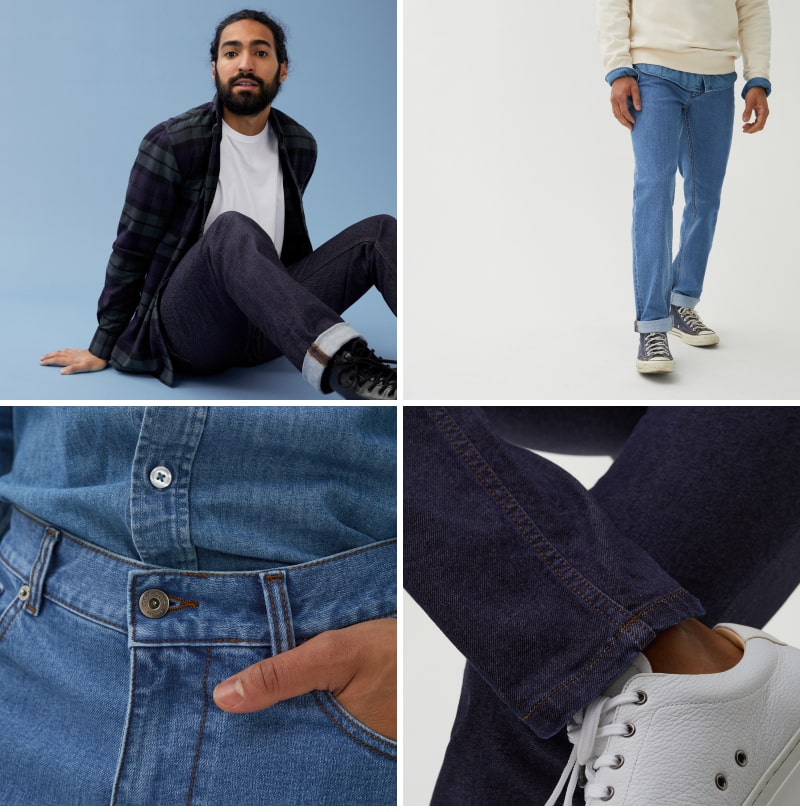


.jpg)
.jpg)
.jpg)