At first, sales were invented to clear out the last of the swimsuits to make room for winter coats. Well, not exactly, since this was the 19th century, but you get the idea: sales allowed retailers to clear out summer collection stock before moving on to the winter collection, and vice versa.
Since then, two things have changed:
There are now far more than two collections per year.
Brands produce on a just-in-time basis and therefore have fewer and fewer unsold items.
As Wikipediaputs it, even if they claim otherwise, brands no longer really need to hold sales. Yet, it seems like the promotions never end: 70% off for Black Friday. 35% off during pre-sales. 50% off for Mother's Day. 45% off just because it's an even-numbered week.
The result? In France, one out of every two garments is sold at a discount or on promotion.
With promotions happening so often, are we actually getting better deals?
No.
It’s because brands can no longer sell their products any other way. It’s because we’ve become so accustomed to buying on sale that everything else feels too expensive the rest of the time. For both customers and brands, discounting has become an addiction.
To be able to sell at a discount half the time, prices have to be inflated the rest of the year.
To keep up this frantic pace of promotions, brands have four options:
Engage in a price war by cutting production costs. This is a bad idea for everyone: the people making the clothes, the planet, and even the people buying them.
Cheat. By artificially inflating prices just to lower them during sales, or by creating lower-quality collections specifically for clearance... The list of questionable practices is long.
Die. Because if you keep playing with your customers' trust, you eventually wear them out.
Slow down. Run fewer promotions, hold sales for the right reasons (i.e., to clear out last season’s stock), or stop running sales altogether.
At Loom, we made the mistake of offering promotions here and there in the beginning... Because we hadn't really thought it through. Because (almost) everyone in e-commerce does it. Because our customers were asking for it. And then we decided to stop. Here is why:
We don't need them. We don't have a seasonal collection system but a unique range of timeless clothing. There’s no need to rush to clear out our stock to make room for new arrivals. That’s (also) what slow fashion is all about.
We can't afford it. We strive to offer a fair balance of quality, ethics, and price all year round. If we were to add discounts on top of that, our business wouldn't be economically viable.
We don't want others to pay the price. Loom’s mission is to create durable clothing: pieces that last longer and have less impact on the environment. If we wanted to sell at even lower prices, we would have to compromise on the quality of our products, degrade the working conditions of those who make them, or increase our negative impact on the planet. In short, we would have to turn to fast fashion (and that is definitely not our dream).
Less, but better. Sales are primarily an artificial way to make you consume things you don't need. We don't want you to buy from us because it's a bargain, but because you actually need the garment and want to keep it for a long time.
We aren't the first company to give up on sales, and we won't be the last. All over France and around the world, brands and consumers are taking a stand against a fashion industry that has lost its way. And that’s a good thing.
Let’s buy less. Let’s buy better.
Who are we to say this?
You are on La Mode à l’Envers, a blog run by the clothing brand LoomThe textile industry is in a bad way, and the planet is paying the price. We’re here to break down everything we’ve learned about the sector. Because making sustainable clothing is great, but being transparent, sharing knowledge, and inspiring change is even more powerful.
If you like what we write and want more, subscribe to our newsletter by clicking here. We promise: we keep it brief and we never spam.
It was December 2017. The whole team agreed: if there was one “disposable” garment whose life we wanted to extend, it was socks.
Not just another old sock
So we sent you a short questionnaire to help us design socks you wouldn’t be throwing away any time soon, and more than 2,000 of you answered the call.
First, how long do they last? Less than a year for 40% of you. We’d expected worse. But we also figured we could do better.
Next, you made it very clear that the two main problems are 1/ your big toe breaking free and 2/ the heel wearing through. Many of you also mentioned the elastic losing its stretch and wear around the tendon, just where the edge of the shoe rubs.
As for style: unsurprisingly, you asked for classic mid-calf socks, unribbed, mainly in blue and black, although quite a few of you also dreamed of bright, original colours (a rather brave request, we thought, given our current range of colours).
We read, sorted and analysed every bit of your feedback, then set off, armed with all that, to find a factory to develop socks that last.
Our saviour is French
Usually, we look for our factories in Portugal. Up until now, that’s where we found the best partners. But for socks, it seemed a shame to cross the border.
If there’s one thing the French know how to do (besides croissants and strikes), it’s socks.
You may be sick of hearing it, but even in Europe, and even in France, it’s not easy to find factories that can do quality and are willing to develop a new product for a small brand (yes, sorry to shatter the myth: we’re a small brand). After meeting several factories, we found one that was a great fit: Atelier Joly.
Beautiful, isn't it? Well, it's in France.
First, because its reputation preceded it: the company holds the Entreprise du Patrimoine Vivant label (a French state label for heritage craftsmanship) for the excellence of its know-how. Second, because the people in this workshop were keen to do R&D with us, not just slap our logo on a sock they’d been making for 1,000 other brands for 10 years. Finally, when it came to values, we really were on the same page: quality, ethics and traceable sourcing are part of their everyday vocabulary.
And the story of this little company is brilliant. At 26, the boss brought 50 goats back from Texas and started France’s very first mohair production. The business grew, and in 2007 it bought the subcontractor that knitted its socks, then in 2013 the one that made its sweaters, just as both were about to go under. And this factory doesn’t just save local jobs and know-how, either. When farmers in the area decide to get proper value from their sheep’s wool instead of selling it at a loss (which happens in 99% of cases in France), Atelier Joly lends them a hand.
Love you Atelier Joly
Making a tough sock (without Kevlar)
We tested various solutions to fix the dozen or so problems you’d reported (fun fact: our very first prototype got a hole in it after a 25 km trail run).
First prototype, after a trail run.
We wanted a fine, smart sock you could wear in town, and here are the solutions we came up with.
Cordura for durability
The biggest problem we faced was wear and tear at the toes and heel. For that, we chose Cordura: a type of polyamide four times more resistant than the others, generally used in military clothing. We used a very dense knit in these areas, which take a real beating from calluses and badly trimmed toenails.
Cordura, the secret to the longevity of this backpack brand.
Fil d’Écosse for comfort
We also wanted to use as many natural materials as possible, which meant cotton. Because it’s softer and makes you sweat less. When it comes to cotton yarn, the best balance of strength and softness is fil d’Écosse (known in English as lisle). Basically, it’s long-staple combed cotton (so, excellent quality) that has been mercerised, meaning treated to make it stronger and hold colour better. Goodbye pilling, fading and other signs of premature ageing. The other advantage: unlike synthetics and poor-quality cotton, it stays soft, even with time and many washes.
Sole and tendon reinforcements
Next question: how do you stop holes forming in the sole and at the Achilles tendon? We first tried knitting the Cordura on the outside of the sock, so that your skin would touch the cotton while the friction zones were reinforced with synthetic fibre. But the Cordura yarn wasn’t fine enough. So we replaced it with a finer, very high-quality polyamide.
A good-quality cuff
To stop your socks slumping down around your ankles or strangling your calves, we did two things: we added a strong elastane thread throughout the body of the sock so it stays put everywhere, and we didn’t skimp on the elastic cuff that holds up the top (still, be careful not to tumble-dry them at the highest temperature: there’s always a risk that the elastane melts and the sock loses its stretch, as with any garment containing elastane).
"Linked" toe seams
Some of you complained about toe seams that rub and irritate. So we chose an ultra-fine seam, closed stitch by stitch (known as "linking"). Traditionally, this was done by hand ("hand-linking"). But our workshop has invested in a state-of-the-art machine that does it even better. The result? Flawless quality, and no annoying ridge when you put your shoes on.
Finally, as well as choosing only OEKO-TEX®-certified yarns (meaning free from substances harmful to the environment and to your health), we set up 100% traceable, local production: Cordura (Italy), fil d’Écosse (Italy), polyamide (Spain), elastane (France), knitting (France), making-up (France), cardboard band (France).
It broke every record
Once we had our final prototype, we put it through the ultimate test: laboratory durability testing. With a sock, there are two things to test: how firmly the elastic holds and how well it resists abrasion. To have a benchmark, we asked the lab to test a Swiss sock as well, reputedly the top performer in durability tests. On elastic hold (making sure it’s neither too tight nor too loose), our team can relax: our sock scored 1.9 kPa, where the comfort zone is between 1 and 2. For abrasion resistance, the method used is the "Martindale" test. Fabric is cut from two areas (the sole and the toe) and placed in a machine that rubs them until a thin patch, then a hole, appears. The result is given as a number of cycles: the higher the number, the tougher the sock.
After running the machine for half a day, the lab called us with the results for the competitor's sock: approximately 10,000 cycles, which (according to them) is a good result. Meanwhile, our sock hadn’t budged.
Martindale test result for the competitor's sock?
We asked them to keep the machine running for another 10,000 cycles to see how far our sock would go. Still intact. We moved up to 50,000. The lab called us back to say there was still no sign of thinning. So we told them to go up to 150,000 cycles. And here are the results they sent us:
Martindale test result for the Loom sock.
Even the lab was blown away by these results. A bit of googling shows that other brands have made super-tough socks before us, reaching an (already very respectable) score of 49,000 cycles… 3 times fewer than ours.
This product was tested on real people
Alongside that, we handed out our socks to friends with notoriously sock-shredding feet (the ones who tell you “I get holes in mine after one wear”) with a single instruction: wear them a lot, wash them a lot. The whole team pitched in too, and since some of our prototypes were white, we didn’t always look our sharpest. But this step really matters: it tells us whether anything’s off. The verdict? Nothing’s off.
Us, when we test our prototypes in real-world conditions.
Voilà
So now you know all about how we made these socks.
We’re launching them at 12 euros. It’s the lowest price we can offer, with our margin cut as far as it will go.
It’s the price of quality materials and skilled labour. It’s the price of Oeko-Tex and of made in France. It’s the price of socks you won’t need to replace every five minutes.
You’re reading La Mode à l’Envers, a blog run by the clothing brand Loom. The textile industry is coming apart at the seams, and the planet is footing the bill. So whatever we manage to understand about this industry, we try to explain here. Because making clothes that last is good, but revealing, sharing and inspiring is even more powerful.
If you like what we write and want more, subscribe to our newsletter by clicking here. Promise: we don’t write often, and we never spam.
You’re on La Mode à l’Envers, a blog run by the clothing brand Loom. The textile industry is spinning out of control, and the planet is paying the price. So whatever we figure out about the industry, we try to explain here. Because making clothes that last is all well and good, but revealing, sharing and inspiring is even more powerful.
If you like what we write and want more, sign up to our newsletter by clicking here. Promise: we don’t write often, and we never spam.
Before we get to recycled polyester, let us introduce you to its "virgin" (i.e. non-recycled) version. And to do so, we'd like to show you the self-proclaimed world's largest textile company: Hengli.
If you're expecting to see thousands of workers at sewing machines, you will be disappointed. A Hengli factory in China looks more like this:
Two supertankers spill millions of liters of oil into a mega-plant, which are then transformed in a series of heavy industrial refining or steam cracking stages to produce... polyester. Yes, polyester starts out as oil.
And just as oil has fueled the transportation sector for decades, polyester is the fuel that has fueled explosive growth in the textile industry. Today, it accounts for more than half the textile fibers used worldwide.
How to explain such an increase?
Because polyester has always been cheaper than cotton? Like many people, that's what we thought. But when you look at the figures, you realize that this isn't true. Until 2010, the prices of the two materials were roughly equivalent:
Comparative price trend for polyester fibers and cotton in Asia in US cents per point (click on the image to access the full analysis)[/caption]
In fact, the main reason for polyester's explosion is that it can be used to make clothes that are better suited to many uses than those made from cotton:
Fast-drying sportswear: Nike, Adidas and Decathlon are all familiar with the phenomenon.
Waterproof or warmer garments for outdoor use: there is a reason why Patagonia and The North Face were the first to use them.
More technical garments for everyday wear: as at Uniqlo, with Heattech technology for heat retention or Airism for better breathability.
More fluid fabrics that wrinkle less, perfect for women's dresses and tops.
Fabrics that distort less, ideal for jogging suits or leggings, for example.
Fabrics that are more resistant to rubbing and washing, and therefore widely used in workwear, furnishing or the medical field.
Etc.At first glance, nothing dramatic. To assess the environmental impact of materials - and communicate this to their customers - most brands refer to the Higg Index. According to this tool, polyester is one of the most environmentally-friendly materials in the world... even more so than organic cotton![caption id="attachment_3022" align="aligncenter" width="500"]
Higg Index impact comparison for different textile materials (click on the image to access the source)[/caption]
It's not totally incoherent: in polyester gigafactories, the manufacturing process is so optimized and industrialized that, on a garment scale, the environmental impact might not be so high.
So, is it true that polyester is eco-friendly?
Sadly, no.
For a start, the Higg Index may be the benchmark used by brands the world over, but it offers little transparency on how it is calculated, and lacks reliability. According to a recent study, to assess the impact of polyester, the Higg Index builds on data from a European factory, whereas the vast majority of production takes place in Asia, under environmental (and working) conditions that are probably less favorable.
In fact, following criticism from a number of media outlets and organizations, the index was officially put on hold in mid-2022, pending a review of its data and calculation methods by independent auditors.
But the main problem with the Higg Index isn't its unreliability: it's what it doesn't measure. Three things in particular.
1/ Making polyester is also making gasoline
Let's go back to Hengli, the Chinese polyester company. When they refine oil, they don't just get "naphtha", the base for making polyester. They also get some of the liquids we're all familiar with: gasoline, diesel, fuel oil and kerosene.
The oil-refining machine: a sort of mega-alembic that doesn't make whisky in the end[/caption]
And all these products are resold. In 2019, Hengli was even the first private Chinese company to have the right to resell kerosene to airlines. And every year, they sell over six million metric tons of petrol and diesel, equivalent to over 10% of French consumption (!).
Hengli is the perfect illustration of the current trend in the oil and gas industry : what is now driving demand is plastics (and yes, polyester is plastic), which will account for more than half of oil's growth by 2050. When Uganda's dictator justifies the economic rationality of Total's controversial EACOP pipeline, he's talking about... his polyester shirt and the economic opportunities for synthetics.
Who would have thought that a bright yellow shirt would serve as an alibi for one of the biggest climate bombs of our time? Aaah fashion, fashion, fashion...[/caption]
The production of synthetic materials, such as polyester, therefore generates income for the oil industry. This supports the production of gasoline and kerosene, while fossil fuels are responsible for two-thirds of the world's CO2 emissions.
But polyester has another co-product that's almost as annoying: fast fashion.
2/ No polyester, no fast fashion
The dramatic ecological consequences of fast fashion and its 100 billion garments produced worldwide every year are well known, not least because of the greenhouse gases emitted during their manufacture: spinning, weaving, dyeing, manufacturing…
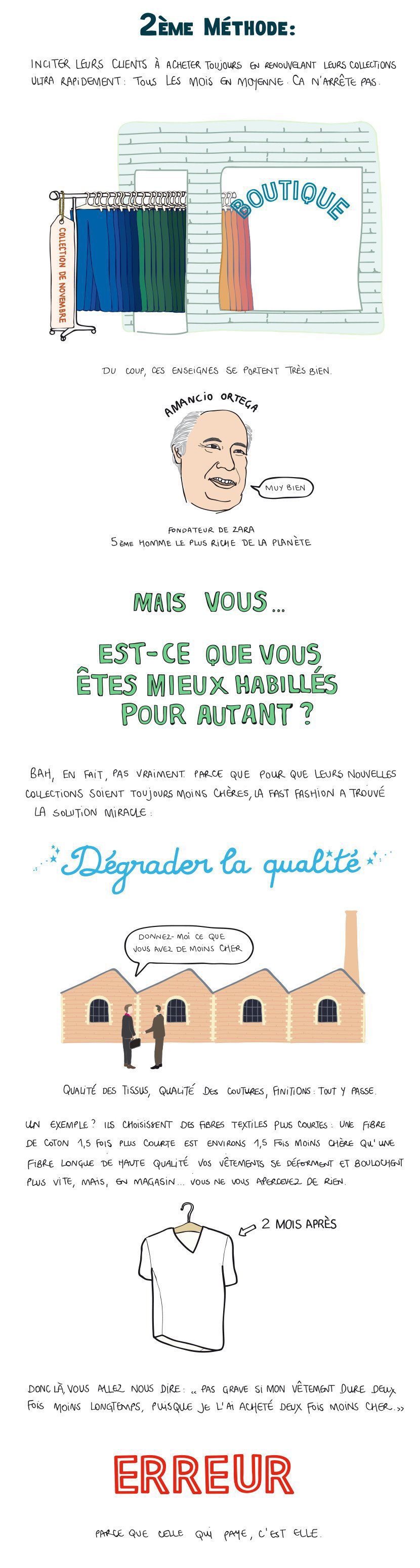
What has enabled the proliferation of H&Ms and Zaras is, first and foremost, their ridiculously low prices (obtained by relocating to countries with low-wages workforces) and the frantic renewal of collections to encourage consumption. As we've seen, it wasn't low polyester prices that enabled the emergence of fast fashion in the 90s and 2000s: until 2010, prices were similar to those of cotton.
But fast fashion would never have grown as fast as it did if there hadn't been a profusion of polyester available on the market. Today, synthetics account for 64% of textile materials. If fast fashion were to do without it - and replace it with cotton, for example - there would very probably not be enough natural material to maintain these production levels: we'd have to devote almost 7% of our arable land to it (vs. 2.5% today), or as much as is needed to grow all the fruit and vegetables on the planet. Difficult to imagine in a context of declining soil fertility and climate crisis.
In other words, while polyester may not have been the initial driving force behind the emergence of fast fashion, it is what keeps it going today. It's the fuel that drives the engine of fast fashion, the prerequisite for producing ever more clothes.
And we can't talk about polyester without mentioning ultra-fast fashion. Shein, the new global fashion behemoth, makes 85% of its garments from polyester. If this Chinese brand was able to emerge a few years ago, it's also thanks to the recent drop in polyester prices, linked to the fall in the price of its main component (ethylene) generated by the exploitation of shale gas in the United States. Without shale gas and very low-priced polyester, this ultra-fast fashion might never have existed.
Finally, the third problem with polyester is not related to its production... but to what happens to it afterwards.
3/ Polyester and microplastics
Getting back to our famous Higg Index: we hadn't even told you all about it yet (no wonder its use has been put on pause). The index is based on a "cradle-to-gate" life-cycle analysis, which leaves out the use and end-of-life phases. For polyester, these two phases pose serious problems.
First, when washed or worn, polyester garments release millions of microplastics into the environment. These microfibers have as yet uncertain but potentially very dangerous consequences for biodiversity, human health... and even global warming.
Secondly, the end-of-life of polyester garments is not very glorious either. When nobody wants them anymore, there are only two options:
The garments end up incinerated, which generates greenhouse gases. Since polyester is made from petroleum, this is even more annoying than incinerating a cotton garment (burning petroleum releases CO2 that has been buried for millions of years, whereas cotton's carbon cycle is much shorter: as cotton plants grow, they capture CO2). Not to mention some potentially toxic fumes, notably from antimony, a carcinogenic compound present in polyester and which can be found in incinerator ashes.
The garments end up in landfill or in the environment, particularly in Africa, which receives more than half of our used clothing. And the problem is that plastic is not biodegradable in the environment, unlike cotton or wool. Inevitably, these polyester garments will end up decomposing in the soil, century after century, into billions of billions of microplastics (contrary to popular belief, the vast majority of polyester microfibers released into the environment come from end-of-life, not from our washing machines). As researcher Nathalie Gontard explains, plastics in landfills represent a gigantic time bomb for centuries to come.
Textile landfill in Nairobi, photo from the excellent Trashion report (click here to read it)[/caption]
In short: between the devil and the deep blue sea.
Fast fashion brands feel all these polyester-related problems are not very good for their reputation... and ultimately, not very good for business.
So they've come up with a magic solution. We name it:
Chapter 2 - What's wrong with recycled polyester
A word of caution before getting to the heart of the matter
We don't want to judge the small and medium-sized brands that use recycled polyester today. The choice of materials is an extremely complex subject, and there's so much misinformation out there that we can all fall for it... And we're the first: at Loom, we've used recycled polyester in our swimsuits, for example. Seeing through all this is almost a full-time job!
And then, of course, it's very tricky for an "ethical" brand not to use a material that seems eco-friendly and that even fast fashion uses extensively! What would customers think?
Recycling appeals to a very powerful imagination. When we think of the word, what comes to mind is nature's magical cycle: dead plants decompose in the soil, and the resulting nutrients enable a new plant to grow. Nothing is lost, nothing is created, everything is transformed.[caption id="attachment_3032" align="aligncenter" width="500"]
How our brains imagine recycling (pretty much like the "circle of life" from the Lion King, right?)[/caption]
A recent report shot in a Primark store showed the marketing power of recycled materials. A customer interviewed at the checkout explained:
"They tell us it's recycled cotton, so it's worth twice as much. I regret buying it less because I tell myself it's good for the planet."
What's more, recycled polyester is barely more expensive than virgin polyester. It is the absolutely perfect material for brands: it looks eco-friendly, it sells by making consumers feel less guilty, without being overpriced.
So, of course, almost every fast fashion brand has jumped on the bandwagon: today, 8% of all clothes sold worldwide are made from recycled polyester. That's 10 billion garments sold every year.
Recycled polyester doesn't cost the earth...[/caption]
Today, virgin polyester is still the mainstay of fast fashion. But tomorrow, it could well be recycled polyester.
According to a report by the NGO Changing Market Foundations, which contacted 46 major brands to find out about their strategy towards synthetic materials, recycled polyester is "their main strategy for reducing their carbon footprint".
But is it really the right strategy? Definitely not.
First of all, industrial recycling is far removed from the "magical cycle of nature" mentioned above. Admittedly, it avoids the need to extract oil and then refine it. But it also requires a lot of machinery: transport, sorting, washing, crushing, melting, extrusion to make a filament... and this equipment needs energy and materials. If we refer to the famous Higg Index, which cannot be suspected of being anti-polyester, the carbon impact of a highly efficiently recycled polyester (from the Repreve company) would be only 42% lower than its non-recycled equivalent.
They look like little four-poster beds, but these are machines for extruding polyester... including recycled polyester.[/caption]
42% isn't bad, is it? Except that to make a garment from recycled polyester, you then have to go through all the usual stages: spinning, weaving or knitting, dyeing, garment making, distribution... And since the raw material only represents around 30% of the final footprint, the carbon impact of a garment with very good recycled polyester is only 13% lower than its virgin polyester equivalent. Well, that's something... but this order of magnitude shows that it's hard to say that this garment is "good for the planet", to use the words of the Primark customer in the report.
But there's more to come.
Chemically, recycled polyester is exactly the same as conventional polyester. In terms of use and end-of-life, it's the same problem as virgin polyester: the release of millions of plastic micro-fibers into nature and/or the emission of greenhouse gases and toxic fumes during incineration.
And perhaps the biggest problem is that this recycled polyester... doesn't come from other polyester garments. No one today has the technical solutions to recycle polyester garments on a large scale, especially because polyester is often mixed with other materials (such as cotton or elastane) and contains many impurities (starting with the dye).
In fact, 99% of recycled polyester comes from a much simpler source to exploit on an industrial scale: PET plastic bottles, which happen to be made up of the same chemical molecules as polyester. To give you an idea, with 13 plastic bottles, you can make enough yarn to make a t-shirt.
Rare image of a Primark t-shirt, 2028 collection[/caption]
"Well, it's better for those plastic bottles to end up in polyester threads than on beaches or in open dumps, isn't it?"
Excellent question Jean-Michel.
When fast fashion brands explain that recycled polyester comes from plastic bottles, they often maintain the illusion that they're preventing plastic bottles from polluting the environment. Indeed, the leading supplier of recycled polyester yarn (Unifi) explains on its website: "We created this yarn to create a more sustainable world where we prevent billions of plastic bottles from ending up in landfills or oceans".
It's touching... but the truth is quite different.
If these bottles hadn't been used to make polyester, they would in fact have been used to make... more plastic bottles. The reality is that the textile industry recovers plastic bottles that can be recycled several times over, and transforms them into garments that cannot be recycled on a large scale.
In fact, the plastic bottle industry is very angry with the textile industry, which steals the majority of its bottles to manufacture "recycled " polyester. The fact that the textile industry recovers so many bottles prevents the bottle industry from achieving its own recycling targets. It is therefore demanding access to its own bottles ahead of other channels. Nicholas Hodac, Director of the Union of European Soft Drinks Association, recently commented:
"Using someone else's materials - as the textile industry does with PET bottles - is not circularity. [...] It's recycling." For some months now, the plastic bottle industry has even been trying to develop its own street collection infrastructure, to ensure that as many bottles as possible are collected and don't end up in textiles. Even the European Union has just affirmed this in its recent strategy for sustainable textiles: "Such a practice is not in line with the circular model of plastic bottles".
Perhaps one day, the textile industry will no longer be able to access these bottles to "recycle" them into garments... Further proof that recycled polyester from bottles is not a magic solution to the environmental problem of textiles. On the contrary, it acts more like a smokescreen, delaying awareness... and distracting us from the real solutions.
So what are they? How can we have a textile industry that can clothe the planet without destroying it at the same time?
Chapter 3 - The solution: reduction
First, could we imagine a closed-loop polyester recycling process, using polyester from old clothes?
For the moment, this practice is virtually non-existent: today, only 0.18% of garments are made from materials recycled from other garments. And according to a 2021 report by the NGO Changing Markets Foundations, none of the 46 major brands surveyed had set themselves the goal of developing closed-loop recycling.
However, there are a number of projects of this type that give cause for hope. And to top it all off, France is not too badly placed in this respect. Carbios claims to be able to recycle 90% of the polyester in clothing using an "enzymatic" method, and is currently building a pilot plant in Meurthe-et-Moselle. And the American company Eastman is to invest a billion dollars to
build the world's largest "chemical" polyester recycling plant near Le Havre by 2025 (it will primarily handle PET packaging, but also claims to be able to recycle polyester textiles).
Eastman recycling plant in Tennesseesoon to be home to a chemical recycling site like the one planned in Le Havre[/caption]
But would this closed-loop recycling of polyester be enough to make the textile industry virtuous?
Unfortunately not.
Firstly, there is still a great deal of uncertainty about the ability of these projects to recycle textiles on a large scale in terms of cost and energy. For example, the public inquiry into the Eastman gigafactory reveals that it hopes to recycle less than 3% of the volumes marketed in France. But above all, this is a rather theoretical objective, since Eastman acknowledges that "textile purity and design is a challenge", and would first target... "100% polyester seat belts". We're still a long way from being able to recycle Shein t-shirts or H&M dresses.
But let's place ourselves in an ideal world where polyester recycling is close to perfection. Let's imagine that:
Half of all polyester textile comes from other polyester garments (as a reminder, it is less than 1% today).
Chemical or enzymatic recycling is ultra-efficient, and the climate impact of recycled polyester is 70% lower than that of virgin polyester (which is very, very optimistic).
Under these ideal conditions, as the material itself represents only 30% of the impact (compared to the manufacture of the garment as such), the reduction in climate impact for the entire manufacture of polyester garments would then be... 10%.
10%? That's barely more than the growth rate in worldwide polyester clothing sales forecast for next year.
In other words, in terms of climate impact, if we managed the technological and industrial feat of deploying polyester garment recycling plants worldwide, it would be just like stabilizing the growth of polyester garments for... a year. That's why recycled polyester is such a smokescreen: the word "recycled" gives us the illusion that we're solving the textile industry's pollution problem, when we're not at all on the right orders of magnitude.
In short, if closed-loop recycling is not accompanied by a drastic reduction in the consumption of polyester garments, it will just be a flash in the pan.
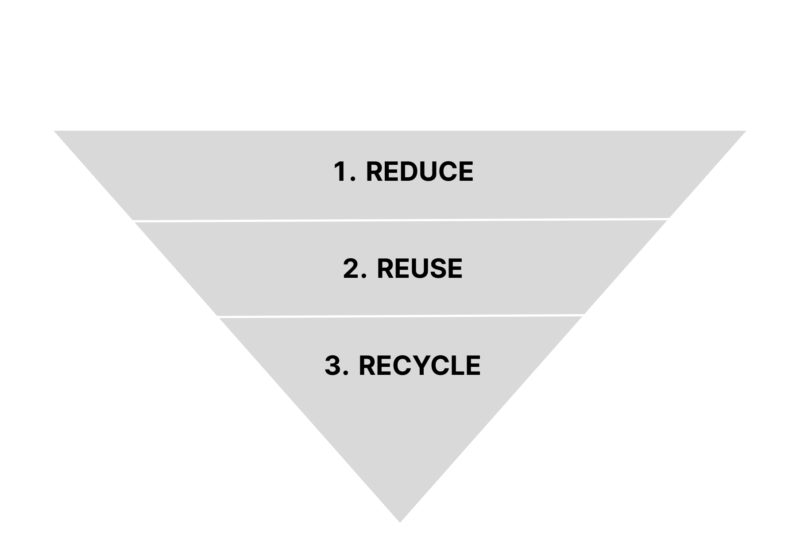
In fact, it's time to remember the good old 3Rs rule: to reduce the ecological impact of clothing, before recycling, you must first re-use and, even better, reduce.
But how do we go about it?
First of all, reuse.
Most of our clothes can have a second life, as long as we maintain and repair them as much as possible. If you're afraid of (sewing) needles, there are thousands of repair workshops all over the country just waiting for your clothes.
But there's another form of reuse, halfway between recycling and upcycling, that we may soon be able to count on: factories that automatically sort our old clothes by composition and color, then fray them to make threads that won't need re-dyeing (thus avoiding the energy-intensive dyeing phase). This is the project of CETI project of CETI, a textile research center near Lille, in partnership with several French mills. Admittedly, the yarns obtained are for the moment less perfect than yarns made from virgin material, but the initiative deserves to be supported.
Last but not least, reduction! Everyone has a role to play in reducing the ecological impact of fashion.
What we can do as a brand:
Polyester accounts for half of the world's textile fibers, and this proportion is growing every year. Sure, it's handy for making fast-drying sportswear... but do we really need to use it to make dresses or t-shirts? Ideally, synthetic materials should be used in the smallest possible proportions, and when there's really no alternative.
If you do decide to use recycled polyester (which is legitimate, given consumer expectations), don't forget the orders of magnitude, and don't let people think that this is a sufficient solution to the textile industry's ecological problems. And focus on the essentials: avoiding production on the other side of the world, not renewing collections every two days, etc.
What the government can do:
Give the bottle industry first access to its own plastic, as many NGOs are demanding. If it no longer has access to recycled polyester from bottles, the textile industry will no longer be able to hide behind this solution and will be forced to ask itself real questions to reduce its ecological impact.
Penalize polyester in future regulations, in particular in the environmental labelling scheme soon to be rolled out in France and Europe. This is far from a foregone conclusion, as the European environmental labelling scheme is coordinated by the organization behind the Higg Index, the same one that considers polyester to be one of the most environmentally-friendly materials on the market.
Penalize the commercial practices of fast fashion, which generate ever greater over-consumption. Along with hundreds of other brands, this is what we're fighting for through the En Mode Climat coalition.
Choose natural materials: there are plenty of cases where you can easily do without polyester or other synthetic materials. And they're always preferable to polyester for garments worn next to the skin, because of their better resistance to odors (underwear, t-shirts, shirts, etc.).
We all want to believe that the solution to the environmental crisis can be found in a simple technical invention: a gigantic CO2 vacuum cleaner to keep burning fossil fuels, hydrogen-powered airplanes to keep flying off to New York for the weekend... and recycled polyester to keep buying more and more clothes. The real solutions to the textile problem are both simpler and harder for the clothing giants to swallow: they must first give up selling more and more. And for you, that means buying fewer clothes and pampering the ones you already own. Perhaps the ecological battle begins in front of our washing machines...
What about synthetic fabrics at Loom?
We try to use as many natural materials as possible, but we sometimes add a little synthetic material when it significantly increases the life of our garments.
Elastane: we use a small amount of elastane in our cotton pants, underwear and in the rib cuffs of our cotton sweaters to limit deformation over time.
Polyamide: we use polyamide to reinforce our socks, our merino t-shirt and our backpack.
Polyester: we use polyester in our swimsuit (because we can't see what to replace it with), a little in our jogging suit (to limit its deformation) and in our chino, in the form of elastomultiester (to limit poaching).
May 23, 2022. We click the “send” button that releases the newsletter announcing the launch of our male denim pants. At first, nothing revolutionary for a clothing brand. Except that these pants are a little bit special: the dreaded crotch blow out should appear later than on other jeans. To get there, we have worked for three years, invented a new wear test with our laboratory and finally developed our own fabric in the Vosges mountains. Let us walk you through the process.
Crotch blow out: a denim's plague
Before starting the manufacturing of our jeans, we sent you a small questionnaire: "What is usually the problem with your jeans?” And to a simple question, a simple answer: the problem is the crotch blow out.That's right: when you walk, your thigh rubs against the other thigh (or rather: against the bottom of your buttock), which weakens the fabric of the jeans and eventually perforates them.To make our own, we first had to understand why some jeans get holes faster than others. Our first reflex: skim the hundreds of web articles dedicated to crotch blow out. But on the websites and forums we visited, nobody agreed: fabric that is too thin, presence of elastane, bad cotton quality, cut that is too tight, seams that are too thick, humidity due to perspiration...
And then one day, we had a revelation: what if the truth about holes in jeans lies... in chino pants. We've been selling our Loom chino pants since 2019, and we know one thing for sure: crotch blow out is not a thing with chino pants, and the few customers who have experienced it are heavy bike or motorcycle riders - in other words, our chinos don't have holes from the friction of walking.
So the question was simple: what are the specifics of jeans versus chinos that could explain the crotch blow out with jeans?
Looking for the explanation
This question allowed us to eliminate most of the hypotheses found online:
Jeans have holes because they are too thin: no, chinos are generally thinner than a pair of jeans.
Jeans have holes because they are too tight in the thighs: no, in the crotch area, jeans and chinos are more or less cut the same way.
Jeans have holes because of exogenous factors (moisture due to perspiration, tension when moving...): no, unless proven wrong, we do almost the same thing with jeans as with chino pants.
Jeans have holes because they have elastane: no, like most jeans, most chinos contain some percentage of elastane for comfort.
Jeans have holes because their cotton is of poor quality: no, there is no reason why the cotton fibers used in jeans should be shorter or of lower quality than those used in chinos.
Jeans have holes because their yarns are of lower quality: no, even if it is true that a part of the jeans were woven since the 70's with "open-end" yarns (cheaper and maybe less resistant to abrasion), 95% of the jeans are nowadays woven with traditional "ringspun" yarns, most probably like chinos.
We were left with only two hypotheses to test:
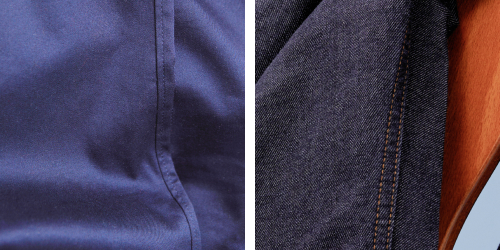
Hypothesis #1: The double seam. The inner leg seam of jeans is thicker than that of chinos - a double seam could cause more intense chafing than with chinos.
Suspect n°1: the jeans' double seam
Hypothesis #2: Roughness. The threads of jeans are thicker than those of chinos: their fabric is therefore rougher. When one thigh rubs against the other, it's a bit like a piece of sandpaper rubbing against the fabric.
Suspect n°2: the roughness of the jeans (not that sweet little horse)
Our lab tests
To test our hypotheses, we decided to simulate this friction in a laboratory, with a test called "Martindale": a machine rubs the fabric until a hole appears. The result is counted in number of cycles: the higher the number, the more resistant the fabric.
A Martindale machine in action.
To begin with, we wanted to check that the Martindale test simulates what happens in real life: we sent pieces of jeans fabric and of chino fabric to our lab to check that, in lab conditions, jeans get holes faster than chinos as well.But when we received the results, we were surprised: in the lab, the jean fabric had lasted twice as long as the chino fabric (100,000 vs. 50,000 cycles). The opposite of what happens in real life...So we thought for a second: this Martindale test cannot simulate what really happens to the crotch, since it uses the same standard "abrasive wool" to rub against the fabric. But when you walk, the fabric rubs against itself! We called our lab and came up with another type of test, where we replace the abrasive wool with the fabric itself. After some adjustments on the right pressure level in the machine, this test will answer to the sweet name of "Fabric abrasion resistance Martindale method modified fabric against fabric, pressure 12 kPa". A few days later, the results of the new test were in:
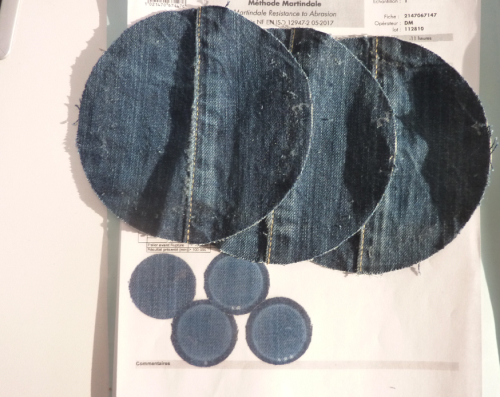
Bingo! We had found a laboratory test that simulates what happens in real life: chinos are (at least) three times more resistant than jeans to friction: 100,000 vs. 35,000 cycles.So we could move on to the next step: testing our two hypotheses to find the cause of these holes on your jeans.To test the first hypothesis (the double sewing of the jeans), we replaced the single fabric with a fabric with sewing on the Martindale machine... When we received the results, we realized that it did not change anything: the sewing does not weaken the fabric.
Suspect found not guilty.
No holes after 100,000 cycles.
By elimination, only one suspect remained: roughness. To check this hypothesis, we decided to have several types of jeans tested: smooth jeans and rough jeans. And all the results confirmed that the thicker and rougher the jeans, the faster they get holes:
The thinnest jeans we found (Muji brand) resist very well: they exceed 100 000 cycles.
Thicker raw jeans (Uniqlo brand) do not resist very well: 35 000 cycles. On the other hand, when we make the fabric less rough manually with sandpaper before sending it to be tested, it holds much better and also exceeds 100 000 cycles!
Jeans that are quite rough because of the use of an "open end" thread do not hold very well: only 16,000 cycles.
Raw jeans and their washed equivalent (and thus less rough): the first one holds 70 000 cycles, much less than the second one, which breaks at 100 000 cycles.
In short, after several months of testing (and a few thousand euros spent...), we had identified the culprit: roughness. Exactly the opposite of what we would have thought intuitively: thick cowboy jeans are more likely to experience crotch blowout than thin jeans.
Had they known, all the cowboys would have worn yoga pants.
Then, we just had to develop our fabric. We had two options:
Test a lot of existing fabrics from suppliers and choose the best one.
Develop our own fabric: more uncertain, slower, more expensive... but with the hope of creating a fabric perhaps more powerful than those that already exist!
You can already guess what we chose, right?
Going to Les Vosges
Finding a factory that would agree to make such a development with us was not supposed to be an easy ride. It takes time, money and we are not Levi's: at first, we hoped to order max 10,000 meters of fabric per year, that is to say a little more than 100,000 euros... Economically not very interesting for a manufacturer.However, Tissage de France, the factory in the Vosges region of France that manufactures the jeans for the brand 1083, immediately agreed to work with us on this project. The deal was: we share the development costs, and if it works, the factory will be able to reuse everything we learned together in other projects with other customers (this is what we had already done successfully when we developed our cotton socks).
Us in the Vosges with Tissage de France (six clues in this photo will help you find the year of our visit).
To develop a denim fabric that is not too rough but still keeps a nice hold, we decided to weave:
A rather thin denim (12 oz weight).
With a ringspun yarn (softer than its open-end equivalent).
And double-twisted (two threads twisted together for more resistance and hold).
All in organic cotton, of course.
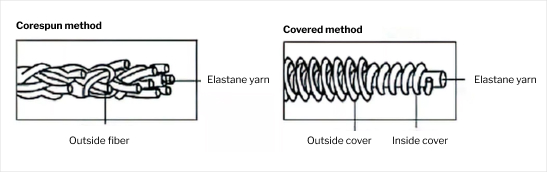
But we didn't stop there: we also wanted to solve the 2nd big problem that came up in our questionnaire: the fact that jeans get loose over time. For that, instead of spinning the elastane at the same time as the cotton fibers (the classic method known as "corespun"), Denis, the director of the factory, recommended that we twist two cotton threads around a filament of elastane (the "covered" method, more expensive but seemingly more effective).
It took us a few tries to make the final adjustments (especially on the size of the elastane thread), and finally: we managed to weave a denim that holds up. If you want proof:
With the test we invented (fabric vs. fabric abrasion), our jeans exceed 200,000 cycles! That's more than any other jeans we've ever tested.
With the residual deformation test, the residual elongation after one minute is only 1.8%, which is quite honorable: on the six other jeans we tested, only one did better.
Yes, but if it's to make a solid but ugly denim, there's not much point, is there? Good news, our fabric looks like this:
A denim with just the right amount of roughness (thanks in particular to spun elastane) to give it character.
We've got it
With the development of the fabric, we had done the biggest part of the job. Because for the manufacturing part, we knew who to turn to: 5D, our Portuguese factory specialized in pants (and which manufactures for many great French brands).Compared to our fabric, our specifications were quite simple... We wanted:
A semi-slim fit.
Pockets deep enough to fit your phone and strong enough for your keys not to tear them.
A zipper fly, because it's more practical and it washes out more nicely.
A first pre-wash on the raw denim, so it doesn't shrink at home.
Reinforced belt loops.
After some back and forth on the cut, we had our jeans! Beautiful, comfortable, and solid. It was ready for production.
A satisfying fitting session.
Sidenote: Let’s talk about that price These jeans are sold for 100€. Yes, it's not cheap... but it's not that expensive: First of all, the development phase cost us a lot of money: between the lab tests, the development of weaving tests and the back and forth on the prototypes, it cost us about 10,000 euros (not counting our own work time). The fabric costs about 15 euros/meter to produce, which is almost twice as expensive as the classic made in Italy fabrics: organic cotton, ringspun, double twisted yarns, elastane yarns with a sheath rather than corespun, made in France... Our ethics and our quality choices have a cost. The confection is carefully made in Portugal, with wages much higher than 95% of the jeans on the market, mostly made in Asia or North Africa. But as we don't make any collection, nor sales, nor ads, and as our shareholders don't push us to make a big margin (more details here - if you can read French), we sell it for "only" 100 euros (for the moment - this price could change with the inflation on energy and raw materials).
Resistant, but not indestructible
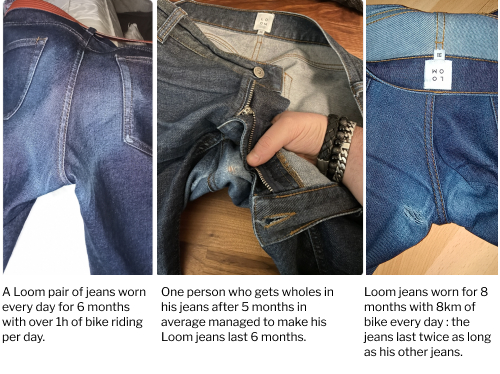
It's been almost a year since we launched these jeans: we're starting to have some hindsight on how they age. First of all, the people who bought them seem very satisfied: they are rated 4.7/5 by more than 100 people, which is really great.But will these jeans resist crotch holes for eternity? No.Out of more than 2,000 jeans sold, we have already had three cases of crotch blowouts: people who regularly ride bikes or motorcycles. Now, we designed these jeans to resist well to "thigh against thigh" rubbing... but they will not be much more resistant than other jeans for "thigh against saddle" rubbing (even if, each time, the concerned customers told us that their Loom jeans pierced less quickly than the other ones they wear).And even for the rubbing related to classic walking, if they will probably resist longer than the average, it is very likely that they will also end up with a hole one day: in a nutshell, like any garment made of natural materials, these jeans will eventually wear out.
Could we make even more resistant jeans?Probably, but then we would have to use more synthetic materials: to make a stronger garment, it is often enough to replace cotton by polyester. But it is less pleasant to wear, it retains odors and especially, for the environment, we think that fashion must get rid of plastic (we talk about it here, in English).
But are these holes really that bad?
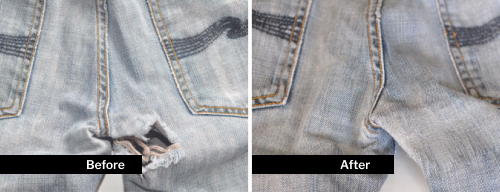
Not really. Because like all clothes, jeans can be repaired.In fact, jeans are even easier to repair than other clothes.First, their alternating blue and white threads make them visually inconsistent... so repairs can be almost invisible. To repair a crotch blowout, you can add a patch of fabric inside the jeans and then sew it with a thread of the right color... And here is the result:
Moreover, even if the repair shows a little, it's not so bad: denim experts consider that what makes the beauty of a pair of jeans is the mark of what it has been through. Washing, tears, repairs... In short, the "patina" are all scars that give it value - and that many brands try to reproduce artificially in the factory.
The A.P.C brand even sells worn jeans that are naturally more expensive than new ones.
Conclusion: let's not focus on the wrong fight
If our jeans will eventually break down and repair relatively easily, was it worth the research?We hope so: if the first holes in the crotch appear even one or two years later than with your other jeans, that’s still a win. Also, to develop these jeans, we had to understand the science behind the clothes. And that really motivates us. Finally, supporting French factories by doing R&D with them is also our most exciting and higher mission.But we have to keep a clear head: indestructible clothes don’t exist… and they never will. The most important thing to do to keep a garment for a long time is not its inner quality: it is above all how we take care of it. The clothes of our grandparents were probably much less resistant than today's. Yet they kept them much longer. Because they knew how to maintain them, repair them, mend them.We must now collectively re-learn how to take care of our clothes. Putting on a towel before eating tomato pasta, shaving the pilling from our sweaters or socks, delicately washing our woolen sweaters, sewing on our buttons, repairing tears… and mending the holes in the crotch of our jeans.In short, clothes that last a long time are above all clothes that age well.Buy less clothes, take care of them.
Fashion is unpredictable. In just a few years, t-shirts have become a whole new space for self-expression. We’re more used to slogans like "mornings are too early" or "Little Miss Grumpy" (sic). But recently, a new, slightly more militant specimen turned up on the website of a famous clothing brand:
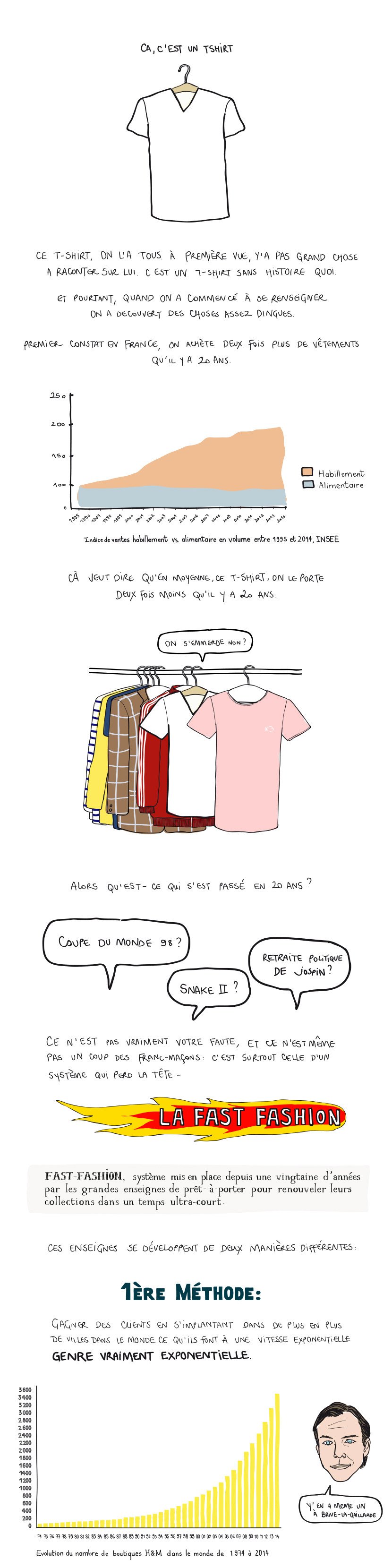
And coming from H&M, that’s no accident. The company wants to be seen as the sustainability leader among so-called “fast fashion” brands (= brands that have set up a system of ultra-fast collection turnover). It churns out one initiative after another, often with plenty of media coverage: H&M Conscious, Close The Loop or Climate positive 2040, for example. And at first glance, it looks like the top of the class on this front, with its 220 people working on sustainability.
Is fast fashion really becoming sustainable, or is it just going all out on greenwashing? (spoiler: the latter)
A prime example of greenwashing: BP turned its logo green just a few years before the Deepwater Horizon oil rig explosion.
Chemical pollution: the one that gets the headlines
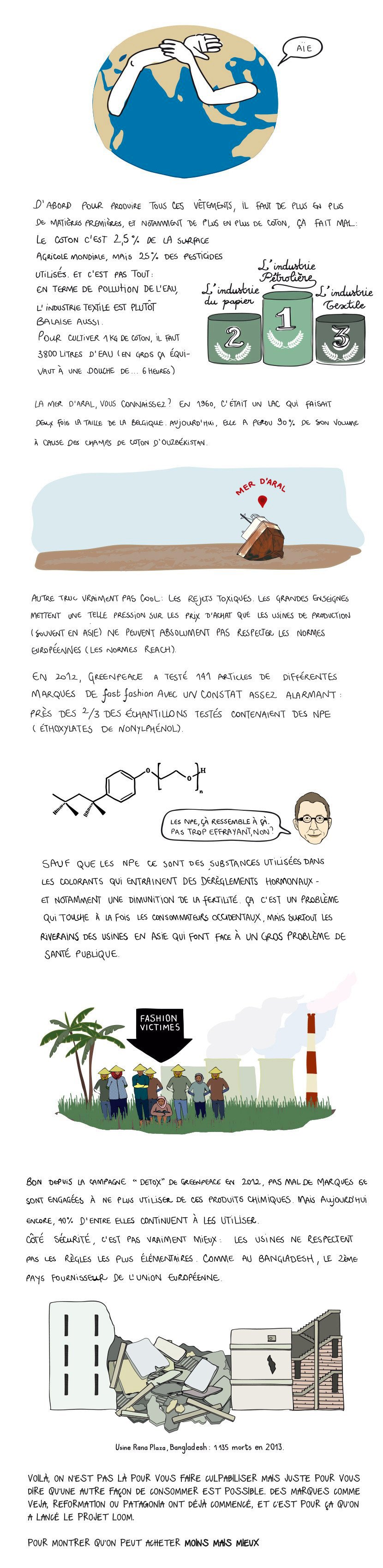
In China, there’s a joke that you can predict next season’s trendy colour just by looking at the rivers (we haven’t checked). When it comes to effort on this front, H&M doesn’t have too much to blush about: it’s the top-ranked brand in Greenpeace’s Detox Catwalk, alongside Zara and Benetton. In a nutshell, they have pledged, by 2020:
to eliminate toxic waste discharged into wastewater;
to limit emissions of carcinogens and endocrine disruptors. These substances are used in particular to make waterproof clothing and prints, or are found in factory detergents.
And it’s a huge job. No fast fashion brand owns its factories: they use subcontractors, who use subcontractors, who use subcontractors, and so on.
But this chemical pollution, dramatic as it is, is only the tip of the iceberg1. Fast fashion has another2 massive environmental problem.
Fast fashion is fuelling global warming
Cotton growing, synthetic fibre production, spinning, weaving, dyeing, garment making… Making a piece of clothing uses energy, and therefore produces greenhouse gases3. To give you an idea, fabric is dyed in autoclaves: huge pressurised machines holding a dye bath at over 100°C. Massive energy guzzlers. And since most factories are in Asia, the electricity comes from burning coal or natural gas, which releases plenty of CO2.
A magnificent example of an autoclave. Admire the beast.
The upshot: depending on which report you read, the fashion industry emits between 2% and 8% of the world’s greenhouse gases, almost as much as all road transport on the planet4. In short, you can cycle to work all you like: if you put on a new t-shirt every day, you’re still melting the ice caps.
So what is fast fashion doing about it?
At first glance, H&M (once again) seems to be near the top of the class. With its Climate Positive 2040 initiative, it claims it will not only cut its greenhouse gas emissions but become climate positive by 2040! Nice. But when you look closely at how it plans to get there, there’s a slight snag. As we’ve seen, most greenhouse gas emissions come from manufacturing… an area it has no control over, since none of the factories making its clothes belong to it. So to pull it off, it plans to rely on “carbon sinks”, including artificial ones. The idea? Sucking CO2 out of the atmosphere with huge machines and stashing it deep underground.
The magic CO2 vacuum cleaners in question.
Minor problem: nobody has ever managed to prove it works… In fact, most carbon sink projects have simply been abandoned because of astronomical costs or technical problems. That’s probably why, on its page, H&M is calling on “experts and innovators” around the world for help. Anyone free?
Another idea: making clothes from recycled fibres. We’re big fans of H&M’s Close The Loop video (and this one too, with M.I.A.), but in carbon footprint terms, recycling textile fibres is only a very, very partial solution5. Making a garment from recycled fibres involves an industrial process that also generates a lot of CO2, if only to recover the fibres in the first place… What’s more, the technology is nowhere near ready for the vast majority of cases: for example, we still can’t separate cotton and polyester fibres at a reasonable cost. The result: even with an ultra-optimistic assumption of 40% recycled fibres, the fashion industry’s CO2 emissions would fall by less than 10%. Recycling clothes does help minimise the use of raw materials (water and pesticides for cotton, oil for polyester), but when it comes to carbon footprint, it’s really not going to save the polar bears.
In short, to borrow the metaphor of the French engineer and author Philippe Bihouix:
"We’re being told to put our foot down on the accelerator and hope we invent wings before we reach the edge of the cliff."
In short, this is roughly where we’re heading.
To solve fast fashion’s environmental problem, we’d rather kid ourselves by betting on technologies that have yet to be invented than tackle the real, awkward issue:
Disposable fashion
Every year, the clothing industry produces 150 billion garments, most of which pile up in wardrobes or get thrown away after a few months. And the number keeps growing:
Number of H&M stores worldwide since 1974 (source: annual report).
Global clothing production doubled between 2000 and 2014. This exponential curve is not compatible with a planet that, by definition, has finite resources. No, there is no planet B.
The damage fast fashion does to the environment is built into its very business model. In that context, any “green” initiative is like trying to fill a bathtub with a hole in it.
Greenwashing is dangerous because it discourages us from changing the way we consume, because it makes us believe the problem is solved, because it lulls us to sleep while our house is burning.
Of course, one day we might invent brilliant technologies to suck up CO2 or recycle fibres and solve our environmental problems. But it’s a huge gamble. And above all, a huge risk. Meanwhile, there’s one equation that won’t change:
To produce is to pollute
So what do we do?
We can make our own clothes. Or buy second-hand. That’s cool. But let’s not kid ourselves: it will never clothe everyone. Good luck finding a white t-shirt in a size M at Ding Fring or Guerrisol (two French second-hand chains)…
There’s only one solution, and it’s simple and obvious. Plain common sense:
Buy less.
By choosing well-made, high-quality clothing that will last as long as possible.
Of course, cotton isn’t Kevlar: you’ll never keep a t-shirt for your whole life. But with a little care, you’ll wear it for several years. And it’s easier than you think:
Take your time: if a garment is a tad too small but you’re buying it in the hope of losing weight, if you don’t much like the colour but you’re buying it because it’s on sale… forget it. And don’t let discounts blind you: they’re very often an artificial way to get you to buy something you don't need.
Check the label. If the material is OEKO-TEX certified, it contains no toxic substances. If it’s made in Europe, you know the workers are protected by a proper legal framework (unlike in Bangladesh) and that the carbon footprint is smaller.
Take care of it. How long a garment lasts depends on how you look after it. So, follow our care tips (yes, you really need to stop washing your wool sweaters).
Alterations are your friend: a small repair rarely costs more than 10 euros, it gives work to someone in your neighbourhood, and it saves you buying a new garment that costs 5 times as much.
The fashion industry hasn't exactly been heading in the right direction. And it is up to each and every one of us to decide where it should go from here.
If you like what we write and want more, subscribe to our newsletter by clicking here. Promise: we don’t write often, and we never spam.
Notes
1 No, the textile industry is not the second most polluting sector in the world after oil. This statistic, repeated far and wide by almost every media outlet and industry stakeholder – even when signing the French fashion industry’s climate commitment charter for COP 21 – does not specify the type of pollution it covers and is based on absolutely no source.
2 Not to mention the working conditions of textile workers, which are often appalling, or the impact on the soul of our town centres.
3 Contrary to popular belief, transport is not what produces the bulk of greenhouse gases in a garment’s life cycle (only just over 1% of emissions). Even though most of our clothes are made on the other side of the world. It makes sense: a garment is neither very big nor very heavy, so it doesn’t take up much room in a container. And since 90% of clothes travel by cargo ship, a mode of transport that emits relatively little CO2 per kg/km travelled, the result is relatively little CO2. Shipping does, on the other hand, emit huge amounts of fine particles, but that’s another story.
4 According to the IPCC (Intergovernmental Panel on Climate Change), road transport accounts for 10% of global greenhouse gas emissions: in 2010, transport accounted for 14% of greenhouse gas emissions, and road transport accounted for 72% of transport-related greenhouse gas emissions. On this criterion, that would make fashion the world’s 4th most polluting sector, behind agriculture, electricity and building heating, and therefore, transport (breakdown of sectors here).
5 This “closed-loop recycling” should not be confused with “open-loop recycling”, which recycles plastic from other products, such as bottles.
Who are we to say that?
You’re reading La Mode à l’Envers, a blog run by the clothing brand Loom. The textile industry is in a sorry state, and the planet is footing the bill. So whatever we manage to understand about this industry, we try to explain here. Because making clothes that last is good, but revealing, sharing and inspiring is even more powerful.
If you like what we write and want more, subscribe to our newsletter by clicking here. Promise: we don’t write often, and we never spam.
You’re reading La Mode à l’Envers, a blog run by the clothing brand Loom. The textile industry is in a sorry state, and the planet is footing the bill. So whatever we manage to understand about this industry, we try to explain here. Because making clothes that last is good, but revealing, sharing and inspiring is even more powerful.
If you like what we write and want more, subscribe to our newsletter by clicking here. Promise: we don’t write often, and we never spam.
Who are we to say this? You’re reading La Mode à l’Envers, a blog run by the clothing brand Loom. The textile industry is coming apart at the seams, and the planet is footing the bill. So whatever we manage to understand about this industry, we try to explain here. Because making clothes that last is good, but revealing, sharing and inspiring is even more powerful.
If you like what we write and want more, subscribe to our newsletter by clicking here. Promise: we don’t write often, and we never spam.
Spy pixels: why we’ve decided to stop keeping tabs on you at Loom
published on
September 4, 2026
Updated on
September 14, 2026
Reading time
3
minutes
Leave a comment
comments
This article was originally written in French, our native language. Apologies in advance if anything reads a little awkwardly – you can write to us at hello@loom.fr to help us improve our translations.
We’ve switched off individual email open tracking via tracking pixel – here’s why.
Over the past few weeks, you’ve probably received a whole bunch of newsletters telling you about their « tracking pixel », with a button to opt out (that’s because the CNIL has just said that these pixels are just like browser cookies: you have to be told they’re being used and asked for your consent).
But what exactly is a tracking pixel? It’s a tiny, blank, transparent image (one pixel wide by one pixel high). Every time you open an email, this little snitch reports it back to the sender (along with the time and the device you’re on). Hence the nickname « spy pixel ».
The code behind a tracking pixel
Why do brands use them? To do all sorts of things:
If you only open emails on one topic, from then on you only get that topic (fair enough)
If you open often, you get labelled an « engaged reader » and receive even more emails (hmm, more annoying)
If you didn’t open it, the same email is sent to you again a few days later with a different subject line (not cool)
If you stop opening anything at all, the brand exports your email address to Insta, Google and YouTube to find your profile and target you with ads on those platforms (not cool at all).
At Loom, though, we do none of that: no automatic follow-ups, no segmentation based on what you open (we wouldn’t know how anyway, and we can’t be bothered to learn), no exporting your address to Instagram to show you ads (because we don’t advertise). In fact, since we refuse to push people into buying more, we don’t really need any of those features.
So we’ve switched off individual email open tracking via tracking pixel. In other words, we no longer know who opens our emails, or when. YEYEYEYE FREEDOM!
It also means we’ll no longer measure the « open rate » of our newsletters. To tell whether what we write is any good, we still have other indicators, like the unsubscribe rate… or your replies (which are always welcome): when a newsletter is rubbish, we find out very quickly ;-)
The Commission nationale de l'informatique et des libertés, France’s data protection authority, whose job is to make sure that information technology harms neither human identity, nor human rights, nor privacy, nor individual or public freedoms.
We do still keep one piece of information that we need and that the CNIL allows us to keep without your consent: the date you last opened one of our emails (not the time, not how many times, not the content… just a date, overwritten every time you read a new one). We use it for one thing only: taking you off our list if you haven’t opened our emails in a long time, so that Gmail or Outlook don’t end up flagging Loom as spam.
Lorem ipsum dolor sit amet, consectetur adipiscing elit, sed do eiusmod tempor incididunt ut labore et dolore magna aliqua. Ut enim ad minim veniam, quis nostrud exercitation ullamco laboris nisi ut aliquip ex ea commodo consequat. Duis aute irure dolor in reprehenderit in voluptate velit esse cillum dolore eu fugiat nulla pariatur.


.webp)













.gif)





.jpg)




.jpg)
.jpg)