Industry
Our analysis of what really goes on behind the scenes of the fashion industry
Thank you! Your submission has been received!
Oops! Something went wrong while submitting the form.


We wanted to understand why, all of a sudden, all these people were so concerned about our customers having trouble making ends meet. And above all, why this type of service is exploding everywhere in the world, whether it’s split payments (in 3 installments, for example) or deferred payments (usually a month later).
And honestly, when we started pulling at the thread, what we discovered really freaked us out.
The deferred payment sector hasn't been around for long, but in Europe, it already looks like this:

Just a few years after they were founded, the valuations of these companies are already astronomical. For example, Klarna is worth 30 billion euros. The same goes for Afterpay. A few comparisons to give you an idea of how crazy this is:
And French players that have barely started are already posting record-breaking fundraising rounds (here or there).
But what explains why these companies are worth so much money in such a short amount of time?
In some cases, buy now, pay later services can have real social utility: they allow people in financial difficulty to purchase essential items they cannot afford immediately. It is practical for certain expensive equipment that they can spread the cost of over several months or years: cars, refrigerators, washing machines, etc.
But the thing is, these services are primarily used to buy… clothes. In the UK, this is the case for 90% of buy now, pay later purchases.
In fact, for clothing brands, this “payment convenience” is almost miraculous. They can install it on their site in 3 clicks, and their revenue increases almost instantly by at least 20%. And if you are a consumer, you will spend on average 68% more if you use their service! Since the founders of these payment companies to the brands that use them, everyone is blown away: “something huge is really happening,” “it’s magic,” and so on.

Naturally, brands are willing to pay a premium: they pay these financial services around 4% of the transaction amount. And since the global online clothing market is worth nearly $500 billion, that adds up to a lot of money—which explains the massive valuations of these new “unicorns.”
So... what’s the problem? As always, when so much money is created in such a short time, someone eventually has to pick up the tab.
With this type of installment or deferred payment, the merchant covers the service fee, so there is no interest for the customer to pay. But let’s call a spade a spade: since customers have to pay it back later, it is, in fact, debt. With all the risks that entails.
You might think people aren't foolish and won't spend more than what they have in their accounts, right?
Except that in this scenario, everything is designed to make us live beyond our means.
First, there’s the brands’ marketing. On one hand, they make clothes desirable with incredibly tempting photos and ads all over the web. On the other, they create the illusion that these dream outfits are accessible to everyone, even those on a tighter budget: Dreaming of dressing like Rihanna but it’s too expensive? Just pay a small amount now and the item is yours. It’s incredibly hard not to give in.
Then, there’s the marketing from these financial services themselves. When you visit these “fintech” websites or see their ads, it doesn’t really feel like you’re dealing with banks, but rather with ultra-stylish fashion brands.

Flashy colors, repurposing viral memes, pop culture tropes : these services go to great lengths to target a young audience.

However, this younger demographic is particularly vulnerable to financial instability, as evidenced by the recent lines of students waiting for food aid. The result: in the UK, where buy-now-pay-later services have been around longer, last year 18% of 18-24 year olds failed to pay off at least one of their debts on time. And when their customers don't pay, these "cool" startups sometimes send in debt collection agencies. In fact, concerns about the risk of over-indebtedness are so high that more than 70 British MPs are calling for the sector to be regulated (under the poetic banner "Stop the Klarnage," named after the leading buy-now-pay-later service there, Klarna).

You might be thinking that in France, we’ll be more vigilant and do a much better job? For now, things aren't looking great. These buy-now-pay-later startups have no reason to change their marketing practices for the French market (as shown in pictures). There’s also no reason to believe they’ll be any better than they are in the UK at assessing a customer's ability to repay before approving a payment (in France, these services have very little data to assess customer solvency, whereas in the UK, everyone has a "credit score" based on all their outstanding loans).
And above all, beyond the individual risks of over-indebtedness, there is a collective risk: at a time when the climate emergency requires us to produce less, buy-now-pay-later services push us to consume even more... and therefore pollute even more.
What brand can say no to an almost instantaneous increase in revenue? Especially when all their competitors have already jumped on the bandwagon?
Like the predict many financial analysts, deferred payment is becoming a market standard—essentially, it will soon be available on all e-commerce sites. More worryingly: as one industry player reveals, deferred payment is “not only a lasting phenomenon but is increasingly expanding into traditional retail.”
In other words, this type of payment method is likely to be rolled out in physical stores as well: this would mean the total volume of clothing sold worldwide could increase by 20 or 30%... That’s billions of garments produced that never should have been. And that is truly the last thing the planet needs... Let’s remember that if the textile industry wants to do its part to meet the Paris Agreement goals on global warming, it must drastically reduce its production volumes, and do so right now.

These deferred payment services will further exacerbate the current environmental catastrophe. In fact, they render brands' efforts to limit their impact obsolete. What is the point of having replaced all store light bulbs with low-energy LEDs if, at the same time, Sephora introduces deferred payment on its American site and announces a 35% increase in average basket size ? Is this really serious?

Perhaps the most terrible thing about all of this is seeing the extent to which deferred payment has reinforced an absurd distribution of wealth:
So, if you’ve read this far, you might be oscillating between wanting to smash everything and wanting to drown your sorrows in a drink that supports French winemakers. In short, you’re thinking it’s hopeless. Cheer up—there’s actually plenty we can do. As usual, we need to act on three fronts: the people who buy, the companies that manufacture, and the government that sets the rules.
If we manage to regulate this sector, we can limit the damage... But deferred payment is only a symptom of much deeper problems. If we want to make the textile industry sustainably more virtuous, we must also challenge the beliefs that led us here.
Among them is the idea that success means growing at any cost (we already talked about this at length here). Today, many brands are rushing to pay a portion of their transaction amounts to a financial intermediary to boost their revenue... Isn’t it time these brands chose to pay factories better and relocate production instead?
There is also the belief that as consumers, we need everything, right now. That we need this t-shirt and can't wait a few more weeks. And that we'll manage to pay for it later. That we can always live on credit.
Finally, there is the illusion that, collectively, we can also always live on credit. That we can spend the equivalent of 1.7 Earths every year to meet our needs. That we can pollute now and that future generations will surely find a miracle solution to get us out of this mess.
Do we really want to take that bet?
Who are we to say that?
You are on La Mode à l’Envers, a blog run by the clothing brand Loom. The textile industry is heading for trouble, and the planet is paying the price. So, everything we learn about the sector, we try to explain to you here. Because making sustainable clothing is good, but revealing, sharing, and inspiring is even more powerful.
We never run ads: if you like what we write and want more, subscribe to our newsletter by clicking here. We promise to email you no more than once a month.


This type of dye can be found in supermarkets for common colours like navy blue and black. Sound familiar? Yes, those are the colours of 99% of our clothes! For more "unique" colours like camel or khaki, you can find dyes online. And if you can't find the exact shade to match your garment, you can always dye it a darker colour, and the result will look just as great. Just keep in mind that because the stitching thread on your clothes is synthetic, it won't change colour like the rest of the fabric—see the photo of the jeans below. If you decide to dye your khaki t-shirt navy blue, you'll end up with a t-shirt where the body is navy, but the seams remain khaki, which can look quite nice (or not, that's up to you).
Before we get to the heart of the matter—how textile dye actually works—here are our tips for preventing your clothes from fading:
Since the composition of supermarket textile dyes is generally not very clean (which is also the case for dyes used in the textile industry), I looked for a brand offering more eco-friendly ingredients. I tested the dye from the brand "La Droguerie Écologique" because its composition complies with the GOTS organic label. I used it to dye a pair of chinos that were very streaky from fading (these were from the first generation of Loom chinos; we’ve improved significantly since then). The result after dyeing isn't perfect, and there are still a few areas that the dye didn't cover:

At the same time, I tested the Ideal brand dye on a polo shirt that had sunscreen stains. The result was much more uniform than the eco-friendly dye, and the polo came out of the machine looking brand new:

Along with the polo shirt, I dyed an old pair of jeans that had become too faded at the knees, and the dye gave them a real new lease on life. In the photos below, you can clearly see that because the stitching thread is synthetic rather than cotton like the rest of the jeans, it didn't take the colour and remained brown:

Based on these various tests, I recommend using:
If you don't have a washing machine at home, unfortunately, you cannot use textile dye in a laundromat. However, you can opt for hand-dyeing products from the same brands, which can be used in a basin. A container of dye costs around €7 and is enough to dye one "heavy" garment like chinos, or three "light" garments like t-shirts (or in my case, a polo shirt + a pair of jeans).

Each dye kit includes a detailed instruction manual that explains the process step-by-step. But generally, it’s as easy as pie:
Who am I to be giving you advice on garment care?
My name is Claire and I am in charge of production monitoring at Loom. Basically, I try to avoid stockouts on our site (well, it’s not perfect yet, but I’m working on it) and I ensure throughout the manufacturing stages that the clothes meet our quality standards. On top of that, I am passionate about everything that helps extend the lifespan of our clothes: maintenance, repairs, and other old-school tips. I love giving clothes a little extra soul, reworking them, repairing them, and giving them a second chance when no one else wants them. On these pages, I will try to pass on what I know that might be useful to you. One last thing: all the tips you find on this site have been personally tested by me to ensure they actually work (in other words, this isn't just a copy-paste job from internet searches). If you have any new ones to suggest, don't hesitate to leave a comment below this article.


Who are we to say this?
You’re reading La Mode à l’Envers, a blog run by the clothing brand Loom. The textile industry is coming apart at the seams, and the planet is footing the bill. So whatever we manage to understand about this industry, we try to explain here. Because making clothes that last is good, but revealing, sharing and inspiring is even more powerful.
We never run ads: if you like what we write and want more, subscribe to our newsletter by clicking here. Promise: we’ll email you no more than once a month.

If you’re here, chances are one of your sweaters has ribbed edges (known as "ribs" or "ribbing" in our little corner of the textile world) that have gone a bit baggy. The good news is that we’ve found a fairly simple fix: give them a good blast of steam with an iron (or a steamer, if you have one).
Here’s the proof on a wool sweater (because, as Confucius famously said, “a GIF is worth a thousand words”):
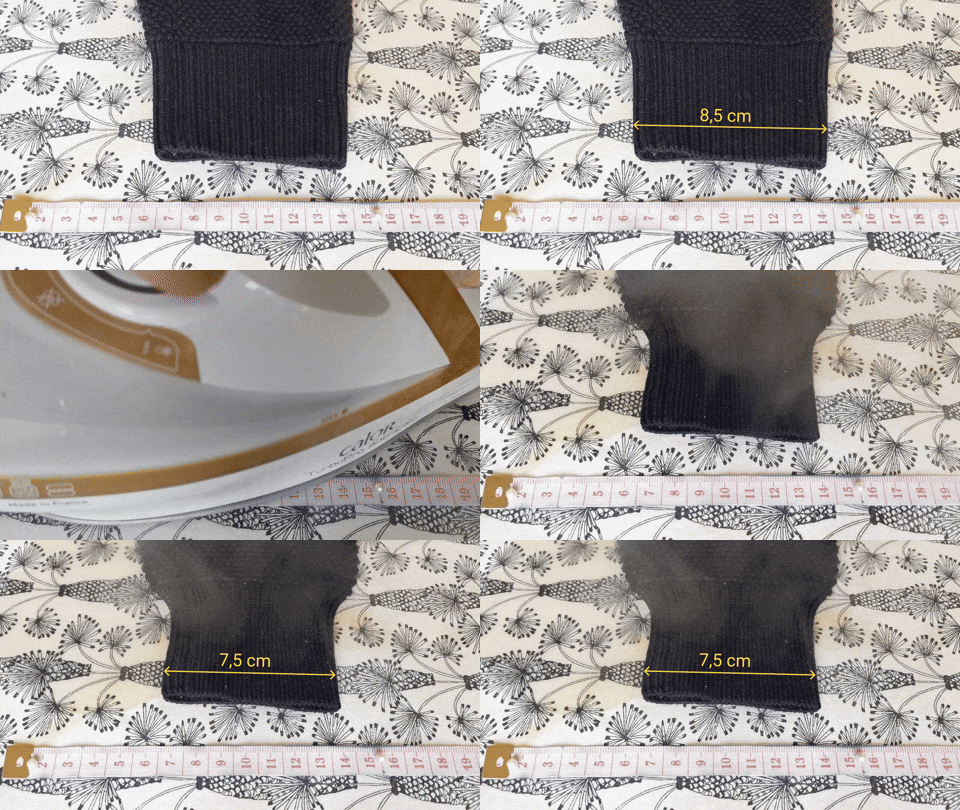
And if you’re still not 100% happy with the result, you can then dip the ribbing into a bowl of boiling water: it should shrink by another few millimetres.
This trick works on the cuffs of your sweaters, but also on the collar and the hem:

Rather pleased with our discovery, we tried the method on materials other than wool, and it turns out it works just as well on 100% cotton ribbing:
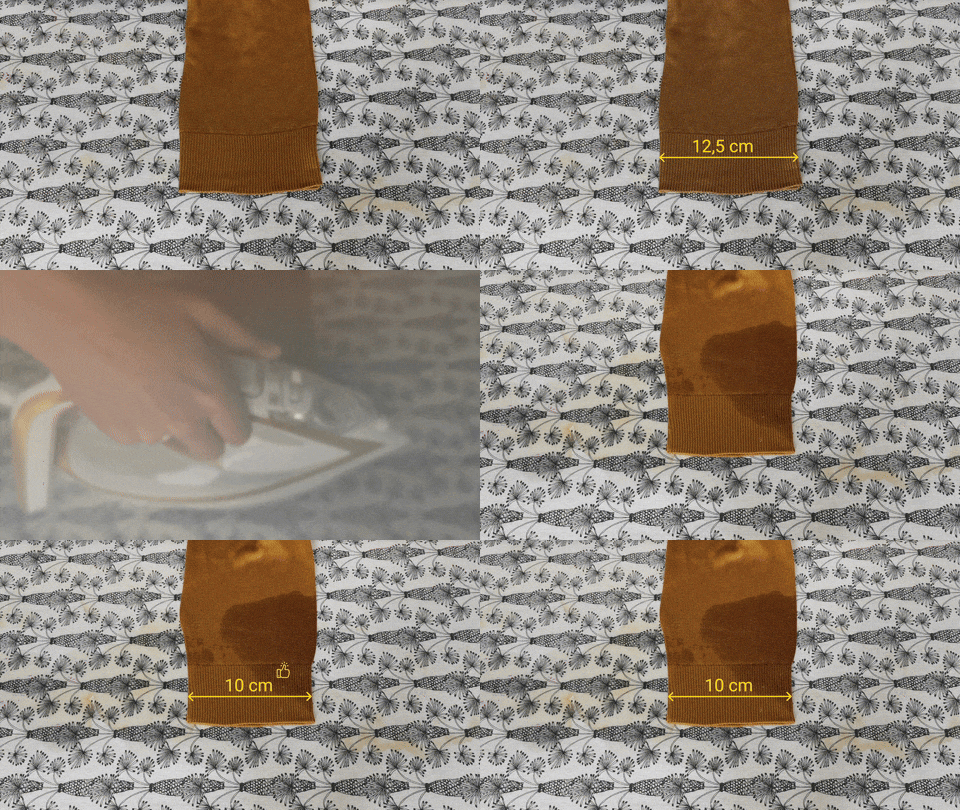
On the other hand, it doesn’t work at all on acrylic ribbing, or on the cotton-elastane ribbing of sweatshirts and hoodies. If you want to tighten the ribbing on your sweatshirts and hoodies, you’ll have to take them to your local tailor: for ten euros or so, they can unpick it completely, cut it down by a few centimetres and sew it back on.
Who am I to give you advice on caring for your clothes?
My name is Claire, and I keep track of production at Loom. Basically, I try to keep things from going out of stock on our site (it’s not perfect yet, but I’m working on it), and I make sure at every stage of manufacturing that our clothes meet our quality standards.
On top of that, I’m passionate about anything that helps our clothes last longer: care, repairs and good old grandma’s tricks. I love giving clothes “a little extra soul”: reworking them, mending them, giving them another chance when nobody wants them any more. On these pages, I’ll try to pass on whatever I know that might come in handy.
One last thing: I’ve genuinely tried every tip you’ll find on this site and checked for myself that it works (in other words, it’s not just copied and pasted from a quick internet search). If you have new ones to suggest, feel free to leave a comment below this article.

The leather of our belt is vegetable-tanned. We chose this option primarily because, unlike traditional tanning, it does not use chromium, the residues of which can be toxic (although with leather tanned in Europe, there is little risk, as we explained in this article). The unique feature of vegetable-tanned leather is that it develops a patina over time: its colour will darken and the leather will show marks and scratches. The passage of time will therefore give this belt a unique personality.
But if you're here, it's surely because you don't want your belt developing too overbearing a personality. So here are a few tips to keep it from developing its patina too quickly:
The fundamental thing to understand is that leather is composed of about 5% natural oils—these are what give it its suppleness and strength. If they escape, the leather dries out and cracks. Your goal is therefore simple: keep the leather oiled.
To do this, you need to regularly "nourish" your belt's leather: at least once a year. Ideally with a nourishing leather cream. Be careful, even if it's tempting, do not use cosmetic creams like Nivea. Cosmetic creams are water-based emulsions that can contain 70 or 80% water, which risks eventually driving the natural oils out of the leather and causing it to crack. This is the opposite of the desired effect!

The first step is to find the right shade of shoe polish. As for the brand, I recommend Famaco: a brand specialising in leather care products, made in France and reasonably priced given the quality of their products.

Here is how to do it:

P.S.: Alternatively, you can always take your belt to your cobbler, who will take care of it for less than 5 euros.
Who am I to talk to you about garment care?
My name is Claire and I am in charge of production monitoring at Loom. Basically, I try to avoid stock shortages on our site (it’s not perfect yet, but I’m working on it) and I ensure throughout the manufacturing stages that the clothes meet our quality standards.
On top of that, I’m passionate about everything that helps extend the lifespan of our clothes: maintenance, repairs, and other old-school tips. I love giving clothes a "little extra soul," reworking them, repairing them, and giving them a second chance when no one else wants them. On these pages, I will try to pass on what I know that might be useful to you.
One last thing: I have personally tested all the tips you’ll find on this site to make sure they actually work (in other words, this isn't just a copy-paste job from internet searches). If you have any new ones to suggest, don't hesitate to leave a comment below this article.

A riddle: what does the graph below show?

Nightclub attendance over the last 24 months? Sales of cropped trousers since 1990? The popularity of François Fillon (a French politician) over the same period?
It’s the greenhouse gas emissions curve we have to follow if we want any hope of staying under two degrees of global warming and keeping the planet more or less liveable by the end of the century (and, incidentally, of honouring the 2015 Paris Agreement on climate).

In other words, we have to divide our emissions by 3 in 30 years. That’s a lot. And above all, if we fail, it’s going to hurt. Very, very badly:

The textile industry accounts for between 4 and 8% of the planet’s greenhouse gas emissions: if it wants to pull its weight, it has to divide its emissions by at least three, within a single generation (that’s a slightly simplified way of looking at it, but it will be our working assumption for this article).
And at first glance, clothing brands are all fired up to meet the challenge.
At the last G7 summit, a global coalition of textile companies came together under the name Fashion Pact. Among other things, they signed a series of commitments to cut their CO2 emissions. Good news? Look closely and you’ll see that these commitments essentially rest on two kinds of action:
1/ They choose so-called sustainable materials: lyocell, recycled cotton, linen, recycled polyester… on the assumption that they emit less CO2.

2/ They cut the emissions from their own operations, in particular by switching to renewable energy or switching to LED bulbs in their offices and shops.

So what do you think: will these two actions divide the fashion industry’s emissions by three within a generation?
That would be lovely. But no.

Because most of the textile industry’s emissions come neither from the materials used nor from the lighting in offices and shops.
To understand where textiles’ greenhouse gases come from, we need a bit of physics (promise: it’s easy to follow even if you haven’t touched a Bunsen burner since your school days).
Most of the textile industry’s greenhouse gas emissions come from something you never see: the energy consumed by the machines that turn raw material (cotton, linen, Tencel or polyester) into clothes.
Time for a bit of “factory porn”:


And so on, and so on.
All these enormous machines use a lot – really a lot – of electricity. And they’re often located in Asia, where electricity comes from coal- or gas-fired power stations: fossil fuels that release greenhouse gases when they burn. So in the end, it accounts for a big chunk of the CO2 a garment emits:

By focusing their efforts on raw materials or their shop network, brands are fighting the wrong battle: that is absolutely not how they’ll divide their CO2 emissions by three in 30 years. In an ultra-ultra-optimistic scenario, where we assume that sustainable raw materials are produced with zero CO2 emissions (which isn’t the case) and that production volumes stop growing (which isn’t the case either), here is the best CO2 emissions trajectory we could hope for:

In short, the only real way to avoid disaster is to get textile machines to cut their emissions drastically. How?
Wind turbines, solar panels… The trouble is that over the last 30 years, ever since we started getting worked up about the climate, the share of fossil fuels burned to generate electricity has barely moved…

In short, our clothes are still, as ever, made with coal and gas. There is still one reason to be optimistic about the future: the cost of renewables has fallen so much that in the last few years they have started to be competitive with fossil fuels. But to get costs that low, you have to keep a good share of fossil or nuclear power so that the electricity keeps flowing without interruption (yes, there’s no sun or wind 24/7). So as for hoping that fossil fuel use will be divided by three in the next 30 years…
It’s true that there are some promising leads, particularly in dyeing. We can now build machines that dye clothes with far less water, which avoids heating huge volumes of it to high temperatures and so uses far less energy.
What about the other machines? That looks a lot harder. To divide machine emissions by 3 in 30 years, you would have to raise their energy efficiency by 300%… which has practically no chance of happening. To give you an idea, the energy efficiency of petrol car engines has improved by 16% in 30 years. For planes, it’s roughly the same. And for spinning mills or looms, which presumably get far less R&D investment, it’s hard to believe we could do much better… Not to mention that we can’t replace the entire fleet of existing machines with a snap of the fingers.
And then (we probably should have started here), throughout history...
Improving energy efficiency has almost NEVER reduced energy consumption the way it was supposed to.
Sometimes it has even increased it. This is what’s known as the rebound effect: making machines more efficient brings product prices down and encourages people to buy more. The effect is there everywhere, all the time (and yet environmental policies manage to forget it almost always).
A few historical examples of rebound effects:

So… what last option do we have left to divide CO2 emissions by three in 30 years?
Yes, you read that right: if brands don’t want to sacrifice the living world, they have to sell us three times fewer clothes than they do today.
And that is… exactly the opposite of what they’re doing.

When brands hammer home that they use more “sustainable” materials, and do nothing else, it makes the problem worse (whether they realise it or not). By presenting themselves as “green” while only working on secondary issues, brands lull their customers’ eco-anxiety to sleep so that they keep on buying – or even buy more.
A panel of ten ready-to-wear brands recently reported that “eco-design” had significantly increased their sales, by +7% to +18% (while also cutting production costs). That’s right: we consume more when our negative emotions are soothed away. In this study, for example, researchers showed that people used 20% more wrapping paper when told the offcuts would be recycled… You can see it in brands’ communication too – green arguments are alibis for encouraging people to buy more:


A quick aside: why recycling is (sometimes) smoke and mirrors
Some brands put forward recycling or the “circular” economy as the answer to environmental problems, for instance by installing recycling bins in their shops.
Recycling does have advantages, admittedly, such as making it possible to produce materials locally or to use less virgin material. But when it comes to cutting greenhouse gases, recycling helps very little. And this for three reasons:
1/ Today, only 1% of our clothes are “recycled”, meaning turned into new clothes. Clothes in good condition do get resold in second-hand shops, but that’s only 6% of volumes. The rest? Either they’re shipped to Africa (where many simply end up swelling open-air dumps), or they’re “downcycled” into rags or insulation.
2/ Let’s say we improve recycling technology enough to make far more new clothes out of old ones. Would that cut our greenhouse gas emissions? Hardly at all. Recycling saves material, but not really energy. A garment made from recycled fibres still has to go through the same industrial process to be made: spinning – dyeing – knitting/weaving – sewing. Result: even if we assume we manage to multiply the volume of recycled clothes by 40 (so up to 40%, which is wildly optimistic), it would save only 5.9% of carbon emissions compared with today (and if you’re keeping up, the goal is to divide by 3, in other words to cut by 66%…).
3/ And even that small drop in carbon emissions assumes that clothes made from recycled fibres will be as good as the others, which unfortunately isn’t always the case. With natural fibres like cotton, recycled fibres are shorter, so the clothes are lower quality than those made with virgin fibres: they pill more, lose their shape faster, and so on. So for the same amount of wear… you’ll have to make more of them.
Beyond consumers, this greenwashing paralyses citizen and political action. Since it looks as though brands are dealing with the problem, we tell ourselves the situation is under control.

In fact, most of what brands are doing today – developing new sustainable materials, promising to recycle clothes, fitting low-energy bulbs in shops – suggests that a technological fix for the climate problem will turn up. They’re stuck in a “green growth” mindset that stops them tackling the real problem: how do we get the textile industry out of its overconsumption model? This smokescreen is costing us precious time when we urgently need to act.
So what should we, the brands, be doing?
To bring down the volume of clothes produced each year, we have to go after the direct causes of this overconsumption.
The first thing to do is to stop centring our communication on symbolic measures with little environmental benefit that might well encourage customers to buy more: recycled polybags, kraft paper packaging, sustainable materials, collection bins for used clothes in shops, and so on.
Does that mean these secondary measures are bad? That we should use more polyester and give up linen? Of course not. We should keep making progress on eco-design, but knowing that it isn’t enough. We, the brands, need to focus first on the following three things:
So yes, under these conditions, companies will end up making fewer clothes. And even if they sell them a little dearer (the price of quality and local production), they’ll probably make less revenue. Is that a problem? For their shareholders, clearly. For the people who work there? Maybe in the short term. But in the long run, it’s excellent news for jobs. Over the last 30 years, while the volume of clothes sold has exploded, the number of jobs in the French textile industry has collapsed because of offshoring, from 425,000 to just 100,000. A fall that far outweighs the number of jobs created by clothing retail (+50,000 between 1996 and 2010). Tomorrow, if we gradually manage to reindustrialise the country, it could create hundreds of thousands of local jobs.

How do we get brands to change? As we explained in this article or this TED talk, we collectively have to stop dreaming only of growth, and build a culture of “better” to replace the culture of “more”. But we’re not naive: we can’t bet our future on a great awakening inside companies. Besides, we know plenty of great people at big fashion brands who would like to change things but can’t manage it.
The problem is that today there’s a “polluter’s bonus” – in other words, an economic advantage to making things badly and making more of them. Take a brand that has offshored to Bangladesh, to factories running on coal-fired power and dumping their toxic waste in the rivers (not a very nice factory, then). It won’t have to pay any of the hidden costs of its behaviour: not the long-term cost of global warming, not the clean-up of the rivers, not the unemployment benefits in France for the people left without a job. Whereas a brand that makes the same products in France, creates local jobs and buys only renewable energy will pay 10 times more for its clothes and will probably sell 10 times fewer. Being a responsible company often means making a lot of effort that, in the end, puts you at a real disadvantage against your competitors. A bit like the clean riders in the Tour de France: they train harder… to go slower.
So, as in the Tour, we need to ask ourselves who we want to let win. And then change the rules of the game.
We’re probably a bit idealistic, but on the legislative side, there are several things that we think would go in the right direction for dividing the volume of clothes sold by 3 by 2050 (or, on a shorter horizon, cutting the volume by 30% within 10 years)
[Article update, January 2022] Since this article was written in early 2021, a lot of ground has been covered in this push to change the laws governing the textile industry. We helped set up En Mode Climat, a coalition of over 300 textile players (brands, but also factories, organisations, media outlets…) brought together to lobby – for once, for good – in the fight against global warming. With En Mode Climat, we’re trying to push regulation in the right direction, particularly on environmental labelling and on a bonus-malus scheme that penalises fast fashion and rewards the most responsible brands. More information on the En Mode Climat website.
It gets a bit technical at times, so we’ve put all our proposals in the box below, which you can read if you want to dig deeper.
It’s crucial to set the terms of the debate right as soon as possible: in a few months’ time the government will amend the Anti-Waste and Circular Economy law as it applies to the textile industry (via the future specifications for the textile EPR scheme, under which brands pay for the end of life of their products). An opportunity to force brands to take real environmental measures: a bonus-malus built into the retail price, environmental labelling, a reuse obligation, and so on.
It doesn’t seem right to us that it’s currently legal to import into France clothes made with forced labour, on the other side of the world, using electricity from coal-fired power stations. Here’s what could be done to change the game:

Today, when a brand puts a garment on the market, it pays a tax that can be reduced if the garment is judged sturdier or made from recycled materials. Great on paper… But we would need to:
To do that, the ARPP (France’s advertising self-regulation body) must no longer be run exclusively by companies, but must also include public bodies and/or NGOs in its governance. In the same way, “extended producer responsibility” schemes (such as Eco TLC / Refashion for fashion) must no longer be self-regulated by the companies themselves. As long as these bodies are made up only of the sector’s brands (and no public bodies or NGOs), their commitments will never be truly binding.E- Steer public funding tools (state-guaranteed loans, loans from the public investment bank BPI, the research tax credit…) so that they go only to companies that meet certain criteria (quality of clothes, incentives to consume, European manufacturing…). Is it right that some brands that manufacture on the other side of the world quickly obtained a state-guaranteed Covid loan while some French textile manufacturers are still waiting for theirs?F- Support the repair and refurbishment of used clothes. Plenty of clothes could be repaired instead of simply thrown away. The Crédit Impôt Collection (a tax credit worth a hefty €45 million that funds the development of new products) could be turned into a reuse tax credit to fund clothes repair. That’s a big potential source of local jobs.
At this point, you may be thinking that what we’re promising is a rather sad world, where we go without buying, where companies disappear, where we all dress the same in black, navy and grey.
It’s precisely the opposite.
Today, we have no idea what conditions our clothes are made in, and we’re outraged by the textile industry’s endless scandals, from the Uyghurs to Rana Plaza. Tomorrow, we could recreate hundreds of thousands of decent jobs in our regions and know where our clothes come from.
Today, a handful of giant global brands are smothering all the others in the race to the lowest price, and flattening clothing tastes the world over. Tomorrow, they could make way for thousands of brands – more local, more thoughtful, more creative – that create less misery and inequality.
Today, we spend our Saturday afternoons buying ever more clothes when our wardrobes are already overflowing, in high streets lined with the same shops over and over, whether you’re in Saint-Malo, Brive, Paris or Nancy – or any other French town. Tomorrow, we could rediscover the pleasure of buying thoughtfully. Of wearing clothes that are better-looking and more hard-wearing. Of sewing a button back on (or having it done) instead of throwing a shirt away. Of discovering a shop you’d never have seen anywhere else.
Time is short: in a few months the government will amend the Anti-Waste and Circular Economy law for the textile industry, and it could force brands to act. For now, with the Fashion Pact we talked about above, many brands aren’t pushing in the right direction. So it’s very important that the government understands what’s at stake and hears these proposals.
If we’re on our own, they won’t listen. But if they feel there are hundreds of us, they might just prick up their ears. So if you too think the law needs to change to put an end to overconsumption, sign up here so we can build a coalition of textile players and take this issue to the government.
Well, you’ve guessed it: if textile production has to be divided by 3, every one of us is going to have to cut our clothes shopping by the same amount (that’s non-negotiable – sorry, Cristina Cordula, France’s favourite TV stylist). But beyond individual actions, you have other powers. Brands try to reach you on social media to sell you their products, so you can talk back to them. Urge them to bring production home, call them out when you feel they’re centring their actions on symbolic measures with little environmental benefit, or pushing too hard for consumption (we’ve set up an Instagram account on the subject). Brands should be ashamed of pushing people to consume and proud of doing things right. And as long as the law doesn’t force them to, social pressure has to be the engine of change.
And if you’ve got any energy left, you can also take the fashion “informers” to task (rating apps, media, ethical fashion blogs, directories, Instagram accounts that list ethical brands and so on): these players have a big influence on individuals and brands alike, and it’s just as crucial that they open their eyes to the criteria that really count.
Together, we’ll change the rules of the game.
Written by Guillaume Declair
Who are we to say this?
You’re reading La Mode à l’Envers, a blog run by the clothing brand Loom. The textile industry is in a sorry state, and the planet is footing the bill. So whatever we manage to understand about this industry, we try to explain here. Because making clothes that last is good, but revealing, sharing and inspiring is even more powerful.
We never advertise: if you like what we write and want more, subscribe to our newsletter by clicking here. We promise: we’ll write to you once a month at most.

Barely onto their site, I’m already being bombarded with dark patterns :

Another red flag in the site's terms and conditions: the company managing this brand is based at 66 avenue des Champs-Élysées: a virtual office service for business registration. To be clear, this isn't proof of a scam, but I don't understand why a company wouldn't want to provide its customers with its actual address (if you can shed some light on this...)
Edit: I received an answer regarding the business registration of the company selling Gargouilles (thanks, Florence).
Virtual office services are very attractive for companies that:
* change locations frequently: it allows companies to avoid updating their legal status every other day (and paying for it),
* are based in residential buildings that prohibit using an apartment as a company headquarters,
* do not want to pay their local business property tax: the CFE in Paris is the cheapest in France.
The Gargouilles' registration at the Champs-Élysées is therefore understandable.
A quick search also revealed 3 competitors selling exactly the same product:
And on AliExpress, you can find these same balls for €1.

Now, sure, the company selling the Gargouilles isn't doing dropshipping because the stock is located in France (as shown by delivery in under 3 days) and the brand created its own packaging for the product. But at €35 from Les Gargouilles versus €1 on AliExpress, that’s some expensive packaging, don't you think?

You might be thinking I’m just being cynical, and that the price difference is likely because the product is made in France. It’s true, there is a probability… which I would estimate at 0.0001%: in our experience, when brands don’t state the place of manufacture, it’s because the country doesn’t look very sexy on the label.

Alright, maybe it’s made in China and sold a bit too expensively. But after all, if it washes laundry more ecologically, that’s still a win, right? True. But that’s assuming these Gargouilles actually wash laundry. And that’s what I wanted to verify.
A little research led me to a study conducted in 2009 by QueChoisir which demonstrates the ineffectiveness of laundry balls, which are, according to this study, as effective as washing with hot water alone without detergent. Their tests were covered here by FRC Mieux choisir, the magazine of the Fédération romande des consommateurs.

But wait, isn't Que Choisir in the pocket of the laundry detergent lobby? That would be very surprising, given that the association has, in the past, waged war against phosphates in detergents and toxic fragrances in indoor air fresheners according to Wikipedia.
But what if they’re wrong at Que Choisir? Even though testing is their job, it’s possible. So, I decided to verify it for myself.
I ran the test on a dish towel stained with the three types of stains that exist: greasy stains (olive oil), enzymatic stains (melted dark chocolate), and oxidizable stains (red wine) (click here to see photos of the towels before washing - yuck).
I compared the Gargouilles to a wash using only water (adding no product to my machine), a conventional liquid detergent (Persil with Marseille soap), and the eco-friendly detergent Mutyne (which I discovered a few months ago and really like because: 1- thanks to it, my laundry smells great, unlike all the other eco-friendly detergents I’ve tested before, and 2- I like their thinking, since they’ve found the best balance between sustainability, effectiveness, and simplicity).
Result: overall, after a normal wash cycle at 30°C, the stains were far from gone on my 4 towels. The standard detergent and the eco-friendly detergent performed better than the Gargouilles (click on each photo to enlarge). I don't see any difference between the towel washed with the Gargouilles and the towel washed without any product.
These results are confirmed by the excellent video from Radio Canada which provides a very scientific quantification of how different washing techniques perform. Be sure to take a look :-)


The result is clear: according to my test,
Gargouilles are just as effective as washing with water alone.
So, when I see that the main page of the site describes Gargouilles as “healthy,” “eco-friendly,” and “effective,” I feel like I'm being taken for a fool:

There you have it. If you are reading this article, we urge you not to buy laundry balls of any brand. If you are looking to wash your clothes with less environmental impact, first read these care tips.
Thanks to Gargouilles, we did learn one thing: washing with water actually works. So, if you just want to freshen up clothes that aren't stained, you can absolutely wash them in the machine without any detergent.
P.S.: I also ordered the laundry ball I found for €1 on AliExpress. I haven't received it yet (a month after purchase), but I haven't lost hope; apparently, that's a normal delivery time for that site. I will be sure to keep you posted as soon as I receive it.
Edit 21/04/2021: My first order was lost by the carrier, so I placed another order, and that second order also got lost in transit... so I'm giving up, but if you have ordered a laundry ball from AliExpress (and actually received it), please feel free to send me a photo.
P.P.S.: And if you're wondering how to get rid of wine, chocolate, or oil stains, I recommend:
If the result isn't perfect, you can soak your garment in a basin of very hot water with baking soda (or sodium percarbonate if your garment is white). The technique is detailed here.

Who am I to talk about garment care?
My name is Claire and I am in charge of production monitoring at Loom. Basically, I try to avoid stockouts on our site and ensure that the clothing meets our quality requirements throughout the manufacturing stages. On top of that, I’m passionate about everything that helps extend the lifespan of our clothes: care, repairs, and other old-school tips. I love giving clothes “a little extra soul”, reworking them, repairing them, and giving them a second chance when no one else wants them. On these pages, I will try to pass on what I know that might be useful to you. One last thing: I have personally tested all the tips you’ll find on this site to make sure they actually work (in other words, this isn't just a copy-paste of internet searches). If you have any new ones to suggest, don’t hesitate to leave a comment below this article.

When we ask for our customers' feedback after a year of wear, one of the first issues to come up is that white clothing (especially t-shirts and shirts) yellows or turns grey over time. There can be lots of reasons for this: colours running in the wash, sweat, tomato sauce stains…

Yellowing isn't about the quality of the garment—it's about how you care for it. To keep your clothes from yellowing, one thing really works: washing whites separately. I know, it’s a hassle, because you end up waiting weeks for your laundry basket to fill up just to run a load of whites. Still, it’s what works best. It makes sense: clothes go dull because they absorb the dye from other items in the machine. So, if you only wash them with other white items that don't bleed... But I imagine it’s already too late and you’d like your garment back to its (almost) snow-white glory. Good news: there is a trick that works for cotton, Tencel, linen, and synthetic fabrics (but not for wool or silk) that:
And that trick is called:

Sodium percarbonate is an odourless white powder made of sodium carbonate (or soda crystals) and hydrogen peroxide:
I recommend the one from the brand La droguerie écologique, because I can find it in any organic shop, because it comes in simple kraft paper packaging, because it's made in Europe, but mostly because it's inexpensive: €5 per kilo. ⚠ Careful: unlike baking soda, sodium percarbonate is a potentially irritating product, so handle it with care. When using it, we recommend wearing protective gloves and opening a window to ventilate the room.
Clément (from the Loom team) had two older-generation Loom t-shirts at home that he didn't wear anymore because he thought they’d gone too grey.


Who am I to talk about garment care?
My name is Claire and I’m in charge of production monitoring at Loom. Basically, I try to prevent stock shortages on our site and ensure that our clothes meet our quality standards throughout every stage of production. On top of that, I’m passionate about anything that helps extend the lifespan of our clothes: care, repairs and other grandmother’s tricks. I love giving clothes a little extra soul—reworking them, repairing them, and giving them a second chance when no one else wants them. On these pages, I’ll try to share what I know that might be useful to you. One last thing: I’ve personally tested every tip you’ll find on this site to make sure they actually work (in other words, this isn't just a copy-paste of internet searches). If you have new ones to suggest, feel free to leave a comment below this article.
Our analysis of what really goes on behind the scenes of the fashion industry

.webp)


