.jpg)

.jpg)

.jpg)












Why France can no longer dress itself
Why France can no longer dress itself


How is the clothing industry doing in France?
To get an idea, take a look in your wardrobe. And count how many labels say “made in France”.
1. The (sorry) state of the clothing industry in France
If you own a hundred or so garments, you should count roughly… three labels. Maybe a pair or two of socks, perhaps a piece of underwear or a sweater. That’s right: only 3% of the clothes sold in France were made in France1.
In other words, the clothing industry in France, the one that dresses us every day, has now all but disappeared2.
And yet that’s not really what you read in the papers. Every now and then you hear about a “textile revival”, supposedly with more than 100,000 jobs3 (a figure that is even said to be rising4) and clothing exports climbing above 14 billion euros5… Unfortunately, these figures are misleading.
Look closely and you’ll see that these 100,000 jobs include the employees of every company whose “main activity” is “textile manufacturing, garment making, leather and footwear”. But among those companies, how many actually make the clothes we wear every day? Well, not many. Here is how the 109,000 jobs in the clothing, textile and leather sector break down6:

So we have:
- 42,000 jobs in the leather industry, which accounts for most of the job growth reported (+14,000 jobs since 20067). But these companies make hardly any clothes: to caricature slightly, they mostly make luxury handbags, which aren’t much use for getting dressed in the morning8.
- 36,000 jobs in the textile industry proper, in other words fabric manufacturing (spinning, weaving and so on). But this industry is largely geared (two-thirds of it9) towards technical textiles (car seat covers, workwear, fabrics for furniture or the medical sector), as well as upholstery fabrics and household linen. Happily, this technical-textile ecosystem is fairly dynamic in France, but it makes almost no clothing.
- 31,000 jobs in garment making. But look at the detail and the biggest companies listed in this category (here or there) are actually brands that have most of their clothes made abroad: these aren’t jobs for seamstresses and tailors, but mostly for office staff and buyers, so nothing to do with a local industry. As for the rest, it’s mainly sewing workshops that produce for the luxury industry (which accounts for up to 90% of their customers). So among these 31,000 employees, very few are actually making clothes...
In fact, out of these 109,000 jobs, only a few thousand (probably no more than 10,00010) are genuinely dedicated to dressing France day to day.
Leave out the sewing workshops, which now work mostly for luxury brands, and France is left with only around fifty small factories that really make clothes: a handful of spinners, weavers, knitters and dyers working in niche segments (we’ve listed them in this document, feel free to add any others you know of). By way of comparison, Bangladesh has more than 8,000 factories dedicated to clothing11, almost 200 times more…
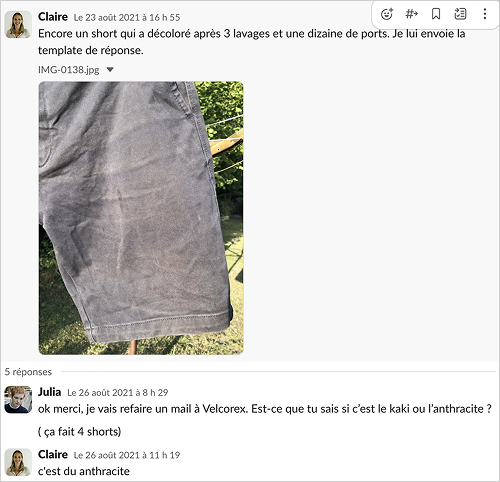
And these are the same factories you see over and over again in TV reports to show that clothes can still be made in France. They often carry the “Entreprises du Patrimoine Vivant” label (a French state label for heritage craftsmanship), and rightly so: they are the guardians of know-how that is disappearing by the day. But for how much longer? Many of them are in serious difficulty today, like Velcorex in the Vosges mountains, in eastern France, or Lemahieu in the Nord département, in northern France12.
And what about those 14 billion of clothing exports sometimes mentioned in the media, where do they come from? Part of it is down to luxury, but otherwise it’s mostly re-exported clothing: the big French brands (Kiabi, Décathlon and so on) store clothes made abroad in their French warehouses, then ship them to their shops abroad to sell them there. As INSEE, the French statistics office, points out13, 75% of French textile exports come from imports.
In other words, France’s everyday clothing industry has almost entirely disappeared… and many of the remaining factories are in serious trouble. In short, we have almost completely offshored an industry that covers what you’d think was a fundamental need of the population: getting dressed.
Why did we lose our industry? Mainly because a garment is… soft.
2. Why France no longer has a clothing industry
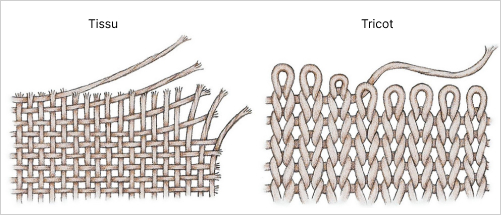
The textile industry makes soft, flexible objects, and that changes everything. Why? Because when materials are soft, nobody knows how to replace the human hand with a robot.
A quick reminder: making a fabric or a garment takes a certain number of steps:

All of these steps use machines, of course. But when you get to the last one, garment making, the machine becomes rather… modest:

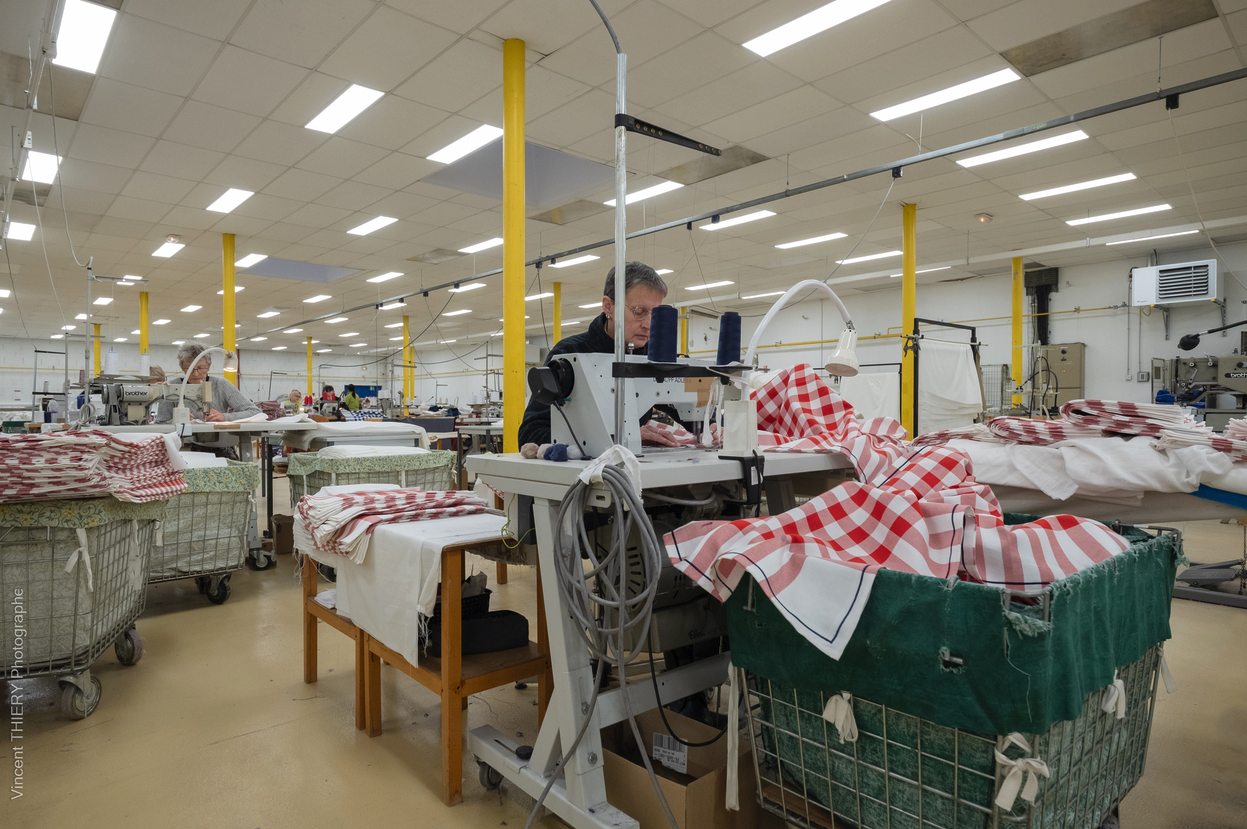
Yes, the sewing machine, and it takes a skilled seamstress or tailor to operate it. So unlike rigid metal or plastic parts that robots can grab and move around, only humans can put pieces of fabric together and sew them. It’s not for lack of trying to automate it: history is full of failed attempts to build robots that would do the sewing instead of humans. The Japanese state itself invested more than 100 million dollars in the idea in the 1980s14. Even DARPA (the US defence research agency) has invested in robotics start-ups to sew t-shirts15. But every time, these attempts came to nothing.
There’s no way around it: making a garment takes human labour, especially at the sewing stage. Sewing a t-shirt, for example, takes 5 minutes. For a pair of jeans, it’s almost impossible to get below 15 minutes16. So clothes were the perfect candidates for offshoring: they are easy to transport, they don’t perish and, since they need a fair amount of labour, there was a huge competitive advantage in moving production to countries where wages are very low.
So from the 1960s and 70s onwards, as soon as container ships made it possible to move goods around cheaply enough, the textile sector was one of the first to offshore. A trend you find in most Western countries.

The final blow came in 2005 (not so long ago!), when the Multi Fibre Arrangement came to an end: this set of rules had capped clothing imports to protect Western countries’ industries. Imports from Asia then soared18, and faced with this competition, what was left of the French textile industry was blown to pieces.

And the consequences are more serious than you might think.
3. The consequences of losing the clothing industry
Before we get to the consequences for France, let’s state the obvious: the problem with offshoring is first and foremost a problem for the countries we offshore to.
We politely say that we make things in “low-cost countries”, but you have to look closely at what that means: companies have moved their production to countries where wages are nowhere near enough to live on with dignity. In Bangladesh, for example, even with a 60-hour working week, the minimum monthly wage only reaches 38% of the living wage19, the income needed to cover all basic needs. So in concrete terms, having a t-shirt made there means that the workers, despite enormous hours, won’t be able to house themselves decently, eat their fill or pay for their children’s schooling: it’s a job that lets you survive, but not live. Working conditions there are so disastrous that the population recently rose up, in protests that were violently put down by the government20.
Not to mention that by offshoring production, we also offshored pollution (and even increased it, since environmental standards in these countries are often lower and less enforced than at home). Scandal after scandal has reminded us of this in recent years: rivers polluted by dye works21, endocrine disruptors released into the environment22, excessive lead levels in clothes23, to name just a few.
That is perhaps the main problem with this offshoring: it damages people and the environment in the countries that now do the manufacturing. And since it doesn’t happen at home, we don’t really feel concerned when we buy our clothes. Out of sight, out of mind.
With that said, and even if it’s a little self-centred, let’s talk about the consequences for France.
A- The social problems: not just unemployment
Unlike service companies, which cluster in big cities, factories need space and lower rents. So they tend to create jobs in rural areas and in small and medium-sized towns. Until the 1970s and 80s, France’s regions were covered with factories, each specialised in a different craft: spinning mills in the Nord, hosiery in the Aube, in north-eastern France, weaving in the Vosges…

When the factories closed, the jobs disappeared and never came back: most of the former textile areas (except the region around Lyon and Roanne) still have a higher unemployment rate today than the rest of France24. All the more so because when the factories closed, so did the bakeries, the cafés, the post offices, in short a good part of the local economy shut up shop.

But unemployment isn’t the only problem: jobs have also become more precarious. Working conditions in textile factories were often hard, but they provided relatively stable jobs (permanent contracts, basically) and sometimes career prospects, not to mention the social benefits that came with certain forms of industrial paternalism26 (education, housing, medical care…). Today, the jobs available in these former industrial areas have changed a lot, with contracts that are often shorter and more precarious27. Industrial jobs have been replaced by service jobs that are less valued, less well paid and often come with precarious working conditions. For example, logistics and transport jobs have risen sharply in the north and east of France28 (to caricature: instead of making things in France, we store and deliver the ones that come from abroad), with low wages, a high share of temp contracts and self-employed workers, unsociable hours for drivers... And as in many rural areas with an ageing population, more and more people work in care and home help, with very difficult working conditions (fragmented hours, very low pay…)29.
And beyond this precariousness, there is also the loss of social status. In the factories, people could build real, valued technical skills30. These jobs gave people genuine pride and a place in local society, all the more so because the clothes and fabrics they made were tangible objects, visible to everyone. And all of this within a rich local life, structured by the presence of the factories: a dense network of bars and cafés, workers’ football clubs, adult-education associations set up by the unions, and so on. Benoît Coquard, a sociologist who carried out a long study31 in eastern France, where many textile factories closed, gives a good illustration: “Industrial activity [...] offered a way to cultivate a shared sense of belonging that people could feel “proud” of. You were from this or that village, there were cafés and bars, associations, a factory just down the road.” Today, jobs in care, home help or logistics, despite their crucial role, carry less social value: they are less visible and no longer give people the same place in the local community. All these difficulties have ended up creating divisions within these areas themselves: people who are out of work or who go from one odd job to the next are heavily stigmatised. Benoît Coquard gives the example of the village football team that goes to an away match and gets called “the losers’ village”.
Beyond the social consequences, there is also the environmental side. We mentioned local pollution above, like discharges into rivers or the spread of endocrine disruptors, but that would be forgetting one form of pollution that knows no borders: greenhouse gases.
B- The environmental problems: let’s not forget CO2
A garment made abroad often emits far more CO2 than one made in France, because the energy that runs the machines in low-cost production countries generally emits far more greenhouse gases than in France and Europe. For example, a garment made in China, where electricity comes mainly from coal-fired power stations, emits twice as much greenhouse gas as the same garment made in France32.
But above all, beyond the pollution per garment, there is the problem of the growing number of garments being made. “Thanks” to offshoring, clothing prices have fallen and clothing consumption in France has more than doubled since the early 1980s33, reaching 40 garments bought per person per year34.

And producing means polluting: the textile industry’s greenhouse gas emissions have grown at roughly the same pace as production volumes. This increase in the number of garments produced is the main reason the textile industry is failing to cut its greenhouse gas emissions.
OK, fine, textile deindustrialisation was a disaster socially and environmentally, but at least it did our economy some good, right?
We could be content with having offshored an industry that isn’t all that strategic. Unlike food or pharmaceuticals, for example, the textile industry isn’t really essential. If we can no longer feed ourselves, we die. If we can no longer get treatment, we die too. But in a serious crisis, we have more than enough clothes in our wardrobes to survive for years, and we can always mend them36. Admittedly, the mask shortage during the Covid-19 pandemic gave textile factories a semblance of strategic importance. But generally speaking, as this report from the Haut Commissariat au Plan (France’s long-term planning body) points out, fashion products are not vital.
But in fact, while clothes as such aren’t strategic, the trade deficit they generate does end up being strategic.
C- The problems for our economy: the deficit and the risks that come with it
In 2023, we imported so many clothes from abroad that textiles and clothing generated a trade deficit of more than 10 billion euros for France, close to 20% of the country’s overall deficit excluding energy37.
Look back and the picture is even darker, because the textile sector has been in deficit for a very long time: since 1993, France has run up more than 240 billion euros of trade deficit on clothing alone38…
And these repeated trade deficits are not without consequences: to finance them, France has to borrow. And over time, that adds up to a lot of money. In 2023, our net debt to the rest of the world stood at 793 billion euros39: if it keeps growing, it could raise solvency risks for France and trigger a serious financial crisis40 (we are in fact getting close to the 35% of GDP warning threshold set by the EU’s macroeconomic imbalance procedure). And with its 240 billion of accumulated deficits since 1993, clothing bears historical responsibility for nearly a third of that debt. So clothes may not be “vital” or “strategic” products in themselves, but the absence of a clothing industry in France generates a debt that ultimately threatens our economy.
OK, we get it: the disappearance of the textile industry has caused a whole pile of social, environmental and economic damage… But does that mean the solution is to bring it back to France?
After all, the trade balance doesn’t have to be balanced line by line. We could instead choose to reindustrialise other, “higher value-added” sectors and leave textiles, which need more labour on the face of it, to the “low-cost countries”.
Roughly speaking, we could tell ourselves we’ll export Rafale fighter jets and import H&M t-shirts. An adviser to Bruno Le Maire (then France’s finance minister) said as much: “the industrial future isn’t in clothes, it’s in moving upmarket”41 42.
So should we just give up and admit that our textile industry is doomed for good?
4. Should we bring clothing manufacturing back to France?
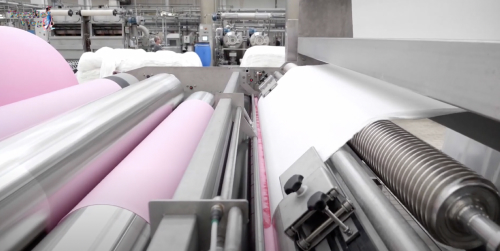
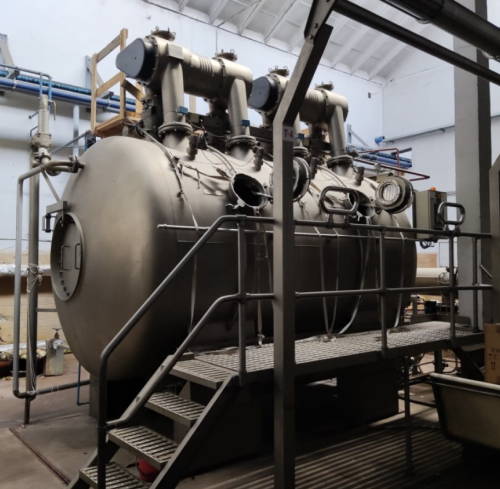
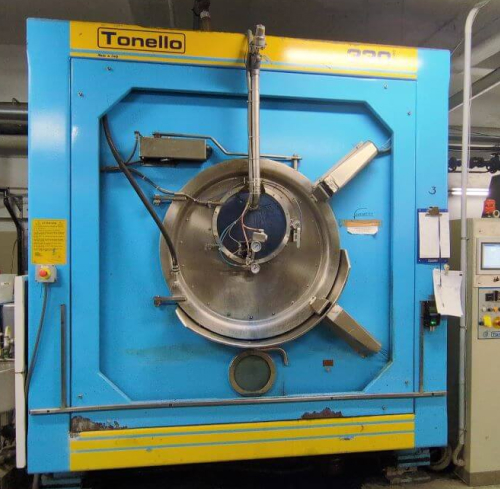
To answer that question, we need to go back to the basics of industry: machines. We talked above about sewing machines, which need a lot of labour. But that’s only the final stage of making a garment. For the upstream stages, the textile industry uses far more imposing machines. Such as:


And year after year, these machines get more and more sophisticated. As a result, in the upstream stages of garment making, labour costs no longer weigh that much compared with the cost of raw materials, machines and the energy to run them.
Today, in theory, the cost gaps between Western countries and low-cost countries are no longer that huge. In a 2018 study43, the federation of textile machinery manufacturers calculated the theoretical cost difference for a fabric between various countries, assuming the factories were equipped with the latest machines. Under those conditions, a metre of fabric made in China would cost only 24% less today than one made in Italy. Because even in Italy, where labour is expensive, it would represent only a small share of the total cost:

In the future, with machines improving all the time, energy costs rising and labour costs climbing in some emerging countries, this gap will only shrink.
Seen this way, the textile industry today doesn’t look so different from other sectors like chemicals, cars or aerospace: labour is part of the cost, but not the biggest part. With the best machines everywhere, at every stage of manufacturing, it would be possible to make up for Western countries’ weaker “price competitiveness” with better “non-price competitiveness”: better quality, for example, faster response times, closer geographical proximity or better knowledge of the market. That, by the way, is exactly what Italy has managed to do: it still has a very solid textile industry making fabrics for clothing.
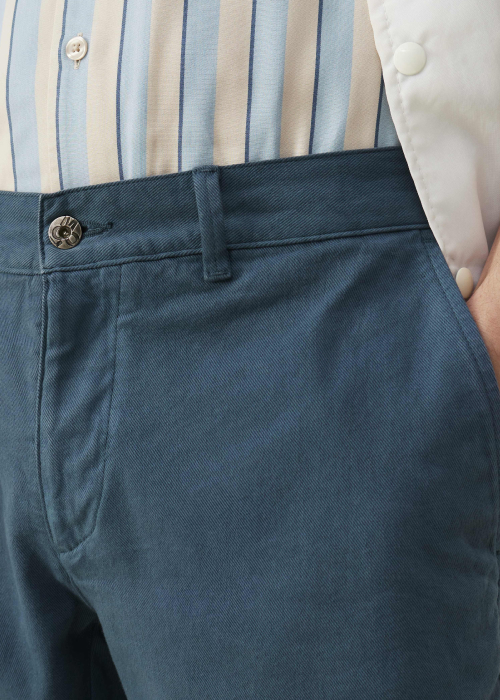
Admittedly, there is still the final sewing stage, which needs a lot of labour (remember, that’s the one with the sewing machines) and can still create big differences in price competitiveness. Sewing shirts or trousers, for example, takes so much time that it’s very hard to reach acceptable costs in France44. But not all garments need that much sewing time: sweaters, socks or even t-shirts, for instance, can be made locally without costs going through the roof. And above all, it is perfectly feasible to send fabrics abroad for the sewing stage, as some brands already do in Portugal, for example (that’s what we do at Loom for our chinos). From an environmental point of view, it makes sense: the machines in the upstream stages are the ones that consume the most energy. Making the fabrics in France or Europe, with lower-carbon energy, reduces the textile industry’s greenhouse gas emissions.
In short, with all due respect to that adviser to Bruno Le Maire, believing that textiles are an industry of the past that should disappear, and that all we need to do is “move upmarket” to build rockets or semiconductors, is a pretty bad idea. In fact, we’ve been told for decades that French industry must specialise in high technology to survive: it has to be said that this strategy hasn’t paid off much. Trying to specialise in “high value-added” industries is probably an illusion if you don’t have the basic skills and no longer have an overall industrial culture. And isn’t it a bit naive to think that emerging countries will be content to make low-end goods? China and India are proving that they can succeed in the very highest technologies (aerospace and electric vehicles in China, for instance, space and semiconductors in India).
In reality, France needs to rebuild an industry for mass-produced goods too (not just luxury products), by investing enough in automation and robotics. That could be in food or cars, but also in textiles: whether in technical fabrics or the upstream stages of garment making, it can be done. This is what can reduce our trade deficit: instead of trying to “move upmarket” and sell things abroad (like planes or handbags), we can also make what we consume locally.
So how do we go about it?
To give the textile sector a second chance, we first need fairer rules of the game. Here’s why.
5. How to give the textile industry a second chance
In the many articles and reports on reindustrialising France, you often read the same things: we need to clear away the “layers of red tape”45, “cut production taxes”46, “steer public procurement”47...
All of that is partly true. But in textiles, we mustn’t forget the elephant in the room: clothing factories in China or Bangladesh produce at very low prices first and foremost because people there are paid poverty wages, because environmental standards are laxer or non-existent, and because the factories run on cheap, ultra-high-carbon energy (Russian gas in China or Bangladesh, for example). All of this skews the country-by-country production cost comparison we showed above: even if French factories run on state-of-the-art machines, the differences in social and environmental standards are such that the cost gap remains too wide.
In short, there is a “reward for bad behaviour”: a competitive advantage for doing things badly.

If we ever want to see a textile industry reappear in France, we first need to restore the conditions for fair competition with other countries. Ideally, low-cost countries would adopt social and environmental standards as ambitious as ours (or better!), but that is likely to take a long, long time... So in the meantime, we need to penalise, or even ban, imports of clothes made in countries with lower social and environmental standards.
That is also one of the conclusions of the recent report on reindustrialisation that Bruno Le Maire commissioned from industry expert Olivier Lluansi: “Our industry [...] suffers from a major competitiveness deficit. Not through any fault of its own, but because of unfair competition with the other continental powers, North America or Asia. Solving this situation through cost-cutting alone would mean giving up our social model or our environmental ambitions, or both. That is not acceptable. To get back to fair competition while standing by our values, we must reintroduce fair rules into international trade.”
In concrete terms, what would that look like as regulation? It all remains to be invented, but here are a few examples to start with:
- Widen the scope of France’s duty-of-vigilance law, which imposes financial penalties on multinationals that violate human and environmental rights. On the basis of this law, NGOs have filed complaints in France against brands that used cotton harvested by Uyghurs in conditions close to slavery. Shouldn’t the law be widened to target brands that produce in factories where the wages paid are too far below the living wage?
- Stricter conditions for access to the European market than today. The REACH rules already make it possible to ban imports of clothes containing certain chemicals. But couldn’t these rules be extended to keep the most polluting (or most "exploitative") clothes out of the European market? That is the aim of the future European ESPR regulation on product eco-design, provided it is ambitious enough…
- A “bonus-malus” (a reward-and-penalty scheme) based on the gap between the minimum wage and the living wage, a kind of “social border adjustment mechanism”. For example: if a brand produces in a factory where wages are only 30% of the living wage, the brand would pay a penalty to cover the remaining 70%. That penalty would be redistributed to brands producing in factories with better social standards. And it would put an end to brands using blackmail to keep wages low.
- An environmental “bonus-malus”, to financially penalise the least responsible clothes and favour the greenest ones, based on the environmental labelling of clothes (which assesses their impact in terms of carbon emissions, toxicity, water pollution and so on). But actually… you know what? This law already exists, and it was even passed unanimously by the National Assembly (the lower house of the French parliament) last March! The problem: to become law, the text had to be voted on by the Senate… and the National Assembly was dissolved in the meantime. So this law is now sinking into oblivion, but with the En Mode Climat movement, we are trying to fight to bring it back.

Would regulations like these be enough on their own to bring a clothing industry back to life in France? No. They are an absolutely necessary precondition for making our clothing industry more competitive, but sadly they won’t be sufficient.
When a forest has been almost entirely cut down, it doesn’t grow back overnight. To come back to life, the clothing industry will also need well-trained workers, entrepreneurs to set up or take over factories, civil servants who steer public procurement, brands that play the game by buying made in France, land made available by local authorities to build factories, and so on. We will also need a change in our consumer culture: because even with state-of-the-art machines and harmonised social and environmental standards, making a garment in France will cost more than in Bangladesh. So we will have to learn to live with less: accept buying fewer clothes, and mend them more often.
All of this will take years, decades probably. So to get there, as many people as possible need to share the same vision: bringing the manufacturing of the clothes we wear back home is highly desirable, but also entirely possible. France can learn to dress itself again, and it is in its interest to do so. What are we waiting for?
Illustration credit: Matthieu Lemarchal @tamieuh
And thank you to everyone who proofread the article: Olivier Lluansi, Anaïs Voy-Gillis, Antoine Camous, Karine Renouil Tiberghien, Flore Berlingen, Pierre Condamine, Maxime Froissant.
Who are we to say this?
You’re reading La Mode à l’Envers, a blog run by the clothing brand Loom. The textile industry is coming apart at the seams, and the planet is footing the bill. So whatever we manage to understand about this industry, we try to explain here. Because making clothes that last is good, but revealing, sharing and inspiring is even more powerful.
By the way, does Loom make clothes in France? Yes, some! At least the ones where we can offer acceptable prices even with French labour costs, in other words:
- Those that need proportionally little labour: socks, beanies, scarves, belts, some sweaters, some care products.
- Those on which other brands traditionally apply a very large margin, so we can stay competitive with a made-in-France version by cutting ours: sunglasses.
- Those whose fabrics are made in France and then sewn in Portugal: chinos, jackets, corduroy overshirts, swim shorts.
- Finally, some of our products are made partly with French linen, the only textile fibre we produce locally (along with wool): cotton-linen shirt, band-collar shirt.
The aim, of course, is to offer more and more of them. But to get there, we need the new regulations mentioned in the article above!
By the way, we never run ads: if you like what we write and want more, subscribe to our newsletter by clicking here. Promise: we’ll write to you once a month, tops.
Notes
1 : Source: FIMIF (a French made-in-France consumer association). Estimate confirmed by this DEFI IFM study in 2024.
2 : Whereas in the 1960s, almost all our clothes were still made in France (customs statistics show very few clothing imports at the time).
3 : Ouest France 2020
4 : Les Echos 2024
5 : Fashion Network 2024
6 : Figures from URSSAF (the French social security contributions agency) for textile APE codes (source). You sometimes also read the figure of 60,000 jobs for the textile and clothing industry in France (excluding leather). That isn’t quite what we get here with the URSSAF figures (36,000 + 31,000 = 67,000 jobs). That figure comes from a calculation by OPCO (the industry’s training body), whose scope isn’t exactly the same: it cross-references all APE codes with identifiers from the textile collective agreements. It is therefore more precise, but it doesn’t provide the textile / garment-making breakdown we needed here to make our point.
7 : Source: URSSAF
8 : 64% of leather goods made in France are handbags (source: INSEE).
9 : Le Monde 2019
10 : Further down we mention the 50 factories working on everyday clothing. If we assume 200 people per factory, which is already very optimistic, that makes 10,000 employees.
11 : 8,000 factories according to this report.
12 : Sources: Fashion Network and La Voix du Nord.
13 : INSEE report on Made in France.
14 : Source: Textiles and clothing: facing the challenges (“Textile et vêtement : faire face aux mutations”), OECD report, 2005.
15 : Why Robots Can’t Sew Your T-Shirt, Harris Quinn for Wired
16 : What is SMV in garments industry, Textile Scholars.
17 : Textiles and clothing: facing the challenges, OECD report, 2005.
18 : EU: clothing imports from China up 15% in January-February, Fashion Network (23/05/2006)
19 : Source: The Industry We Want
20 : Source: France 24
21 : Asian rivers are turning black. And our colorful closets are to blame, CNN 2020.
22 : Toxic Threads: the big fashion stitch-up (in French), Greenpeace 2012.
23 : Martin Weill’s documentary “Victimes de la Mode” (Fashion Victims), TMC 2022: lead levels measured at 4 times the REACH limit in a Shein garment imported into France.
24 : Unemployment rate, third quarter of 2021 according to INSEE: 10.0% in the Nord, 10.2% in the Aube, 8.5% in the Vosges vs. 7.9% in mainland France.
25 : Source: INSEE 2020: 29.7% unemployment among 15-64 year-olds in Roubaix. And with the collapse of Camaïeu, which had its head office in Roubaix, misfortune keeps piling up on a city that is, more than ever, a victim of low-cost textiles.
26 : For example at Boussac textile: schools were set up, nurseries opened near the factories, housing built, along with domestic-science schools and apprenticeship schools.
27 : “In 2017, the share of employees on a permanent contract was 44% in industry versus 28% in services. The industrial sector thus gives the middle class jobs that are both better paid and more stable” Source: (Accelerated) deindustrialisation: the role of macroeconomic policies (in French), François Geerolf and Thomas Grjebine.
28 : DARES journal Travail et Emploi, 2020 (DARES is the French labour ministry’s statistics department): “Given the labour requirements involved, areas [...] in industrial decline are targeted as a priority, so that logistics becomes a favoured development strategy for revitalising so-called distressed areas. In northern France, in the east along the border, in the greater Paris area and in the Rhône basin, working-class employment areas with a strong logistics component have thus taken shape.
29 : “Doing home care” in the countryside: professional identities of home helpers for the elderly in rural areas (in French), 2023.
30 : Textile professionals: building a proud self-awareness (in French), Françoise Faye, 2005.
31 : Benoît Coquard, Ceux qui restent (Those who stay: making a life in declining rural areas) (La Découverte, 2019).
32 : Assessment of Carbon Footprint for the Textile Sector in France, Cycleco, February 2021: 20.90 kg CO2eq per kilo of textile made entirely in France vs 43.43 kg in China.
33 : In 1984, clothing consumption in France was 1.3 billion items, so 23 garments per inhabitant. Source: 1984 INSEE survey of 7,500 households. Today it stands at 2.7 billion garments according to Refashion, the industry’s recycling body.
34 : Source: Refashion 2022 activity report. 3.3 billion * 83% clothing / 67.8 million inhabitants * 99% = 40 garments per inhabitant. Add shoes and household linen and you get almost 50 textile items per French person.
35 : Source: FRED Economic Data.
36 : Governments in countries at war actively encouraged clothing repair, by the way: see the Make Do and Mend campaign in the United Kingdom during the Second World War
37 : Cumulative textile + clothing deficit since 1993 according to French customs (excluding leather) (source).
38 : Source: French customs, calculations in this document.
39 : Our trade deficits help widen our current account deficits (which also take into account trade in services, among other things). Over time, this generates external debt, technically known as France’s “net international investment position”. The fact that it is negative means that foreigners hold more assets in France than French residents hold abroad. More information on the Banque de France website.
40 : “The international investment position makes it possible to assess a country’s risk of experiencing a financial crisis in the short term (a sudden drying-up of liquidity) or the long term (risk of insolvency), in line with the analytical methods generally used by international organisations". Source: The international investment position: measurement and usefulness for monetary policy and financial stability (in French), Banque de France, 2003.
41 : Marine Le Pen and Eric Zemmour sketch out their economic proposals at the Made in France trade show (in French), Ivanne Trippenbach for Le Monde (15/11/2021).
42 : This belief in moving upmarket is in line with the position of the 2012 Gallois report, “Pact for the competitiveness of French industry”, whose second part is titled “An industrial ambition: moving upmarket”.
43 : Source: IPCC 2018
44 : To give you an idea: a shirt takes around 30 minutes of sewing time, so with an hourly labour cost of almost 40 euros in France, that would come to €20 of production cost for French labour alone. Apply a classic brand multiple (x5) and that makes €100 just for this stage.45 : Reindustrialisation: why France has everything it takes to succeed (in French), Augustin de Romanet for Le Cercle des Economistes (27/11/2023)
46 : Bruno Le Maire: “Cutting production taxes is one of the conditions for reindustrialising France” (in French), L’Opinion (07/10/2022)
47 : Reindustrialising France by 2035 looks more like guerrilla warfare than a “Blitzkrieg” (in French), Solène Davesne for L’Usine Nouvelle (08/06/2024)


